Hiển thị các bài đăng có nhãn 1966. Hiển thị tất cả bài đăng

Thứ Hai, 2 tháng 3, 2015

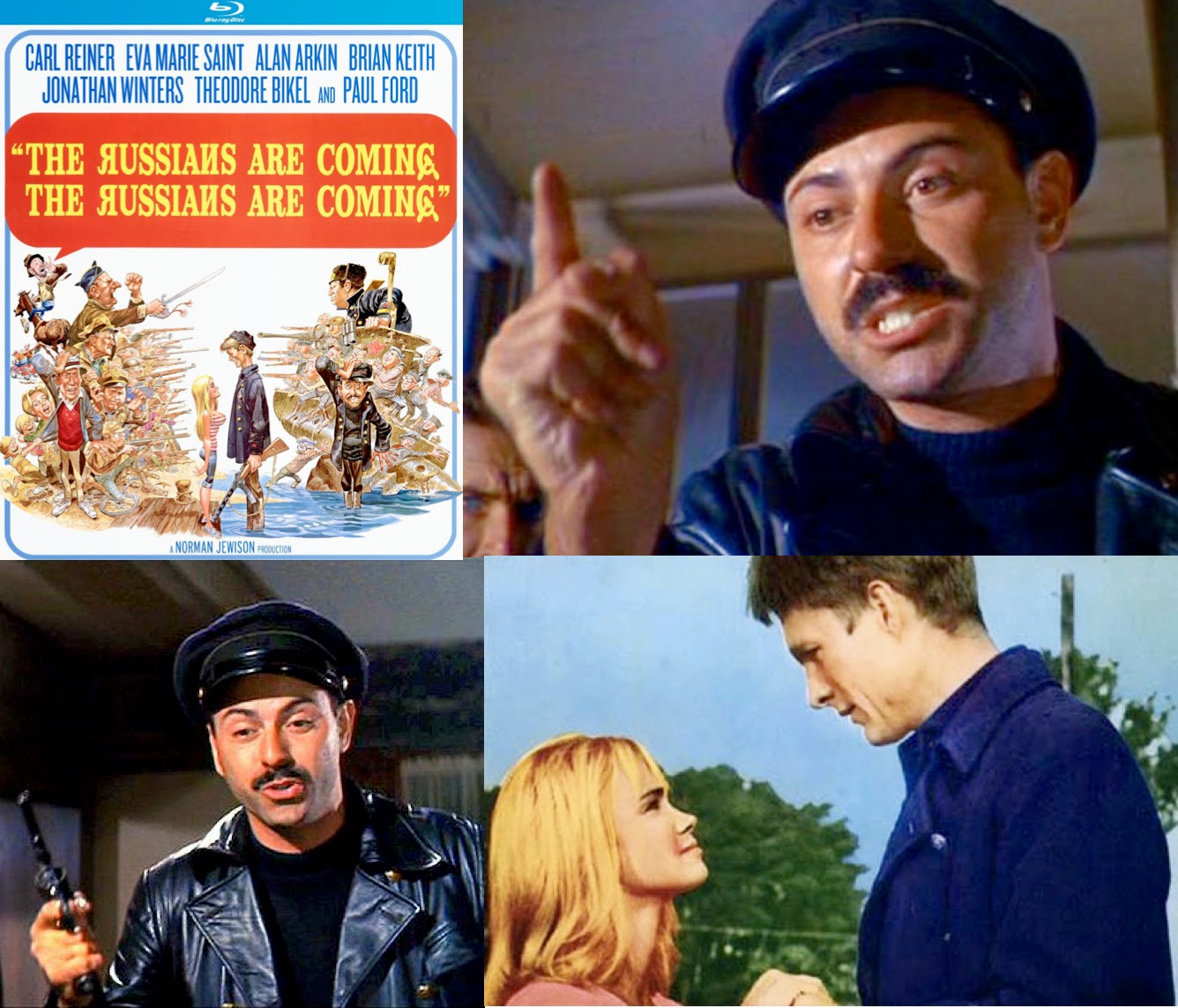
THE RUSSIANS ARE COMING, THE RUSSIANS ARE COMING - Review By Greg Klymkiw


The Russians Are Coming, The Russians Are Coming (1966)
Dir. Norman Jewison
Starring: Carl Reiner, Eva Marie Saint, Alan Arkin, John Phillip Law,
Theodore Bikel, Andrea Dromm, Jonathan Winters, Brian Keith, Paul Ford, Ben Blue

Review By Greg Klymkiw

In Cold War America, the most terrifying mayday imaginable was, no doubt, the title of Norman Jewison's 1966 hit comedy The Russians Are Coming, The Russians Are Coming (a play on the wild ride Paul Revere cry during the American Revolution against Britain). These days, with Vladimir Putin's illegal annexation of Crimea and his violent takeover of Eastern Ukraine, in addition to the threat Russia poses to all former Soviet countries, this might not seem like a laughing matter.

However, during the 60s, with the hysteria of Senator Joseph McCarthy's targets of his witch hunts still fresh in the minds of rednecks as a genuine threat to freedom, the reality of the Cuban Missile Crisis and the government's own rallying promotion of a survivalist mentality, replete with Duck and Cover-styled educational films and the building of fallout shelters in many backyards, the threat of a Russian Invasion upon their own soil was firmly lodged in the minds of Americans from coast to coast. That a Canadian director with seemingly liberal leanings would tackle this threat with humour was more than a little bit subversive, especially within the context of being a major studio production.

Jewison's comedy, however, captured the hearts and tickled the funny bones of Americans and the world. At the time, his grand farce seemed to border on black humour, if not outright cutting edge satire, but perhaps the passage of time has been the much needed balm to assuage our responses and appreciate it for what it really is - a sweet, funny clarion call for peace and understanding between nations all over the world.

In this sense, Jewison's film might well find whole new audiences receptive to its charms in a contemporary context.


Based upon Nathaniel Benchley's novel "The Off-Islanders", Jewison and his screenwriter William Rose, fashioned the sprightly, if not downright silly fable involving a dim, pig-headed Russian submarine Captain (Theodore Bikel) who wishes to grab a glimpse of America and upon getting too close to a New England island, it runs aground on a sandbar. Somewhat embarrassed, the Captain decides it's best to quietly dispatch a group of men on shore to "borrow" a tugboat to pull the sub back into open waters.

Leading the pack is Lieutenant Yuri Rozanov (Alan Arkin). Seeking the "forced" assistance of Walt Whittaker (Carl Reiner) and his family, what should have been a quiet operation turns into a crazy mobilization of island forces against the friendly Russians. Loaded with slapstick and hysteria, a veritable mini-World-War-III threatens to erupt, but in the course of all the complicated chicanery, the film offers an opportunity for Russians and Americans to come to new understandings, friendships and yes, even romance.

The film alternates between cleverly sending up the differences between the two cultures, but also tends to overdraw the redneck American knee-jerking patriotism. The latter is hardly a flaw. It's perfectly in keeping with the period and in a strange way, it doesn't actually seem dated at all. In fact, I can imagine a contemporary remake actually painting even broader portraits of bloodthirsty American Tea Party types rallying against a foreign horde of perceived invaders.


Jewison expertly handles the huge cast and subplots with his typical high level of craftsmanship and anything for a laugh sense of humour. The acting varies from straight-up to wildly over-the-top, but the real treat here is Alan Arkin in his first major movie role. He's got stardom written all over him and you'd think he'd been making movies for years.

He's that good!

Of course, so is the movie!

THE FILM CORNER RATING: ***½ 3-and-a-half-Stars

The Russians Are Coming, The Russians Are Coming is available on Blu-Ray via Kino-Lorber and includes a very interesting and lively making-of featurette with director Norman Jewison.

Thứ Bảy, 28 tháng 2, 2015

A FUNNY THING HAPPENED ON THE WAY TO THE FORUM - Review By Greg Klymkiw


A Funny Thing Happened On The Way To The Forum (1966)
Dir. Richard Lester
Starring: Zero Mostel, Phil Silvers, Michael Crawford, Buster Keaton,
Jack Gilford, Michael Hordern, Leon Greene, Roy Kinnear, Peter Butterworth,
Bill Kerr, Jon Pertwee, Annette Andre, Patricia Jessel, Inga Neilsen, Ingrid Pitt

Review By Greg Klymkiw

So what happens when the Borscht Belt comes to ancient Rome? You get one of the funniest, naughtiest and most delightfully low-brow musical-comedies you're going to see in some time. What's especially wonderful about the 1966 all-star film adaptation of the hit Broadway play A Funny Thing Happened On The Way To The Forum is that it jettisons a huge whack of Stephen Sondheim's songs in favour of only the very best stuff, rearranges and sharpens the plot via screenwriters Melvin Frank and Michael Pertwee (originally written for the stage by Burt Shevelove and Larry Gelbart), tosses gags in your face that are so non-stop that the picture makes the Zucker-Abrams-Zucker (Airplane) comedies seem restrained and best of all, the whole thing bubbles with the styling of the wonderful director Richard Lester who brings his manic British New Wave approach that he popularized in A Hard Day's Night, Help! and The Knack.

All this contributes greatly to keeping the movie from being the hoariest knee-slapper imaginable. But don't worry, the picture is plenty hoary, in all the right ways. It's also (forgive me) whore-y, given the seemingly endless parade of scantily clad courtesans romping about.

Our leading man Pseudolus (Zero Mostel) is a slave in the home of the not-so-happily married couple Senex (Michael Hordern) and his ball-busting wife Domina (Patricia Jessel), low-level members of the Roman gentry who just happen to live next door to one of Rome's more infamous brothels. Luckily for us, the gentleman's sporting house is run by the irrepressibly anything-for-a-buck pimpus-erectus Marcus Lycus (Phil Silvers). Who in their right mind would dare resist Sgt. Bilko peddling flesh?

When Hero (Michael Crawford), the young, unmarried only-begotten son of Senex and Domina falls madly in love with Philia (Annette Andre), a virgin whore next door who's been auctioned to the highest bidder, the conqueror of Crete, Captain Miles Gloriosus (Leon Greene), Pseudolus comes up with a mad plan to win his freedom in exchange for hooking up our juvenile leads.

This, however, is easier said than done. After all, even well-laid plans go awry and Pseudolus has essentially been making his plan up as he goes along anyway. This is good news for the audience since the farce quotient escalates to deliciously ludicrous heights.


Shevelove, Gelbart and Sondheim's musical was deeply rooted in adapting ancient farces by the Roman playwright Plautus (251-183 B.C.). That these works were written BEFORE Christ and work, not only in the context of when the film was made, strangely working even better in a contemporary context, is a testament to both the film's screenwriters and Lester'd direction.

And the lines! Oh the magnificent lines, quips, throwaways and double-entendres! When Pseudolus first learns of Hero's love for "a common courtesan in the house of Lycus", Hero naively asks, "Is that bad?" and Pseudolus, with Zero Mostel's impeccable timing responds, "There's no way to make it sound like an achievement!" Then as Philia's considerable virtues are revealed, Pseudolus further quips, "An honest virgin! What a terrible combination!"

Upon learning that she can't be betrothed to Hero because she's been sold to the brutal Gloriosus, Philia identifies the mad Roman Captain as "the brute who raped my country, Thrace!" "He raped Thrace?" asks Psuedolus. "Oh woe!" she laments, "And then he came and did it again! And then again!" Pseudolus scratches his noggin, then cracks, "He raped Thrace, thrice?"

Oh, and it doesn't let up!

As the shenanigans get nuttier and ever-convoluted, the bon mots spew forth with even greater persistence. As the mad plan to put the juvenile leads together keeps getting scuttled, Hero whines, "For us there will never be happiness." To wit, Philia assuages he lover with, "We must learn to be happy without it."

And for this fella, I always bruise my knees from slapping them too hard as I howl madly at Captain Gloriosus approaching the brothel and ordering, "Arrange food, drink, entertainment, and a sit-down orgy for fourteen."

My God! It's the Catskills with Roman Columns!


I recall Pauline Kael complaining that Lester's style of rapid-fire cutting and occasionally skewed shots worked against the fixed proscenium of this sort of vaudeville-like humour. I'd normally agree with her (as I do in most things), but when she wrote the review, she had no idea how awful contemporary editing/filmmaking would become in terms of the old herky-jerky-wham-bam-thank-you-mam approach to mise-en-scene. Lester's approach is restrained compared to this. Also, given the clever rewrites of the material by the screenwriters, coupled with Lester's trademark style, A Funny Thing Happened On The Way To The Forum actually feels far ahead of its time.

Viewed today, the picture lives and breathes like a cool, almost-post-modern approach to proscenium-rooted musical comedy. Besides, when he needs to, Lester does indeed affix his camera to let the glorious dialogue play out in contrast to the more manic approach.

This is one fun and funny movie that's ripe for rediscovery.


THE FILM CORNER RATING: ***½ 3-and-a-half Stars

A Funny Thing Happened On The Way To The Forum is available on a gorgeous looking Blu-Ray via Kino-Lorber. It's extra-feature-free, which is a shame, since a nice commentary trek focusing up the historical roots of the production and how they work in the context of the film would have been a valuable accompaniment to the whole package.

Thứ Hai, 16 tháng 2, 2015

THE ASCENT and WINGS - Reviewed By Greg Klymkiw - Susan Sontag called Larisa Shepitko's harrowing anti-war film THE ASCENT "the most affecting film about the horror of war I know." Shepitko focused on suffering, slaughter and senseless strife and did so in a stunning allegorical portrait of Christ and Judas during the German occupation of Belarus. The movie was miraculously rendered under Communist oppression in the Soviet Union. With WINGS, Shepitko delivered a powerful, romantic look at Russia's fighting women of the Second World War in a post-war world. Shepitko's eye, like a mad pit bull's jaws, always clenched furiously on its quarry and never, ever let it go.

This is a perfect time to take another look at two films about war by the late Ukrainian filmmaker Larisa Shepitko (a protege of Dovzhenko and the wife of acclaimed director Elem Klimov). Ukraine has been at war with Russia since the Maidan revolution in Kyiv just over one year ago which ousted the Putin-backed gangster-President Yanukovitch. Since that time, Russia illegally annexed Crimea and organized an army of terrorists to take control of two provinces in Eastern Ukraine. In recent days, Tatars and Ukrainians in Crimea have suffered massive discrimination and even death, all Tatar and Ukrainian books in a historical Crimean library have been chucked into the streets and publicly burned, Putin is rallying his nation to publicly protest Ukraine's freedom and just yesterday, during peaceful rallies in Ukraine to celebrate freedom from Russia, Moscow-backed terrorists exploded a bomb in Ukraine's second-largest city Kharkiv which killed and wounded many innocent people. The farcical and cowardly EU-backed-and-negotiated truce might only instigate the break out of a large-scale war. Here are my reviews of The Ascent (Christian allegory set in WWII) and Wings (examination of post-war female soldiers) by Larisa Shepitko.


The Ascent (1977) *****
dir. Larisa Shepitko
Starring: Boris Plotnikov, Vladimir Gostyukhin, Sergei Yokovlev, Anatoli Solonitsin

Review By Greg Klymkiw

"Is there an antidote to the perennial seductiveness of war? And is this a question a woman is more likely to pose than a man? (Probably yes.) . . . No photograph, or portfolio of photographs, can unfold, go further, and further still, as does The Ascent (1977), by the Ukrainian director Larisa Shepitko, the most affecting film about the horror of war I know." - Susan Sontag, "Looking at War: Photography’s view of devastation and death", The New Yorker

Survival and sacrifice are at the forefront of Larisa Shepitko’s harrowing World War II drama The Ascent – only fitting since the film, at once simple, at the next complex, is ultimately an allegorical portrait of Christ and Judas in a world turned topsy-turvy by the senseless strife and slaughter during the German invasion and occupation of Belarus. That notion of faith, extracted as it is from the New Testament and applied to such issues as love and betrayal of country are completely at home within the context and backdrop so vividly and evocatively portrayed.

For the Ukrainian-born Shepitko, herself a student of Master Ukrainian filmmaker Olexander Dovzhenko, it is clear why this story resonated with her and why she applied such staggering Dovzhenkian compositions to the picture. Coming from Ukraine, a country and culture that had been under the yoke of occupation and suppression almost from its very beginnings and having been mentored by a brilliant filmmaker who himself had been repressed and censored by Joseph Stalin, the mixture of frank political material coupled with a story and central relationship derived from the opiate of the masses, is illustrative of Shepitko’s artistic bravery at such a relatively early stage of her career in the repressive Soviet regime that frowned upon anything that deviated from the State disavowal of all things based in faith.

The story is a simple one. It is also both tragic and compelling. Ultimately, however, it is the simple narrative backbone that allows Shepitko to inspire an audience’s engagement in the proceedings as well as opportunities for contemplation and reflection both during and after seeing the film.

Following a rag-tag band of partisans through the snowy steppes and forest of Belarus, we are introduced to our pair of mismatched protagonists, the hardened, practical Rybak (Vladimir Gostukhin) and the physically weak, but thoughtful Sotnikov (Boris Plotnikov) as they volunteer to journey through the bitter cold of the dangerous, Nazi-infested region to find food for the tired and starving freedom fighters. The journey begins to take, almost from the beginning, a series of increasingly disastrous and dangerous detours as Sotnikov becomes sicker with bronchitis and a bullet wound while Rybak becomes so intent upon survival that he begins to question all the sacrifices he is enduring. They both find themselves face-to-face with having to make the ultimate sacrifice for each other, those around them and most importantly, home and country.

Given that most of us are more than aware of the relationship between Jesus and Judas, it is also a testament to Shepitko’s cinematic storytelling prowess that we are still gripped by the proceedings in spite of having a good inkling of where the story will go. In fact, it is the inevitability of where things are headed that keeps us glued to the screen – we keep hoping against hope that the inevitable will be circumvented and, of course, Shepitko plays the portent with harrowing assuredness and style.

Interestingly, The Ascent is not dissimilar to another great Soviet war picture, Grigori Chukrai’s Ballad of a Soldier. On the surface, both pictures deal with soldiers who have a specific goal, but on their journey they face a series of obstacles and detours that painfully keep them from reaching their ultimate destination. The difference, however, is that Chukrai’s film (also full of lush, gorgeously composed exteriors in the Dovzhenkian mold) involves detours routed firmly in sacrifice wherein the central character is kept from visiting his destitute mother because he is continually sidetracked by being duty-bound to helping other people with their own challenges. In The Ascent, it is both betrayal and survival that provide the obstacles. This basic difference highlights why one picture feels romantic and the other is overwhelmingly tragic.

That said, The Ascent is equally powerful and perhaps even more so since the will to survive – at any cost – becomes so poignant. Sacrifice, which involves principles rather than that of the plight of individuals, takes The Ascent into (ironically) political territory that mirrors the struggles of everyone living within the Soviet system. As an audience we are forced to confront a system of repression (Soviet-ruled Belarus) that is also being occupied and repressed by a foreign aggressor (Germany). The enemy is sadly, from within and outside so that our characters are surrounded – almost in futility. The domestic collaborators with the Nazis are at once evil and altogether human. We understand the need to collaborate while condemning it at the same time.

Living in a system of repression like Belarus and under the yoke of a madman like Stalin, the Nazis provide a way out of the madness – an alternative to Stalin. Two of the supporting characters in this narrative are perfectly emblematic of this. One is a village elder (Sergei Yakovlev) who is a reluctant collaborator while the other is a local Nazi interrogator (Anatoli Solonytsin), a cold, practical bureaucrat. The former is a man who seeks safety in collaboration for his family and friends, while the latter is a pure opportunist – someone who is just as happy serving the dictator du jour (Hitler) as he would be engaging in a Stalinist purge. These dichotomous personalities brilliantly mirror Rybak and Sotnikov – especially since their journeys and the inevitable outcomes are so similar: suggesting, of course, that notions of sacrifice and betrayal, collaboration and resistance, good and evil are almost always grey areas in war, and in particular, within repressive regimes.

What is not a grey area in The Ascent is suffering – represented not only by the physical pain and death of violence, but by the land itself. Here is where Shepitko’s kino-eye is especially evocative. The bitter cold and the endless, bone-chilling whiteness of snow overwhelm all the exterior shots. One of the more intensely powerful moments involves Rybak dragging a sick and wounded Sotnikov through the snow – for what seems like forever – as Nazi bullets fly at them. Shepitko’s camera is like a mad pit bull’s jaws clenching at its quarry – it seems to never let go of these two men as they painstakingly make their way through the snow.

Throughout the film we see the actors enduring literal physical hardships. Seeing The Ascent again, I was reminded of the genius of Werner Herzog’s Fitzcarraldo, a movie that has suffered unnecessarily over the years due to the hype surrounding the mad German (and ethnically Slavic) director’s decision to force his own cast and crew to drag a riverboat through the jungle and over a mountain. When writing at an earlier juncture about Shepitko’s Krylya/Wings I was also reminded of Herzog – in that case, it was the documentary Little Dieter Needs To Fly. Visually, Herzog and Shepitko are very different. Herzog’s visuals in drama and documentary, while stunning, have the immediacy of cinema vérité while Shepitko is rooted in the classical, sumptuously composed imagery her mentor Dovzhenko was known for. What Shepitko and Herzog share, however, is an unflinching search for truth in image, and in particular, the use of truth in image in the telling of stories cinematically.

Speaking of sharing, it is also worth noting that some of the finest war films of all time were made under the Soviet system – many of which put the best American examples of this genre to shame. That said, Ukrainians appear to have directed the very best Soviet war films. Olexander Dovzhenko (Arsenal, Schors and his WWII documentaries), Sergei Bondarchuk (Destiny of a Man, War and Peace), Grigori Chukrai (Ballad of a Soldier, Cold Skies, The 41st) and Shepitko have powerfully and evocatively portrayed the horrors and even glories of war and share Ukrainian ethnicity. Perhaps it is coincidence, or perhaps it is worthy of further study. In any event, it is certainly worth noting. It is also worth reiterating that all the abovementioned filmmakers come from a country that has always been dominated and repressed by other powers. With The Ascent, it is finally survival and sacrifice that drives the picture and makes it a film that is haunting, unforgettable and tragic.

Ukrainians, it seems, and others who have lived under repressive regimes, have always known something about survival, sacrifice and war.


Wings (1966) dir. Larisa Shepitko
Starring: Maya Bulgakova

*****

By Greg Klymkiw

The romance of war has seldom been so heartbreaking than in the hands of the great Ukrainian-born director Larisa Shepitko who made this first feature after a few short films and studying under the watchful eye of fellow countryman and master film artist Oleksander Dovzhenko. What’s especially bittersweet is that Wings is set in a post-war Soviet world where the lead character Nadezhna (Maya Bulgakova) struggles to settle into a life of seeming normalcy and, compared to her career as a fighter pilot, complacency. Now in her fortieth year, she works as a schoolmistress and goes about her daily tasks with professionalism and commitment on the surface, but always yearning and dreaming of the days when she soared above the normal world – touching Heaven, surrounded by the billowy clouds and racing through the air, dipping and swooping like a bird of prey.

Shepitko, part of that breed of Soviet filmmaker that rejected the occasionally overwrought montage-heavy storytelling of the likes of Eisenstein, tells her delicate tale with the same kind of editorial restraint common to her generation. Favouring gorgeously composed tableaus and a stately pace, Shepitko aims her lens at the realism of Nadezhna’s life, but with such a keen eye that the commonplace becomes extraordinary.

And what is it about the “normal” that nags at Shepitko’s central character?

The bottom line is this: The girl just wants to fly high. But alas, it is not to be – Nadezhna’s place in servitude to the Soviet ideal is now in the shaping of minds – youthful minds that live in a peaceful world that cannot even begin to comprehend the horrors of war. Nor are her students (and most others – adults AND children) equipped to fathom the mad, youthful rush accompanying Nadezhna’s idealism which led her into the cockpit of a bomber and into the arms of a fellow high-flyer, a dashing young man who eventually dies in a fireball before her very eyes – an image that haunts her constantly.

Shepitko expertly juxtaposes the romance and tragedy of Nadezhna’s life during the war with a series of poetic flashbacks that always help move the story forward when the drabness of her current existence reaches its nadir. One of the more moving sequences has our protagonist watching as a group of schoolchildren in the local museum are shown a display devoted to her heroism during the war. With the love of her life long dead and a schlubish museum director vying for her attentions – Nadezhna’s own life has become a literal and figurative museum piece.

Her daughter Tanya, a ravishing beauty, has married a much older man and Nadezhna can only think of her long-lost lover and how this prissy egghead who cohabits with her progeny can only pale in comparison. While Tanya has married for love, Nadezhna’s lover died for love – not necessarily for romantic love, but for the romantic ideals and love of flying that he shared with her.

With such a pedigree, can anyone ever be good enough for Nadezhna’s daughter?

While Wings shares much in common with Dovzhenko and Grigori Chukrai (Ballad of a Soldier), this is, unlike the work of her male colleagues, a relatively contemporary film by a woman and about a woman, which builds towards a conclusion as soaring and heartbreaking as the one that ends Nadezhna’s story. Werner Herzog’s astounding 1997 documentary Little Dieter Needs To Fly still can evoke tears when one recalls the final images as the title subject has a dream come true. A similar and extraordinary sequence occurs at the end of Wings and delivers the kind of impact that only movies can bring when a dream comes true.

In both cases the wish fulfillment is endowed with both elation and heartache.

Shepitko firmly roots her character in a past that seems so far away and yet, truth and redemption are found in the reclamation of that past – albeit a reclamation that embraces the present and includes an acceptance of the future.

Shepitko only made three features following this debut. Her life was tragically cut short in a car accident while on a location scout for what would have been her fifth feature.

Like Nadezhna’s dashing flyboy lover, Shepitko died while doing what she knew and loved best.

Great art and life are never that far apart, are they?

Wings and The Ascent are available in one set on Criterion's Eclipse DVD label
Thứ Ba, 11 tháng 2, 2014

THE BIG GUNDOWN - Review By Greg Klymkiw - Great "Lost" Italian Western now available on absolutely stellar 4-disc set of Blu-Ray, DVD, CD and CD-Rom from Grindhouse Releasing and available in Canada via the visionary VSC (Video Service Corp.) This undiscovered classic of Italian westerns is strangely and downright contemporary in its exploration of those who have (the Texicans) and those who do not (the Mexicans) and the huge gap between justice for the rich and justice (or lack thereof) for the poor.


The Big Gundown (1966) *****
Dir. Sergio Sollima
Scr. Sergio Donati and Sollima
Starring: Lee Van Cleef, Tomas Milian, Walter Barnes

Review By Greg Klymkiw

Does it get more basic than the hunter and the hunted in Sergio Sollima's rediscovered classic of Italian western cinema The Big Gundown? Well, on the surface, no, but this is a movie that works tremendously on several layers thanks to a character-driven screenplay by trusted Sergio Leone writer Sergio Donati, Sollima's stalwart, subtle direction with just the right flourishes the tale needs and a superb central performance by the Lee Strasberg-trained Cuban actor Tomas Milian as Cuchillo, a Mexican wanted for the rape and murder of a 12-year-old girl.

The Hunter is one Jonathan Corbett, played by Lee Van Cleef, the steely-eyed "Bad" of Leone's The Good, The Bad and The Ugly. (The moronic ads for the truncated, dubbed American version of The Big Gundown referred to Van Cleef as "The Ugly", the role played in Leone's film by Eli Wallach.) Here, Van Cleef plays a bounty hunter with a difference. He's a man of business who's supplemented his obsession with tracking down and cleaning up the scum of Texas with the proceeds of a saloon he owns. Corbett has NEVER accepted bounties for his quarry and the tale begins when Brokston (Walter Barnes), a powerful land baron, offers Corbett a political career as a Senator on a platter. The prospect of continuing to do the very best for Texas in his august years, without roaming the plains in search of bad guys, is extremely appealing - especially since Corbett recently lost his business holdings in a poker game gone awry.

Brokston, of course, needs one thing from Corbett - a promise that he'll go to Washington and smooth over the magnate's designs upon building a railroad from the U.S. of A. to Mexico. This will make Brokston rich beyond his wildest dreams and though Corbett makes it clear, he's not in the business of making anyone rich, he believes this railroad will be good for Texas, so he agrees to the generous offer. There is, however, one more job Corbett needs to do. A savage sex killer has taken the life of a little girl and there is, to Brokston's mind, only one person who can bring the filth to justice.

With thoughts of a Senate position dancing across his cerebellum, Corbett sets out in search of the aforementioned Cuchillo. Where the narrative deviates from the usual cat and mouse of such a mission, is the political context with which the story is layered. The film is strangely universal and downright contemporary in its exploration of those who have and those who do not and the huge gap between justice for the rich and justice (or lack thereof) for the poor.

Cuchillo turns out to be far more than the garden variety bounty and Corbett is faced with an adversary who manages to outwit him at every turn. Most importantly, Corbett becomes oddly enamoured with the wily sex maniac outlaw - not just because of the bad guy's prowess at getting away, but the lengths to which Cuchillo goes to stay several steps ahead of the law. Most of the hardened criminals Corbett has dealt with are either too stupid and/or tired enough to know when they're beaten and eventually succumb to capture or death, whichever comes first.

Not so, here. Cuchillo is a formidable quarry and damn likeable. He also could have well dispatched Corbett quite handily on several occasions if he so chose to, but he doesn't. Something's definitely rotten in the State of Texas and as the hunter and hunted proceed with the cat and mouse game, Corbett realizes there's more here than what appears to meet his steely eyes.

Though the movie never goes out of its way to hammer home the tale's political implications in a didactic manner, the delineations between rich and poor definitely give the movie the sort of weight truly great westerns are imbued with. As a director, Sollima never gets caught up in his own style and/or cleverness. He tackles the proceedings with yeoman attention to spinning a good yarn first and only indulging in flourishes that are as breathtaking as they are absolutely necessary to advancing the narrative and/or expressing important elements of character.

There are, for example, any number of reveals, pull-backs, cutaways and smash cuts that do knock us on our ass, but nothing ever feels like the sort of style over substance frissons that, say, Leone indulges in with completely over-the-top frequency (albeit stunningly and operatically).

The Big Gundown is also blessed with an Ennio Morricone musical score that might well be one of his very best. There are any number of stirring moments when image, narrative and music combine expertly to create moments of nail-biting suspense as well as gonad-gooseflesh-stirring drive and emotion. The ballad and central theme by Morricone are, frankly, as hummable and unforgettable as anything the great composer ever wrought.

The Big Gundown is finally, without a doubt, one of the greatest westerns ever made in Italy and an extremely worthwhile picture for both film and genre aficionados.

What's truly wonderful here, is that Grindhouse Releasing's complete package (in Canada via VSC) is as first-rate as the very best home entertainment releases from, say, the Criterion Collection label. The wealth of interview material is staggering and deeply enriching, the international marketing media galleries are thoroughly overwhelming and what you get with this package is more than worth its price tag.

There are four - count 'em - FOUR great discs: a gorgeous Blu-Ray of the original director's cut in Italian, the English language and runcated American release version on Blu-Ray, a DVD version of the film which includes a superb CD-Rom supplement that painstakingly takes you through the very interesting differences of the European and American versions and, for lovers of great music, a gorgeous CD of Morricone's soundtrack.

Seeing Sollima's unexpurgated original film would have been quite enough for me, but I have to admit that I was so blown away by the movie that the supplements more than provided the kind of added value material that not so much enhances the experience of seeing the film, as it expertly provides a magnificent combination of scholarly and practical materials that allow you to marvel at the film's artistry and importance.

A gorgeous and nicely written glossy booklet, a nicely designed jacket and slipcase, an attractive and nicely navigable menu plus a delicious bonus of numerous 60s/70s Euro-Grind trailers all contributes to making Grindhouse Releasing/VSC's disc one of the best home entertainment packages of this year.

Thứ Bảy, 8 tháng 2, 2014

TOKYO DRIFTER and BRANDED TO KILL - Review By Greg Klymkiw - Seijun Suzuki X 2 Seijun Suzuki for you Seijun Suzuki for one, for all, Hip Hip Hooray on Criterion Blu-Ray

Is the director of these movies
CLINICALLY INSANE?
You be the judge, jury and executioner!
Tokyo Drifter (1966) dir. Seijun Suzuki ***1/2
Starring: Tetsuya Watari, Chieko Matsubara, Hideaki Nitani

Branded To Kill (1967) dir. Seijun Suzuki ****
Starring: Jô Shishido, Kôji Nanbara, Isao

Reviewed By Greg Klymkiw

Nobody. Seriously. Nobody. Nobody. Nobody. Nobody - and I'm dead serious - NOBODY ever or will ever make crime pictures like the supremely stylish and (quite possibly) clinically insane Japanese maestro of strange gangster shoot-em-ups - Seijun Suzuki. In the span of a decade, Suzuki directed 40 - count 'em - 40 B-movies for Japan's Nikkatsu studios.

Suzuki's favourite setting was against the backdrop of the Yakuza and his pictures just got increasingly delirious as he continued to grind out one after another. He hit his peak with Nikkatsu in 1966 and 1967 with, respectively, Tokyo Drifter and Branded To Kill. The latter picture was so confounding, so over-the-top, so disinterested in narrative logic, that the studio fired him - even though he delivered consistent product that made money for Nikkatsu. He successfully sued the company for wrongful dismissal, but his high ideals and legal victory effectively blacklisted him from making a movie for over ten years.


Tokyo Drifter, shot in lurid technicolor and scope, is a pure visceral rollercoaster ride of violence and - I kid you not - includes musical numbers. Even John Woo in his Hong Kong prime NEVER delivered such inspired nuttiness and nastiness in one fell swoop of a cinematic bushido blade.

The plot, such as it is, involves a loyal hit man, Phoenix Tetsu (Tetsuya Watari) who respects and acquiesces to his mob boss' desire to go straight. However, Tetsu is one bundle of trouble and every rival gang is drawn to creating a nightmare for his boss. Tetsu does the only thing honour will allow - he imposes a strange self-exile and becomes a drifter; a man without a country, so to speak. Loyalty, only goes so far, however, and when he realizes he's been set-up as a fall-guy, there is hell to pay.

One action scene after another is shot in near-fluorescent colour with lurid, yet stunning backdrops. The guns blaze and the blood flows freely. I'm also happy to declare that the climactic shootout ranks way up there with all the greats.

Oh, have I mentioned yet that there are musical numbers?

Tokyo Drifter made absolutely no sense to the top brass at Nikkatsu and they demanded that Suzuki tone it down for his next movie. He agreed.

Then, like all great filmmakers, he lied.


The next picture was the hypnotically demented Branded to Kill. Shot in glorious widescreen black and white with wall-to-wall sex, violence and tons of delectable nudity, it told the tale of hit man Goro Hanada (Jô Shishido) who is currently rated as Killer #3. When he screws up a job, his status in the Yakuza is threatened and soon, he finds himself the target of several hit men and hit ladies (including his mistress and wife). And soon, he is embroiled in a cat and mouse dance of death with the almost-ghost-like Killer #1.

Like Tokyo Drifter, Branded to Kill has absolutely no need or respect for issues like continuity and narrative clarity. Suzuki can barely acknowledge the plot and in its stead, stages one brilliantly shot and choreographed action set-piece after another. If Luis Bunuel had been Japanese, not even he would have approached the surrealistic heights that Suzuki ascends to so dazzlingly.

Branded to Kill is populated with some utterly delicious babes - all of whom sport guns and remove their clothing a lot. Our hero Goro, is played by the suave, ultra-cool Jô Shishido. With his odd puffy cheekbones and wry expression, Shisedo invests his role with steely intensity. The movie oozes with style like lava chugging out of a roiling volcano. The stunning black and white photography is worthy of John Alton's great noir work and the movie is driven by a terrific score that blends ultra-cool jazz styling with Ennio Morricone-influence spaghetti-riffs with crazed orchestral action genre music as if performed by the Kronos Quartet on crack cocaine.

If the picture has one crowning glory (and frankly, it has many) it surely must be Goro's fetish for the smell of boiling rice. Any excuse Suzuki can give his hero to demand it and then sniff away with abandon he manages to find it. Sometimes, there isn't even a good reason for it. Sometimes, it's just the thing to do. Sometimes, a man's just got to sniff boiling rice.

This, I understand. I hope you do, too.

If not, go to Hell.

"Tokyo Drifter" and "Branded To Kill" have been released with mind-bogglingly stunning Blu-Ray transfers on the Criterion Collection label. Both films are replete with fine added content, but ultimately, it's the movies that count. These are keepers and belong in any self-respecting cineaste's collection.

Thứ Hai, 9 tháng 12, 2013

SECONDS - Review By Greg Klymkiw - Creepy Classic Psychological Thriller Comes Alive on Criterion Blu-Ray

ROCK HUDSON
UNMASKED
An upper-middle-class businessman has his identity erased, then transformed via cutting edge plastic surgery. He starts life over with a fresh persona. Gradually, he longs for his old life, but trying to go back might reveal a sad truth he'd never imagined and ultimately, lead to a fate he never bargained for.

Seconds (1966) ***** 

Dir. John Frankenheimer
Starring: Rock Hudson

Review By Greg Klymkiw

The myth of post-War prosperity in America created an endlessly compelling series of films within a variety of genres from the late 1940s and onwards, but for me, few are sadder, scarier and creepier than the great John Frankenheimer's chilling exploration of identity in a world seemingly bereft of genuine individuality. Based on John Ely's novel and superbly adapted by screenwriter Lewis John Carlino, we're introduced to a shell of a man, living in an upscale suburb with a wife he ignores, endless train rides to and from the city where he manages a bank and in spite of a very comfortable lifestyle, the surface trappings of his success merely mask a living death.

When he begins receiving telephone calls from a long-dead pal he is, at first, disturbed that someone would play this cruel practical joke on him until the voice on the other end of the line begins to reveal details that only his late pal would have known.

This is the middle-aged banker's chance to change his life.

You know, I've gotta say that if it were me, I'd be checking myself into a looney bin and/or visiting a priest or maybe, just maybe, I'd be looking for a better way to change my life. I, however, did not live in post-war America (though Gen-Xrs and beyond certainly suffered its influence in other ways) and given the after-effects of the horrors of World War II upon our fathers, the Korean War, the burgeoning Vietnam War, the Cold War and the horrendous assassination of JFK, maybe I too - like much of America then and now - would be looking for an easy way out.

Of course, what seems to come easy, always has strings attached. Though our banker friend falls for this macabre solicitation from the grave, he is plunged even deeper into a cruel and eerie existence that is as fraught with the surface trappings of prosperity as his previous existence yielded, but his inner life is also tinged with a surface gloss that eventually gives way to heartache and anxiety.

And believe me, the picture's been super-creepy and scary up to this point, but like any great thriller, things are going to get even more horrific than we'd ever imagined.


Seconds is a film that has so much going for it on every level. When scribes refer to "terse" direction, I'm not always sure they know precisely what they're on about, but I will say, from my standpoint that John Frankenheimer might well be the genuine grandfather of a directorial approach that's as concise and trenchant as one would hope for in genre pictures that are rooted in a boldly simple structure that allows for peeling back layers on thematic, narrative and stylistic levels that few have ever been able to genuinely master. Here, Frankenheimer seem to give almost free reign to the unparalleled cinematographer James Wong Howe (Sweet Smell of Success) to create one shot after another that, taken on their own, seem like masterworks of lighting and composition. Movement is almost always subtle and crisp, though one's memory always comes back to dynamic activity bordering on the slightly jangling. Even more evocative the use of wide-angle lenses and, in particular, the consummately ghastly fish-eye shots which we never seem to forget.

In spite of these flourishes, they're used sparingly and so many of the compositions - whilst gorgeous - are simple and there to serve both the blocking, narrative and emotion. This was a style Frankenheimer developed in earlier features, most notably The Manchurian Candidate, but part of me thinks, that like so many great American directors of the 60s and 70s he cut his teeth with the kind of abandon afforded so many writers, directors and producers during the truly "Golden Age of American Television" where Frankenheimer directed oodles of "plays for television".

One of his great works during this period was the "Playhouse 90" production of Rod Serling's The Comedian starring a malevolent Mickey Rooney who was never, before or after, so downright brilliant. This "teleplay" (a magnificent amalgam of cinema, theatre and even radio drama that was most often broadcast live before millions on premiere broadcasts) is so original and compellingly grotesque, that it's extremely interesting to watch it within the context of Frankenheimer's best work for the big screen during the 60s.

Of course, there isn't a single performance in Seconds that seems false or out of place, but the movie really belongs to the late, great movie star Rock Hudson. His sensitivity and vulnerability (so often on display in the numerous Doris Day romantic comedies as well as some of his greatest triumphs during the 50s) is uncanny here. Though Frankenheimer initially had hoped for the likes of Laurence Olivier in the role, it's impossible to imagine anyone other than this bonafide movie star. The notion of a formerly dullish, slightly portly middle-aged cog in the upper levels of the post-war machine transformed into this gorgeous, hunky, Marlboro Man among Marlboro Men, is not only a brilliant stroke of casting in terms of an audience connecting to this character, but the film so expertly builds the empty frumpiness of this person's earlier life that when Hudson keeps looking in the mirror, he expertly yields a strange combination of disbelief, elation and yes, sadness. Rock Hudson, quite simply and movingly, breaks our hearts.

For all the creepiness and suspense Seconds delivers, what makes it resonate with such force and deliver several jabs to our collective solar-plexes is the heartbreak, the swirling sadness, the tragic search for a place in a world where identity has been stripped from those who thought it was all going to be better.

It doesn't get more real than that.

"Seconds" has been given the royal treatment on the Criterion Collection Blu-Ray, but I urge you, as great as the accompanying materials are, watch the movie not once, but maybe even twice before you dive in. I didn't watch any of it prior to even writing the aforementioned and I can assure you this allowed me to experience the film on subsequent viewings with even more appreciation than I'd ever imagined was possible. Here are the disc's highlights: A stunningly restored 4K digital film transfer, with an uncompressed monaural soundtrack, a genuinely great commentary with Frankenheimer, a surpringly insightful interview withactor Alec Baldwin, excerpts from "Hollywood on the Hudson" TV show from 1965 that has on-set footage and a Hudson interview, a fine making-of with interviews from Frankenheimer’s widow and actor Salome Jens (who plays the film's "love interest"), a 1971 interview with Frankenheimer, a decent visual essay by film scholars R. Barton Palmer and Murray Pomerance and the de rigueur booklet that has the added value of a superb essay by movie critic David Sterritt.

Read my Review of John Frankenheimer's THE COMEDIAN, part of the Criterion Collection mega-box DVD set "The Golden Age of Television" HERE.

Thứ Tư, 7 tháng 8, 2013

LIGHTS! CAMERA! ELVIS! - Blue Hawaii, Easy Come Easy Go, GI Blues, Girls Girls Girls, King Creole, Fun in Acapulco, Roustabout, Paradise Hawaiian Style


The Lights! Camera! Elvis! DVD Collection: Blue Hawaii (1961), Easy Come Easy Go (1967), GI Blues (1960), Girls Girls Girls (1962), King Creole (1958), Fun in Acapulco (1963), Roustabout (1964) and Paradise Hawaiian Style (1966)

RATING OF COLLECTION: **1/2
INDIVIDUAL FILM RATINGS:
BLUE HAWAII: *
EASY COME EASY GO: *
GI BLUES: *
GIRLS GIRLS GIRLS: *
KING CREOLE: ****
FUN IN ACAPULCO: *
ROUSTABOUT: ***
PARADISE HAWAIIAN STYLE: *


By Greg Klymkiw

Paramount Home Video’s contribution to the recent glut of Presley celluloid on the market is a nicely packaged box set entitled: “Lights! Camera! Elvis! Collection”. It is precisely the packaging – a fancy blue suede box that holds the eight movies – which counts as one of two reasons to recommend picking up this title that exploits (I mean, commemorates) the 30th anniversary of the King’s deadly slide off the porcelain throne onto the cool slab of Memphis marble adorning the second floor of Graceland.

The second reason to pick up the box is the inclusion of Mr. Presley’s fine movie – the just-short-of-great King Creole. Based loosely on Harold Robbins’s best-selling pot-boiling trash-lit "A Stone For Danny Fisher" that serves, not surprisingly, as a solid structural coat-hanger to this stylish dark fabric of late-noir. It's a Michael (Casablanca) Curtiz-helmed studio picture that tells the tale of poor-boy Danny Fisher and his rise from the gutter and ultimate acceptance of his loving Dad while battling a sleazy gangster and having to choose between a life of crime or a life of song.

Featuring a terrific supporting cast, King Creole features the delectably sleazy Walter Matthau as the gangster-club-owner who makes Danny’s and pretty much everyone else’s life miserable, a sad and sexy Carolyn Jones as Matthau’s Madonna-whore moll with a heart of gold, a suitably pathetic Dean Jagger as Danny’s loser Dad and the radiant and utterly magical Dolores Hart as Presley’s main love interest. Better yet is Presley’s fine performance. His smouldering screen presence is palpable and he displays a wide range of emotion. If Col. Tom Parker had not so horribly bungled Elvis’s motion picture career, the King might well have joined the ranks of James Dean, Paul Newman and Marlon Brando as one of the truly great angry young men of 50s and 60s celluloid rather than the popular, but ultimately cartoon-like joke he became in later pictures.

The rest of the package is a woeful collection of some of Presley’s worst screen offences – some more risible than others, but risible nonetheless. From the standpoint of picture quality, this collection offers transfers ranging from adequate to first-rate. The lack of extra features (save for original theatrical trailers) is a bit annoying, but only King Creole really suffers from having no additional tidbits to add some informational cherries to the ample and tasty treat of the picture itself. It’d be great to try and score a commentary track (or even extensive interview) from Dolores Hart who, at the age of 25, left the fame and glamour of the movie business to become a nun in the Catholic Church. Even now, she apparently holds the distinction of being the only nun who is a voting member of the Academy of Motion Picture Arts and Sciences. I also think a scholarly commentary would be great with this picture especially since Curtiz’s direction is so first-rate and the late-noir style would also deserve some in-depth analysis.

The other movies in this box include one of Elvis’s biggest hits, the utterly ludicrous travelogue Blue Hawaii which has the dubious distinction of virtually no plot and an annoyingly over-the-top Angela Lansbury offering support. G.I. Blues is a plodding attempt to present Presley’s service experience in an entertaining fashion. Stella Stevens is mouth-wateringly gorgeous in Girls! Girls! Girls! but her character is such a sourball that one is not surprised that Elvis’s eyes may occasionally roam around at the constant bevy of beauties around him. Fun in Acapulco and Paradise Hawaiian Style are both dull and silly travelogues, while Easy Come Easy Gotries to mix it up with some deep-sea diving action to liven up the stale proceedings.

These titles are pretty woeful, but for some they might offer enough nostalgia appeal to warrant sitting through more than once. I, for one, was kind of hoping for at least some melancholic magic that’d bring me back to those halcyon days when I first saw many of these movies as a kid attending the Saturday matinees at a little neighbourhood cinema in my old hometown. Through the gentle haze of childhood recollection, I thought many of these pictures were really wonderful. Alas, they do not hold up to adult scrutiny. Elvis is always cool in the pictures, but it’s alternately depressing seeing this brilliant young actor in material that is so below his talents that all feelings of bygone warm and fuzzies dissipate pretty quickly.

Other than the terrific King Creole, the only other picture in this collection that might warrant more than one viewing is the solid, though unexceptional Roustabout that tells a tale of Elvis amidst some old-time carnies played with classic verve by Barbara Stanwyck and Leif Erickson. This is one movie that might have benefited from having someone or something resembling a director behind the lens as opposed to the dull-as-dishwater competence of John Rich who is, not surprisingly, a veteran television director. He’s a decent enough camera jockey, but it might have been nice to imagine this picture in the hands of someone like Don Siegel or Sam Peckinpah.

Now, I am sure that some might argue that the whole point of the Elvis pictures is to showcase the songs and the King performing them in a variety of locations. This might have been fine in the day, but it’s awfully hard to watch most of what’s in this box set after watching King Creole. It’s not only a good movie with a genuinely good Elvis performance, but the music is presented in a context that does not detract from the noir-ish world Curtiz creates, but actually works within it, not unlike the musical sequences in something like the classic Rita Hayworth picture Gilda. Among a whole mess o’ tuneful crawfish ditties crooned by everyone’s fave lipster, my personal delights were his renditions of the title track, “Trouble” and the get-up-and-boogie “Hard Headed Woman”.

And while this may be hard to believe, many of the other movies don’t actually feature Elvis’s best numbers. They’re always beautifully performed – his voice is smoother than smooth, but tinged with those occasional wild-man highs and lows that can send us to truly orgasmic places – however, many of the songs themselves just plain suck. There’s no polite way of saying it, so allow me to reiterate – they just plain suck! For example, the Blue Hawaii soundtrack features one – count ‘em – one truly legendary song (“Can’t Help Falling In Love”), but I am sure my life will be full if I never again have to hear “Rock-a-Hula Baby”. And yes, I know the album from this picture was probably one of the biggest albums of all-time, but that doesn’t mean most of the songs on it were any good. In G.I. Blues we get to see Elvis sing “Blue Suede Shoes”, but we also have to suffer through numerous musical mediocrities. This is pretty much the case for the rest of the pictures in this box set.

In summation, the “Lights! Camera! Elvis! Collection” presents an interesting look at how a brilliant young actor was used, abused and wasted – especially in light of the great work he displayed in King Creole. If you must own the blue suede box that houses the abovementioned titles, then feel free to pick this collection up. Otherwise, you might do better by just renting Roustabout and purchasing King Creole on its own or waiting until someone issues a special edition of this fine picture. Art thou listening Paramount Home Video? Do Elvis and his fans proud and get cracking on a tasty DVD gumbo of this fabulous movie.

8/28/07

Thứ Hai, 10 tháng 12, 2012

Greg Klymkiw's 10 Best Blu-Ray and DVD Releases of 2012 - There will be one new ALPHABETICAL posting everyday until we hit the magic number. Today's Klymkiw Blu-Ray/DVD Accolade for 2012 is: Alfred Hitchcock - The Masterpiece Collection from Universal Studios Home Entertainment

The Best Blu-Ray and DVD Releases
of 2012 as decreed by Greg Klymkiw

This was a stellar year for Blu-Ray and DVD collectors that it's been difficult to whittle my personal favourites down to a mere 10 releases. So hang on to your hats as I'll be presenting a personal favourite release from 2012 EACH and EVERY single day that will comprise my Top 10. At the end of all the daily postings, I'll combine the whole kit and kaboodle into one mega-post.

My criteria for inclusion is/was thus:

1. The movie (or movies). How much do I love it/them?
2. How much do I love owning this product?
3. How many times will I re-watch it?
4. Is the overall physical packaging to my liking?
5. Do I like the picture and sound?

There was one more item I used to assess the material. For me it was the last and LEAST area of consideration - one that probably surprise most, but frankly, has seldom been something I care that much about. For me, unless supplements really knock me on my butt, their inclusion is not that big of a deal. That said, I always go though supplements with a fine tooth comb and beyond any personal pleasure they deliver (or lack thereof), I do consider the educational value of such supplements for those studying film and/or those who might benefit from them in some fashion (film students or not).

So, without further ado, here goes.


Greg Klymkiw's 10 Best Blu-Ray & DVD Releases of 2012 (in alphabetical order) Today's Title (more to follow on subsequent days) is none other than: 


Alfred Hitchcock - The Masterpiece Collection (Limited Edition) Universal Studios Home Entertainment
15 (!!!!!) BLU-RAY Discs

This is the Blu-Ray release we've all been waiting for and it pretty much lives up to all the anticipatory slobber from movie geeks the world over. The 15 films that comprise this mega-box-set, presented on 15 individual Blu-Ray discs in the order of their original theatrical release dates are, for the most part, a stellar assortment. Here are brief capsule reviews of all the movies within this absolute must-own set.

SABOTEUR

"Totalitarian nations . . . get things done." 
Saboteur
(1942) ****
A solid hero in the dependable form of Robert Cummings, the delectable Priscilla Lane and vile villains of the juiciest order in this exciting espionage-tinged chase thriller inspired by Hitch's own 1934 The Man Who Knew Too Much. Noted for its bizarre expressionistic climax atop the Statue of Liberty. As the following clip from Saboteur demonstrates, the film was, politically ahead of its time, only now, in contemporary terms, the tables have turned and the totalitarian regime Hitch's hero might be fighting would be America itself:

SHADOW OF A DOUBT

"Horrible, faded, fat, greedy women."
Shadow of a Doubt 
(1946) ***** 
Utter perfection. One of the most chilling, disturbing & harrowing thrillers of all time with dollops of mordant wit plus an indelible sense of time & place - a seemingly pure, sun-dappled mid-western America. Best of all is Joseph Cotten as "The Merry Widow Killer", one of the creepiest serial killers in movie history - he's truly, utterly horrendous (and, for a time, quite charming). Written by Thornton (Our Town) Wilder, Sally Benson & Alma Reville (Mrs. Hitchcock herself as ludicrously rendered in the recent theatrical film Hitchcock & brilliantly played by Imelda Staunton in the HBO feature The Girl). It has, however, been said that Hitch himself wrote Joseph Cotten's famous dinner table speech. Take a gander at it here and . . . ENJOY!

ROPE

"I never strangled a chicken in my life!"
Rope ***** (1948)
Shot to approximate real time with no cuts (save for reel breaks). Based on the notorious Leopold/Loeb killings with Hume Cronyn's treatment, a script by Arthur Laurents (writer of, I kid you not, the Redford-Streisand weeper from the 70s: The Way We Were), memorably sickening John Dall & Farley Granger performances, first-rate thesping from James Stewart, expert Hitchcock blocking & his trademark expressionism in extremis. Here's a delectable taste of Rope's foul killers:

REAR WINDOW

"He likes the way his wife welcomes him home."
Rear Window
(1954) ****
For my first three decades on Earth, THIS was my all-time favourite Hitchcock movie. Eventually overtaken by Vertigo, it still delivers big time in the suspense department with fetishistic peeping tom qualities running rampant as invalided James Stewart spies on his neighbours and witnesses a murder. Raymond Burr plays one of Hitchcock's scariest villains.

THE TROUBLE WITH HARRY

"Mom! Wally's picking on me."
The Trouble with Harry (1955) ***
A mildly entertaining trifle of a black comedy that's not quite as dark as it wants to be. Buoyed by a tremendously sexy, funny, engaging and very young Shirley MacLaine, Jerry Mathers (Leave it to Beaver) and some stalwart character actors to make the whole affair a pleasure.
THE MAN WHO KNEW TOO MUCH
Que Sera, Sera 
WHATEVER
WILL BE
WILL BE
The Man Who Knew Too Much
(1956) ***1/2

Odd remake of Hitch's 1934 original with great suspense set pieces, a weirdly brilliant James Stewart and, in spite of occasional longeurs, can one ever go wrong with Doris Day a singin' ever-so sweetly? In a Hitchcock picture, no less.


VERTIGO
"I don't care anymore about me."
Vertigo (1958) *****
These days when people ask me what my favourite movie of all time is, I have no problem citing this one - but always with the added history of how it is a film I have grown with over the years. The more years, the more life experience, the more I related to the psychological intricacies, layers of character, its obsessive romanticism and the fetishistic qualities of moulding someone into precisely what you want. As creepy, chilling and suspenseful as Vertigo is, it's also deeply and profoundly moving. No surprise it's moved up in so many polls as the best movie of all time. It might well be. What I know for sure is this: Kim Novak's entrance in Vertigo is without a doubt the greatest entrance of any star, of any character, in any movie known to man - now and forever.
NORTH BY NORTHWEST
"That wasn't very sporting. . ."
North by Northwest
(1959) *****
The greatest mistaken identity espionage thriller of them all. Classy Cary Grant, suavely sinister James Mason and that ever-so deadly crop duster diving and aiming on a flat, bald prairie with no cover of escape.


PSYCHO
"I'll lick the stamps."
Psycho (1960) *****
Foul, vile and still astounding psycho-thriller that jangles the nerves with all manner of perversities and horror. The isolated motel. The blonde. The nervous young man. The screeching harridan mother. The taxidermy. The sandwich. The peep hole. The bathroom. The psycho. The blood. It seldom gets scarier than this. And the shower? The jets of refreshing water. The shower curtain. The malevolent shadow on the other side of the curtain. Scared the crap out of me the first time I saw the picture as a kid and still creeps me out.
THE BIRDS

The Birds (1963) *****
Gorgeous blonde.
Stalwart hunk.
Yummy Brunette.
Schoolhouse.
Children.
Thousands of birds that kill.
'Nuff said.


MARNIE

Marnie (1964) ***** Hitchcock's final genuine masterpiece of obsessive love with a great Tippi Hedren performance and a gloriously expressionistic mise-en-scene. Oh God, and that score, that score that sticks to one's brain forever.

TORN CURTAIN
Torn Curtain (1966) **** This espionage thriller is a mess and full of longeurs of the worst kind, but its flaws are overshadowed by several set pieces of suspense and violence that are up there with Hitchcock's best. There's a "kitchen" scene that seems to be a strange reversal, yet extension of the "shower" scene from Psycho that still shocks and horrifies even the most jaded contemporary viewers.

TOPAZ

"Flores para los muertos."
Topaz (1969) ** Bloated, dull spy thriller that's almost uwatchable save for a handful of decent set pieces.


FRENZY

A SACK O' POTATOES
Frenzy (1972) **** I love this sick, hilarious, shocking, brutal and terrifying thriller to death. There's a killer loose in London and he's into rape and necktie strangulation. The detective in charge is more sickened by his wife's grotesque gourmet cooking than the crime scenes he must pore over with a fine tooth comb. Even more perverse is the hero of the film who is so reprehensible that we almost find the necktie killer charming. And then, we have the potato truck scene.

FAMILY PLOT

Family Plot (1976) **1/2 Slight, mildly amusing thriller with a clutch of decent performances - especially from Karen Black and William Devane. It's not quite the last film one would have hoped for Hitch, but it's not without some merit.

Alfred Hitchcock - The Masterpiece Collection on Blu-Ray is ESSENTIAL to own. This gorgeously produced box set is not without some mild flaws, but overall it's a winner and a keeper. The sound and picture transfers range from okay at worst to mind bogglingly spectacular at best, The packaging is attractively designed, though a tad cumbersome in terms of the basic practicality of removing discs for play. And the extra features - the thing I usually care least about - are rendered here with such magnificent detail and considerable educational value that it's an element of the package worth touting.

PLEASE FEEL FREE TO ORDER THIS GREAT BOX SET DIRECTLY FROM THE LINKS BELOW (& GENEROUSLY SUPPORTING THE MAINTENANCE OF THIS SITE):