Hiển thị các bài đăng có nhãn 1958. Hiển thị tất cả bài đăng

Chủ Nhật, 15 tháng 12, 2013

SOUTH PACIFIC - Review By Greg Klymkiw - One of the GREAT movie musicals of all time !!!


South Pacific (1958) ****
dir. Joshua Logan
Starring: Mitzi Gaynor, Rossano Brazzi,
Ray Walston, Juanita Hall, John Kerr, Tom Laughlin, France Nuyen

Review By Greg Klymkiw

South Pacific is a great movie musical. Its detractors will have you believe it’s clunky, theatrical to a fault, hampered by poor casting choices and a waste of actual locations on the Hawaiian island of Kauai because of the aforementioned. It is none of those things.

In fact, it’s quite the opposite and I daresay it might well be one of the great movie musicals of all time and as thrilling and stunning a MOVIE musical as the best work of Vincente Minnelli, Rouben Mamoulian, Rene Clair and Busby Berkeley.

Based upon the huge Richard Rodgers/Oscar Hammerstein II Broadway success (first launched onstage in 1949 and recently afforded a highly acclaimed remount) and in turn taken from James Michener’s bestselling “Tales of the South Pacific” (recounting his own experiences in the Eden-like setting of the title), South Pacific charts the love lives of several characters who find themselves in a paradise on Earth. The main love story involves a vivacious female Navy Ensign and nurse, Nelly Forbush (Mitzi Gaynor), who is stationed, along with hundreds of other military personnel on an American island during World War II in order to prepare for an offensive upon the Empire of the Rising Sun and to keep an eye on the nearby Japanese-controlled islands.

A local French landowner and man of mystery, Emile De Becque (Rossano Brazzi), is courted by the U.S. navy to assist them with gaining access to one of these islands, the enchanting Bali Ha’i. The island, bearing two volcanoes and a bevy of beauties (male and female) and fresh fruits (edible, I would argue, in more ways than one) acts as a magnet for all these sailors, but is, alas, off-limits to them.

When a Hawaiian Earth Mother named Bloody Mary (the brilliant Juanita Hall) beckoningly sings of the island’s virtues to the young Lt. Cable (John Kerr) he, not unlike the other American seamen and women, is drawn to the “special island [where] the sky meets the sea”. And of course, before you can sing “Cockeyed Optimist” (one of the immortal Rodgers-Hammerstein songs in this musical), love begins to blossom between Nelly and Emile as well as Lt. Cable and Bloody Mary’s gorgeous daughter Liat (France Nuyen).


Bring on the bare-chested hunks and grass-skirted babes, please.

Volcanoes were made for erupting, mais non?

And eruption of the most pleasurable kind is what happens to me whenever I see this musical. Aside from the fact that it’s a pretty agreeable narrative with great characters and terrific tunes, what really get my juices flowing are Joshua Logan’s stunning and brave visual choices as a director.

Logan gets a bad rap from most film critics. Originally a stage director (and yes, he mounted the original Broadway production of South Pacific), Logan is often criticized for not using the medium of film in a “cinematic” fashion and that his attempts to do so are mistakenly labeled as clunky.

Here’s where I really have to disagree with my colleagues on the matter. In fact, the knee-jerk negative reaction to utilizing a proscenium-styled frame in film adaptations always gets this fella’s yarbles in a wringer. I love the use of proscenium, the tableaux approach if you will, as much as I love the dipping, whirling shots of Mamoulian and Clair, the kaleidoscopic, only-in-a-film stylings of Berkeley, the stunning splashes of colour in Minnelli (and most of the pictures out of Arthur Freed’s unit at MGM). The proscenium is only wrong if it’s done without passion and imagination. That’s not Logan’s problem at all.

Using the stunning 65-millimeter TODD-AO widescreen process he manages to create one of the strangest and I daresay imaginative visual hybrids ever created for a motion picture. Perhaps it’s the hybrid effect that stymies critics, but for many viewers, myself obviously included, the effect is always a treat – more so because it is rooted in the emotion of the narrative, the characters and the truly magical settings.
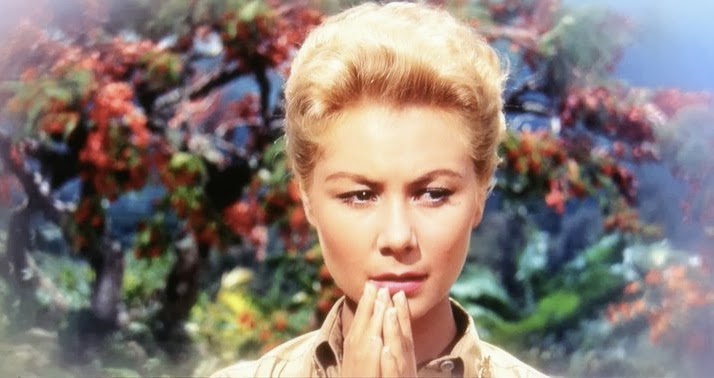

First of all, you get the intense clarity of the huge 65mm negative that delivers a truly widescreen image without anamorphic compression. Shooting on location, one gets all the real-thing backdrops instead of theatrical backdrops or, for that matter, the studio-bound backdrops of other musicals. Then, utilizing a variety of coloured filters, Logan brings movie magic to the proceedings wherein we can feel the filmmaker’s hand applying a wash of colour to transport us to a realm of Never-Never-Land so that we ALWAYS feel we’re watching a movie, and most importantly, a world within the movie that feels like a world unto itself. Blending this with stationary chorus line compositions, we get to see the beauty of the choreography and enjoy the various bits of business without a barrage of cuts and cutaways that purportedly move us emotionally through the action using a variety of shots at different lengths.

We get to experience all the action in as pure a form as the dance numbers in the RKO Astaire-Rogers musicals. Logan lets the action occur WITHIN his frames. He uses theatrical convention as one piece of his extremely rich visual palette. Logan makes us feel like we’re watching something we’ve NEVER seen before. Ultimately though, we have. By distorting the reality of the on-location settings with both cinematic and theatrical techniques, Logan ventures boldly into the world of expressionism that, frankly, feels perfectly apt for a tale that examines love and magic against the backdrop of war.

This directorial decision is a stunner. Then again, for anyone who loves Logan, it makes perfect sense. His occasional forays into the world of movies almost always yielded strange, uncompromising work. Picnic, his film adaptation of William Inge’s play still has the power to move and provoke while Bus Stop, also from Inge, is as funny and heartbreaking as any of Marilyn Monroe’s great work and Sayonara, a straight-ahead examination of American-Japanese relations and racism taken from writing by James Michener is one of the great dramas on these themes. Even his tremendous flop, Paint Your Wagon, is not without the expressionistic qualities of his best work – the mere thought of juxtaposing Harve Presnell’s outstanding vocal rendition of “They Call The Wind Maria” and Clint (I kid you not!) Eastwood half-singing, half-whispering, semi-rasping out “I Talk To The Tress” delivers the kind of satisfying gooseflesh very few movies are capable of.

The Blu-Ray release of “South Pacific” is a mixed bag. It features both the theatrical and Roadshow versions of the picture. Alas, the Roadshow version is presented from a solid, but definitely standard definition transfer – which is a real shame, since it adds footage that is not in any way, shape or form extraneous. That said, the shorter theatrical version is still a mind-blower and to see it in a high definition transfer is to experience a lifetime of orgasmic pleasure in one huge dollop. Also, the extra-features – including a terrific feature length documentary – are magnificent supplementary materials to an already magnificent motion picture. “South Pacific” is available in a special Blu-Ray release on the 20th Century Fox Home Entertainment label.

Thứ Tư, 7 tháng 8, 2013

LIGHTS! CAMERA! ELVIS! - Blue Hawaii, Easy Come Easy Go, GI Blues, Girls Girls Girls, King Creole, Fun in Acapulco, Roustabout, Paradise Hawaiian Style


The Lights! Camera! Elvis! DVD Collection: Blue Hawaii (1961), Easy Come Easy Go (1967), GI Blues (1960), Girls Girls Girls (1962), King Creole (1958), Fun in Acapulco (1963), Roustabout (1964) and Paradise Hawaiian Style (1966)

RATING OF COLLECTION: **1/2
INDIVIDUAL FILM RATINGS:
BLUE HAWAII: *
EASY COME EASY GO: *
GI BLUES: *
GIRLS GIRLS GIRLS: *
KING CREOLE: ****
FUN IN ACAPULCO: *
ROUSTABOUT: ***
PARADISE HAWAIIAN STYLE: *


By Greg Klymkiw

Paramount Home Video’s contribution to the recent glut of Presley celluloid on the market is a nicely packaged box set entitled: “Lights! Camera! Elvis! Collection”. It is precisely the packaging – a fancy blue suede box that holds the eight movies – which counts as one of two reasons to recommend picking up this title that exploits (I mean, commemorates) the 30th anniversary of the King’s deadly slide off the porcelain throne onto the cool slab of Memphis marble adorning the second floor of Graceland.

The second reason to pick up the box is the inclusion of Mr. Presley’s fine movie – the just-short-of-great King Creole. Based loosely on Harold Robbins’s best-selling pot-boiling trash-lit "A Stone For Danny Fisher" that serves, not surprisingly, as a solid structural coat-hanger to this stylish dark fabric of late-noir. It's a Michael (Casablanca) Curtiz-helmed studio picture that tells the tale of poor-boy Danny Fisher and his rise from the gutter and ultimate acceptance of his loving Dad while battling a sleazy gangster and having to choose between a life of crime or a life of song.

Featuring a terrific supporting cast, King Creole features the delectably sleazy Walter Matthau as the gangster-club-owner who makes Danny’s and pretty much everyone else’s life miserable, a sad and sexy Carolyn Jones as Matthau’s Madonna-whore moll with a heart of gold, a suitably pathetic Dean Jagger as Danny’s loser Dad and the radiant and utterly magical Dolores Hart as Presley’s main love interest. Better yet is Presley’s fine performance. His smouldering screen presence is palpable and he displays a wide range of emotion. If Col. Tom Parker had not so horribly bungled Elvis’s motion picture career, the King might well have joined the ranks of James Dean, Paul Newman and Marlon Brando as one of the truly great angry young men of 50s and 60s celluloid rather than the popular, but ultimately cartoon-like joke he became in later pictures.

The rest of the package is a woeful collection of some of Presley’s worst screen offences – some more risible than others, but risible nonetheless. From the standpoint of picture quality, this collection offers transfers ranging from adequate to first-rate. The lack of extra features (save for original theatrical trailers) is a bit annoying, but only King Creole really suffers from having no additional tidbits to add some informational cherries to the ample and tasty treat of the picture itself. It’d be great to try and score a commentary track (or even extensive interview) from Dolores Hart who, at the age of 25, left the fame and glamour of the movie business to become a nun in the Catholic Church. Even now, she apparently holds the distinction of being the only nun who is a voting member of the Academy of Motion Picture Arts and Sciences. I also think a scholarly commentary would be great with this picture especially since Curtiz’s direction is so first-rate and the late-noir style would also deserve some in-depth analysis.

The other movies in this box include one of Elvis’s biggest hits, the utterly ludicrous travelogue Blue Hawaii which has the dubious distinction of virtually no plot and an annoyingly over-the-top Angela Lansbury offering support. G.I. Blues is a plodding attempt to present Presley’s service experience in an entertaining fashion. Stella Stevens is mouth-wateringly gorgeous in Girls! Girls! Girls! but her character is such a sourball that one is not surprised that Elvis’s eyes may occasionally roam around at the constant bevy of beauties around him. Fun in Acapulco and Paradise Hawaiian Style are both dull and silly travelogues, while Easy Come Easy Gotries to mix it up with some deep-sea diving action to liven up the stale proceedings.

These titles are pretty woeful, but for some they might offer enough nostalgia appeal to warrant sitting through more than once. I, for one, was kind of hoping for at least some melancholic magic that’d bring me back to those halcyon days when I first saw many of these movies as a kid attending the Saturday matinees at a little neighbourhood cinema in my old hometown. Through the gentle haze of childhood recollection, I thought many of these pictures were really wonderful. Alas, they do not hold up to adult scrutiny. Elvis is always cool in the pictures, but it’s alternately depressing seeing this brilliant young actor in material that is so below his talents that all feelings of bygone warm and fuzzies dissipate pretty quickly.

Other than the terrific King Creole, the only other picture in this collection that might warrant more than one viewing is the solid, though unexceptional Roustabout that tells a tale of Elvis amidst some old-time carnies played with classic verve by Barbara Stanwyck and Leif Erickson. This is one movie that might have benefited from having someone or something resembling a director behind the lens as opposed to the dull-as-dishwater competence of John Rich who is, not surprisingly, a veteran television director. He’s a decent enough camera jockey, but it might have been nice to imagine this picture in the hands of someone like Don Siegel or Sam Peckinpah.

Now, I am sure that some might argue that the whole point of the Elvis pictures is to showcase the songs and the King performing them in a variety of locations. This might have been fine in the day, but it’s awfully hard to watch most of what’s in this box set after watching King Creole. It’s not only a good movie with a genuinely good Elvis performance, but the music is presented in a context that does not detract from the noir-ish world Curtiz creates, but actually works within it, not unlike the musical sequences in something like the classic Rita Hayworth picture Gilda. Among a whole mess o’ tuneful crawfish ditties crooned by everyone’s fave lipster, my personal delights were his renditions of the title track, “Trouble” and the get-up-and-boogie “Hard Headed Woman”.

And while this may be hard to believe, many of the other movies don’t actually feature Elvis’s best numbers. They’re always beautifully performed – his voice is smoother than smooth, but tinged with those occasional wild-man highs and lows that can send us to truly orgasmic places – however, many of the songs themselves just plain suck. There’s no polite way of saying it, so allow me to reiterate – they just plain suck! For example, the Blue Hawaii soundtrack features one – count ‘em – one truly legendary song (“Can’t Help Falling In Love”), but I am sure my life will be full if I never again have to hear “Rock-a-Hula Baby”. And yes, I know the album from this picture was probably one of the biggest albums of all-time, but that doesn’t mean most of the songs on it were any good. In G.I. Blues we get to see Elvis sing “Blue Suede Shoes”, but we also have to suffer through numerous musical mediocrities. This is pretty much the case for the rest of the pictures in this box set.

In summation, the “Lights! Camera! Elvis! Collection” presents an interesting look at how a brilliant young actor was used, abused and wasted – especially in light of the great work he displayed in King Creole. If you must own the blue suede box that houses the abovementioned titles, then feel free to pick this collection up. Otherwise, you might do better by just renting Roustabout and purchasing King Creole on its own or waiting until someone issues a special edition of this fine picture. Art thou listening Paramount Home Video? Do Elvis and his fans proud and get cracking on a tasty DVD gumbo of this fabulous movie.

8/28/07

Thứ Ba, 1 tháng 1, 2013

MISSILE TO THE MOON - Review By Greg Klymkiw - Glorious Retro Sci-Fi from the 50s (and it's chock-full o' babes!!!)


Missile to the Moon (1958) dir. Richard E. Cunha
Starring: Richard Travis, Cathy Downs, K.T. Stevens, Tommy Cook

***

By Greg Klymkiw

Truly great science fiction is rooted firmly in science fact. Missile to the Moon is just such a motion picture. Directed with passion and panache by the great Richard E. Cunha, audiences will thrill to the care and effort taken to plunge us into a celluloid world that reproduces – blow by blow – what it truly must be like to travel in space and to walk, ever-so-boldly on the surface of the Moon. What especially will blow your mind is the astounding accuracy of what actually exists beyond the boundaries of our atmosphere.

First and foremost is the painstaking attention to the details of what an actual space program must be like. Even though the picture was released in 1958, it’s so ahead of its time that one can only apply the word “visionary” to its awe-inspiring use of fact and fiction to transport us to a reality not quite achieved either before or after this picture was made. At the beginning of the movie, a group of scientists are seen on the cusp of sending a missile to the Moon. The chief scientist reveals to his colleagues his incredible rocket and while some might mistake it for a crudely carved phallus against a cardboard backdrop, they would be … well; uh … they would surely be mistaken. Many missiles look like phalluses (or is the plural “phallusi”?) and who really knows what anything looks like from the launch bridge of a place like Cape Canaveral. Unless one has actually been there personally, it might well all look like painted cardboard.

Secondly, how can one possibly ignore the accuracy with respect to security at the launch site? In a world where crazed terrorists can hijack passenger planes and fly them into buildings, surely it is possible to believe that the crew of the first missile to the moon could be manned by two petty criminals who wander into the top secret launch site and hide in the missile itself. In light of the realities of a world where Osama bin Laden continues to reign supreme and plot his revenge upon the infidel, does it not take a visionary like Richard E. Cunha to show how a missile can be manned by a scientist and his girlfriend who accidentally find themselves on the launch pad and eventually in the ship itself?

Thirdly, the travel into space itself is handled with customary adherence to fact – everything from the accurate use of seatbelts to the meteor shower of paper-mache-like boulders that threaten the missile and finally, how it does not really affect the missile’s use of fuel and/or resources to have several unaccounted-for passengers on board.

And last, but certainly not least is the stunningly accurate rendering of the Moon itself – a world where the rocks have arms, legs and pointy heads and appear to have been brought to life by Art Clokey himself, a world with giant spiders (and unless we’ve seen one up close, how do we know they don’t look like puppets?) and an entire race of babe-o-licious women who rule the Moon with firm, but gentle hands.

Is this picture a pile of crap? It sure is. But what a pile of crap! This is no guilty pleasure. One must feel pride in relishing every delightfully absurd moment of this undeniably entertaining movie that is so idiotic that, like the work of Ed Wood, it’s impossible to believe that Cunha and his collaborators had no idea of what they were doing. Of course they did, and for the good of the picture, and for entertainment value that has spanned the decades since its first release, Cunha and company delivered a fast, fun and insane little picture.

The Legend Films DVD is also a lovely way to see the picture. It presents both the black and white version and a colorized version in addition to the inclusion of some 50s TV commercials as extras. If truth be told, however, and in spite of the excellent colorization job, I preferred the black and white version, because the colorized version chooses to deliver all the babes on the moon with skin that is colored green. Green just doesn’t inspire the proper degree of manhood engorgement that the straight-up black and white rendering of the babes most certainly does. "Missile to the Moon" is available on DVD from Legend Films.

12/22/07

Thứ Hai, 10 tháng 12, 2012

Greg Klymkiw's 10 Best Blu-Ray and DVD Releases of 2012 - There will be one new ALPHABETICAL posting everyday until we hit the magic number. Today's Klymkiw Blu-Ray/DVD Accolade for 2012 is: Alfred Hitchcock - The Masterpiece Collection from Universal Studios Home Entertainment

The Best Blu-Ray and DVD Releases
of 2012 as decreed by Greg Klymkiw

This was a stellar year for Blu-Ray and DVD collectors that it's been difficult to whittle my personal favourites down to a mere 10 releases. So hang on to your hats as I'll be presenting a personal favourite release from 2012 EACH and EVERY single day that will comprise my Top 10. At the end of all the daily postings, I'll combine the whole kit and kaboodle into one mega-post.

My criteria for inclusion is/was thus:

1. The movie (or movies). How much do I love it/them?
2. How much do I love owning this product?
3. How many times will I re-watch it?
4. Is the overall physical packaging to my liking?
5. Do I like the picture and sound?

There was one more item I used to assess the material. For me it was the last and LEAST area of consideration - one that probably surprise most, but frankly, has seldom been something I care that much about. For me, unless supplements really knock me on my butt, their inclusion is not that big of a deal. That said, I always go though supplements with a fine tooth comb and beyond any personal pleasure they deliver (or lack thereof), I do consider the educational value of such supplements for those studying film and/or those who might benefit from them in some fashion (film students or not).

So, without further ado, here goes.


Greg Klymkiw's 10 Best Blu-Ray & DVD Releases of 2012 (in alphabetical order) Today's Title (more to follow on subsequent days) is none other than: 


Alfred Hitchcock - The Masterpiece Collection (Limited Edition) Universal Studios Home Entertainment
15 (!!!!!) BLU-RAY Discs

This is the Blu-Ray release we've all been waiting for and it pretty much lives up to all the anticipatory slobber from movie geeks the world over. The 15 films that comprise this mega-box-set, presented on 15 individual Blu-Ray discs in the order of their original theatrical release dates are, for the most part, a stellar assortment. Here are brief capsule reviews of all the movies within this absolute must-own set.

SABOTEUR

"Totalitarian nations . . . get things done." 
Saboteur
(1942) ****
A solid hero in the dependable form of Robert Cummings, the delectable Priscilla Lane and vile villains of the juiciest order in this exciting espionage-tinged chase thriller inspired by Hitch's own 1934 The Man Who Knew Too Much. Noted for its bizarre expressionistic climax atop the Statue of Liberty. As the following clip from Saboteur demonstrates, the film was, politically ahead of its time, only now, in contemporary terms, the tables have turned and the totalitarian regime Hitch's hero might be fighting would be America itself:

SHADOW OF A DOUBT

"Horrible, faded, fat, greedy women."
Shadow of a Doubt 
(1946) ***** 
Utter perfection. One of the most chilling, disturbing & harrowing thrillers of all time with dollops of mordant wit plus an indelible sense of time & place - a seemingly pure, sun-dappled mid-western America. Best of all is Joseph Cotten as "The Merry Widow Killer", one of the creepiest serial killers in movie history - he's truly, utterly horrendous (and, for a time, quite charming). Written by Thornton (Our Town) Wilder, Sally Benson & Alma Reville (Mrs. Hitchcock herself as ludicrously rendered in the recent theatrical film Hitchcock & brilliantly played by Imelda Staunton in the HBO feature The Girl). It has, however, been said that Hitch himself wrote Joseph Cotten's famous dinner table speech. Take a gander at it here and . . . ENJOY!

ROPE

"I never strangled a chicken in my life!"
Rope ***** (1948)
Shot to approximate real time with no cuts (save for reel breaks). Based on the notorious Leopold/Loeb killings with Hume Cronyn's treatment, a script by Arthur Laurents (writer of, I kid you not, the Redford-Streisand weeper from the 70s: The Way We Were), memorably sickening John Dall & Farley Granger performances, first-rate thesping from James Stewart, expert Hitchcock blocking & his trademark expressionism in extremis. Here's a delectable taste of Rope's foul killers:

REAR WINDOW

"He likes the way his wife welcomes him home."
Rear Window
(1954) ****
For my first three decades on Earth, THIS was my all-time favourite Hitchcock movie. Eventually overtaken by Vertigo, it still delivers big time in the suspense department with fetishistic peeping tom qualities running rampant as invalided James Stewart spies on his neighbours and witnesses a murder. Raymond Burr plays one of Hitchcock's scariest villains.

THE TROUBLE WITH HARRY

"Mom! Wally's picking on me."
The Trouble with Harry (1955) ***
A mildly entertaining trifle of a black comedy that's not quite as dark as it wants to be. Buoyed by a tremendously sexy, funny, engaging and very young Shirley MacLaine, Jerry Mathers (Leave it to Beaver) and some stalwart character actors to make the whole affair a pleasure.
THE MAN WHO KNEW TOO MUCH
Que Sera, Sera 
WHATEVER
WILL BE
WILL BE
The Man Who Knew Too Much
(1956) ***1/2

Odd remake of Hitch's 1934 original with great suspense set pieces, a weirdly brilliant James Stewart and, in spite of occasional longeurs, can one ever go wrong with Doris Day a singin' ever-so sweetly? In a Hitchcock picture, no less.


VERTIGO
"I don't care anymore about me."
Vertigo (1958) *****
These days when people ask me what my favourite movie of all time is, I have no problem citing this one - but always with the added history of how it is a film I have grown with over the years. The more years, the more life experience, the more I related to the psychological intricacies, layers of character, its obsessive romanticism and the fetishistic qualities of moulding someone into precisely what you want. As creepy, chilling and suspenseful as Vertigo is, it's also deeply and profoundly moving. No surprise it's moved up in so many polls as the best movie of all time. It might well be. What I know for sure is this: Kim Novak's entrance in Vertigo is without a doubt the greatest entrance of any star, of any character, in any movie known to man - now and forever.
NORTH BY NORTHWEST
"That wasn't very sporting. . ."
North by Northwest
(1959) *****
The greatest mistaken identity espionage thriller of them all. Classy Cary Grant, suavely sinister James Mason and that ever-so deadly crop duster diving and aiming on a flat, bald prairie with no cover of escape.


PSYCHO
"I'll lick the stamps."
Psycho (1960) *****
Foul, vile and still astounding psycho-thriller that jangles the nerves with all manner of perversities and horror. The isolated motel. The blonde. The nervous young man. The screeching harridan mother. The taxidermy. The sandwich. The peep hole. The bathroom. The psycho. The blood. It seldom gets scarier than this. And the shower? The jets of refreshing water. The shower curtain. The malevolent shadow on the other side of the curtain. Scared the crap out of me the first time I saw the picture as a kid and still creeps me out.
THE BIRDS

The Birds (1963) *****
Gorgeous blonde.
Stalwart hunk.
Yummy Brunette.
Schoolhouse.
Children.
Thousands of birds that kill.
'Nuff said.


MARNIE

Marnie (1964) ***** Hitchcock's final genuine masterpiece of obsessive love with a great Tippi Hedren performance and a gloriously expressionistic mise-en-scene. Oh God, and that score, that score that sticks to one's brain forever.

TORN CURTAIN
Torn Curtain (1966) **** This espionage thriller is a mess and full of longeurs of the worst kind, but its flaws are overshadowed by several set pieces of suspense and violence that are up there with Hitchcock's best. There's a "kitchen" scene that seems to be a strange reversal, yet extension of the "shower" scene from Psycho that still shocks and horrifies even the most jaded contemporary viewers.

TOPAZ

"Flores para los muertos."
Topaz (1969) ** Bloated, dull spy thriller that's almost uwatchable save for a handful of decent set pieces.


FRENZY

A SACK O' POTATOES
Frenzy (1972) **** I love this sick, hilarious, shocking, brutal and terrifying thriller to death. There's a killer loose in London and he's into rape and necktie strangulation. The detective in charge is more sickened by his wife's grotesque gourmet cooking than the crime scenes he must pore over with a fine tooth comb. Even more perverse is the hero of the film who is so reprehensible that we almost find the necktie killer charming. And then, we have the potato truck scene.

FAMILY PLOT

Family Plot (1976) **1/2 Slight, mildly amusing thriller with a clutch of decent performances - especially from Karen Black and William Devane. It's not quite the last film one would have hoped for Hitch, but it's not without some merit.

Alfred Hitchcock - The Masterpiece Collection on Blu-Ray is ESSENTIAL to own. This gorgeously produced box set is not without some mild flaws, but overall it's a winner and a keeper. The sound and picture transfers range from okay at worst to mind bogglingly spectacular at best, The packaging is attractively designed, though a tad cumbersome in terms of the basic practicality of removing discs for play. And the extra features - the thing I usually care least about - are rendered here with such magnificent detail and considerable educational value that it's an element of the package worth touting.

PLEASE FEEL FREE TO ORDER THIS GREAT BOX SET DIRECTLY FROM THE LINKS BELOW (& GENEROUSLY SUPPORTING THE MAINTENANCE OF THIS SITE):

Thứ Sáu, 13 tháng 1, 2012

THE KILLER SHREWS - Review By Greg Klymkiw - A Son of the Pioneers not only became "Festus" on GUNSMOKE, but produced this movie!!!


The Killer Shrews (1958) dir. Ray Kellogg
Starring: James Best, Ken Curtis, Ingrid Goude

***

Review By Greg Klymkiw

Ken Curtis is known to most of us for his long and distinguished career as an actor – from his musical appearances with the magnificent Sons of the Pioneers in numerous John Ford westerns (including his immortal turn as the guffawing clodhopper in The Searchers) to his long-running role as "Festus" the town drunk in the legendary TV western Gunsmoke. These achievements surely pale in comparison to the cherry on the chocolate fudge sundae that is Ken Curtis’s career - he was also the visionary producer of The Killer Shrews.

This extremely entertaining B-movie begins with extremely portentous narration informing us that shrews are nasty little beasts. If we take these scientific facts to heart, it appears that shrews put Hannibal Lecter’s (and presumably Robert Pickton’s) piggies to shame. From here we are plunged onto the bargain basement Dr. Moreau-like island where shrews have been bred all big and nasty by some mad scientist types. It's never explained why they choose shrews for their nefarious attempts at playing God, but one supposes we must take the aforementioned narration as reason enough.

The island is populated by a wide variety of local natives (shrew-fodder), a babe and a villainous heavy (played by Curtis himself). They eventually encounter a stalwart sea captain and his Stepin Fetchit-like sidekick who come to sniff out the dirty doings in this tropical paradise.

Much of the plot, such as it is, revolves around the captain trying to put the make on the babe who is inexplicably involved romantically with the seemingly psychotic Ken Curtis while shrews attack the inhabitants of the island.

As this movie clearly pre-dates CGI, the killer shrews are enterprisingly rendered by utilizing dogs with stringy mops affixed to their backs and huge vampire beaver teeth gaffer-taped and/or glued to the insides of their mouths.

I dare Industrial, Light and Magic to beat that!

The movie is surprisingly replete with thrills and they're reasonably genuine. This is no surprise as the proceedings are directed efficiently by famed special effects man and second unit director Ray Kellogg (making his directorial debut here). Let’s not forget that Kellogg was hand-picked years after this film by John (Our Father) Wayne to direct The Green Berets.

Then again, perhaps we DO want to forget that.

You will not, however, want to forget The Killer Shrews.

I dare you to try.

Legend Films has released “The Killer Shrews” in a terrific DVD that features a delightful bevy of special features including a terrifically colorized version, the original black and white version, some oddly amusing factoids on shrews, a bunch of period trailers from B pictures, an astounding 50s educational film titled “Squeak the Squirrel” and an entire second feature in a double bill (the incredibly lame “Giant Gila Monster” which is of interest only as the second Ken Curtis – Ray Kellogg collaboration).