Hiển thị các bài đăng có nhãn 1969. Hiển thị tất cả bài đăng

Thứ Bảy, 11 tháng 4, 2015

MEDIUM COOL - Review By Greg Klymkiw - Haskell Wexler Classic on Criterion Blu-Ray

In anticipation of the upcoming 2015 Toronto Hot Docs International Festival of Documentary Cinema, enjoy a repost review of Haskell Wexler's Medium Cool, a classic of Direct Cinema blending Documentary and Drama on Criterion Blu-Ray.

Medium Cool (1969) *****
Dir. Haskell Wexler
Starring: Robert Forster, Verna Bloom, Peter Bonerz, Marianna Hill, Harold Blankenship

Review By Greg Klymkiw
“I hope we can use our art for love and peace.” So said cinematographer Haskell Wexler as he accepted an Oscar last April for his work on Who’s Afraid of Virginia Woolf? His seriousness and obvious sincerity startled the Academy Awards audience, long used to the standard thank yous to co-workers and producers. “I realized I might never get another chance at an audience of 60 or 70 million people. It seemed too big an opportunity to miss. What was I supposed to do – thank my gaffer and Jack Warner?”
Kevin Thomas
Los Angeles Times, 1 June 1967


A car off the highway. Metal twisted. Open door. Woman's body splayed on the asphalt. Blood gushing. A photographer attached to a movie camera hovers above - shooting - like a vulture circling its prey. One gruesome shot after another. Every conceivable angle caught on film. Real film. Real movie camera. Real cameraman - or so we think. We pray he isn't real because when he's sucked as much life out of his quarry as possible, he packs up and leaves the woman to bleed and presumably die. Alone.

The cameraman is John Cassellis. He is played by Robert Forster. Yes, we're watching a movie, but WHAT a movie! When Medium Cool was unleashed upon the movie-going public, nothing like it had ever been seen before and without question, not much (if anything) like it has been seen since.

Written, directed and photographed by Haskell Wexler, the celebrated cinematographer of such films as In The Heat Of The Night, The Thomas Crown Affair, One Flew Over the Cuckoo's Nest as well as two Oscar-winning turns for Who's Afraid Of Virginia Woolf and Bound For Glory, he crafted what might be the ultimate auteur film made in America. To this very day, Medium Cool is an important and influential work of the Cinema Vérité movement. It's exciting, urgent and vital - impossible to take your eyes off the screen while watching it, almost impossible to blink for fear of missing a frame and most of all, impossible to get out of your head once you've seen it.


On the surface, it might seem very simple - deceptively and cleverly so. Cassellis doesn't seem to care about much of anything unless he sees it through the lens of his camera. He loves shooting to the exclusion of all else. The only thing that matters is what he sees is what he shoots. The image is everything to him. It's not even especially important what story he's telling so long as he's telling it, so long as he's capturing his perspective on the world around him. He shoots, then hands off his negative (yes, kids - negative - ever hear of that?) to a helmeted motorcycle rider who crazily zips through the Chicago streets in the film's great opening title sequence.

The shots are in the can. What's next for him to plaster onto negative? He's like a junkie. He needs another shot. All that counts is the shot. From his eye, through the lens and bouncing back from his target and captured on unexposed stock greedily demanding a chemical bath in order to spool itself through the projection sprockets of a telecine and then, beamed over airwaves, mediated through a cathode ray screen and into the eyes, hearts and, hopefully, minds of its viewers.

His aim is true. What's done with it afterwards might not be.


Certainly Cassellis seems untroubled with his own part in journalistic exploitation and this is hammered home by his purely sexual relationship with a sex-drenched young fuck-buddy (Mariana Hill). He needs to SHOOT - film AND sperm. It's only once his life has been touched by a chance encounter with a pair of Appalachian expats in the slums of Chicago - a single mother (Verna Bloom) and her only child (Henry Blankenship) - that Cassellis opens his eyes to the insidious manner his images are being disseminated.

When he discovers that the corporate pigs running the stations and networks are furnishing his potentially incriminating footage of civil unrest to law enforcement officials (most notably, the FBI), he flies into a rage. The film builds to a harrowing climax involving a riot where his eye, so fixed on the events he's shooting, misses the plight of the people closest to him and eventually (and literally) jettisons both himself and the audience smack into a shocking conclusion.

The eyes of Cassellis remain shark-like, though the emotion fuelling his actions shifts from obsession to a form of vengeance. Nothing, however, can match the eyes of the mother and her son - especially her son - they're the battered and bruised receptacles of America's indifference and their part in Wexler's film reaches heartbreaking proportions.


The corruption and collusion of mainstream media and its relationship to both corporate interests and government are today a given fact, but in the late 60s, when Medium Cool was made, such a thing seemed unthinkable. When Wexler fashioned this film it was a shocker, but somehow in the context of today's world - our own strife amidst uncaring governments, in turn the puppets of a new world order of corporations - this picture is more important than ever. Its importance to both history and the art of cinema is virtually a given, but its importance to exposing and keeping all of us aware of contemporary political gangsterism has seldom been matched.

Films that focus upon media have never been uncommon, but only Federico Fellini in his 1960 film La Dolce Vita pre-dates Medium Cool with any significance. Via the character of Paparazzo (a name Fellini derived from Italian dialect to describe the buzzing of mosquitoes), the Maestro's masterwork is often credited with generating the etymology of paparazzi to describe the European phenomenon of photo journalists who use their lenses to capture celebrities in poses of compromise.

Certainly, Wexler's horrific opening pre-dates the death of Princess Diana and the photographers who chased and surrounded the twisted metal - shooting with abandon as life painfully drained from her. Years after Wexler's picture, writer Paddy Chayefsky and director Sidney Lumet delivered Network, the savage satire of news becoming "entertainment" and being rooted in corporate greed rather than any altruistic desire to deliver news in a traditional journalistic sense. Finally, though, Medium Cool is the yardstick to measure all cinema dealing with media and I'd argue that nothing even comes close to matching it.

America was on the precipice of massive upheaval and there was an overwhelming sense that major shit was going to hit the fan in Chicago during the 1968 Democratic Convention - which, of course, it did. Wexler designed his film to shoot on location during this time and what he captures is probably the most powerful cinematic game of "chicken" between documentary and drama ever made.

He populates his film with a mix of great actors, non-actors and the real thing in the midst of actual events Cassellis and, by extension, Wexler's film, both capture so indelibly.


Robert Forster is the revelation here. Handsome, rugged, nicely buff - he's handed the difficult task of being often mute, bereft of real passion or caring - until, of course, it's too late - and even then, he switches into obsessive auto-pilot. Forster's performance here is one of the great performances in contemporary American cinema. Cassellis is a superbly etched character - seemingly passive, but active where it counts. His early years as a boxer (which he continues to train as) are the sort of physical skills cameramen absolutely require to get the brilliant handheld footage they need.

His motion picture debut was a couple of years earlier in John Huston's magnificently insane adaptation of Carson McCuller's novel Reflections in a Golden Eye. This was a brave way for any actor to expose himself in his first film. Playing the apple of Marlon Brando's closeted military officer's homosexual eye, Forster taunts Brando by riding a horse nude in eyeshot of the smitten military man, and in turn, obsessed over Brando's sexually frustrated wife played by Elizabeth Taylor, he repeatedly enters her bedroom nude and jerks off into her dirty panties as she dozes deeply within the Land of Nod.


Most actors today would greet such a role as a bad career move, but if they were lucky enough to have a director as visionary as Wexler, they'd go from one great role to another, as Forster did by going from Huston to Wexler. Forster, by the way, never hit the heights of stardom he should have and instead had a hugely successful film and TV career as a "working" actor until Quentin Tarantino displayed the same vision Huston and Wexler were imbued with and cast him in the world weary male romantic lead bail bondsman opposite Pam Grier in the wonderful Jackie Brown.

If anything, though, Wexler might well have handed Forster the role of a lifetime here - especially within the context of a medium like cinema that has the power to inform, entertain and effect real change. The shooter Cassellis is always alert to the possibility of those images and Forster always commands our attention to this fact with his expressive eyes. His powerful body helps him hoist that camera and aim it where his eye wants to go.


Wexler captures so many genuinely real events during his drama and it is Forster who is always at the centre of them. Whether we see riots, national guardsmen in mock training during protest march scenarios, the lives and milieu of Chicago's most racially segregated areas of Chicago - it's Casselis who is our onscreen tour guide as we see what Wexler sees via Forster - and it is ALL TOO REAL; the looks of hatred and mistrust upon the faces of those living in the neighbourhoods, the poverty stricken naked kids splashing through fire hydrant water in the blistering heat, encounters with revolutionaries in tenement slums, Wexler uses this great actor to allow us into a world of reality.

It's a mediated reality, to be sure, and this is always Wexler's aim.

But where the film, its intentions and ultimately, its impact become all too clear is the breathtaking, salient moment when Wexler trains his lens upon Cassellis and Forster so evocatively utters one of film history's great lines:

"Jesus," he says with a hint of passion that escapes from his seemingly cold, detached demeanour, "I love shooting film."

And so he does. He loves shooting film with a purity that is eventually soiled by both corporate and government evil. What then is left for a man when he discovers that his lifeblood is being perverted, subverted and sucked out of him - not for the good of man, but for the good of profits and maintaining the Status Quo? What finally is left, is that which Wexler shockingly provides us in his movie.

It's not a pretty picture.

What's truly terrifying to me and utterly disgusting (because it continues today with even more frequency and intensity) is that Wexler was strongly urged to re-cut his film as the corporate giants at Paramount were being pressured from so many levels of influence to mute and ultimately emasculate the film's power. Wexler refused. He had the power to do so. Instead, a brilliant filmmaker who had just won a fucking Oscar had his work initially manhandled and censored by the Motion Picture Association of America (MPAA). For one brief scene of nudity and a handful of cuss words, the film was slapped with an X-rating which was effectively a kiss of death as it relegated Wexler's film to the same status of hard core pornography.

Nobody in their right mind would believe the rating was due to the aforementioned language and nudity.

Medium Cool was being censored for being too political and worse, not the capital "R" RIGHT political.

"Jesus, I love shooting film."

This is the sin more grave that those laid down in the Ten Commandments since loving to shoot film often means we must expose the evils of God and Country.

And God only knows, we can't have that now, can we?

The Criterion Collection Blu-Ray and DVD of Haskell Wexler's Medium Cool is perhaps one of the best packages the company has ever put together. Wexler's haunting images are gorgeously transferred for our edification and the entirety of this disc is bursting at the seams with a wealth of material.

There are two audio commentaries, one with historian Paul Cronin and the other with Wexler, editing consultant Paul Golding and actress Marianna Hill, as well as a new Wexler interview.

The real gems are extended excerpts from Look Out Haskell, It’s Real!, Cronin's documentary that has interviews with Wexler, Golding, Forster, Verna Bloom, Peter Bonerz, Chicago historian and the film's intrepid consultant Studs Terkel and a myriad of others, as well as excerpts from Sooner or Later, Cronin’s documentary about Harold Blankenship, who plays Verna Bloom's son in the picture. Both of these documentaries form an important and near-epic look at a film AND a time and place when America was on the precipice of the eventual decline it's experiencing now. They both look great on this disc and present enough salient details for most viewers, though, in fairness, versions can be accessed in full unexpurgated form outside of the disc. They don't look "pretty" and suffer a bit from the editorial decisions made by Criterion, but part of me wishes they'd been presented in their whole on this disc in addition to the excerpts.

The other absolute gem is Wexler's new documentary Medium Cool Revisited which focuses on the Occupy movement’s protests during Chicago's 2012 NATO summit.

As per usual, the disc includes a trailer and a fine booklet with a new essay by film critic and programmer Thomas Beard. This is a keeper. If you care about cinema, you'll want to own this. I've only had this disc for two weeks and I've already spent hours and hours pouring over it.


IF YOU WANT TO BUY THIS MOVIE, JUST CLICK THE HANDY LINKS BELOW AND BY DOING IT DIRECTLY FROM THIS SITE YOU WILL BE CONTRIBUTING TO THE ONGOING MAINTENANCE OF THE FILM CORNER.


Thứ Ba, 1 tháng 7, 2014

DAYS AND NIGHTS IN THE FOREST - Review By Greg Klymkiw - The Films of Satyajit Roy #TiffBellLightbox

Sekhar (Robi Ghosh), Asim (Soumitra Chatterjee) and
Hari (Samit Bhanja) have imbibed in foul rural liquor
and share in delectably rollicking manly camaraderie.
Days and Nights in the Forest (1969) *****
Dir. Satyajit Ray
Starring: Soumitra Chatterjee, Sharmila Tagore, Samit Bhanja, Subhendu Chatterjee, Rabi Ghosh, Pahari Sanyal, Kaveri Bose, Simi Garewal

Review By Greg Klymkiw

The tradition of male bonding in the cinema is a time honoured indulgence which has yielded some of the great pictures of all time. In a world of Federico Fellini's I Vitelloni, Barry Levinson's Diner and Tin Men, Michael Cimino's The Deer Hunter, Hal Ashby's The Last Detail, Martin Scorsese's Mean Streets, John Milius's Big Wednesday, Donald Shebib's Goin' Down The Road, Alexander Payne's Sideways and yes, even Todd Phillips's The Hangover, there are none that quite have the unique power of Satyajit Ray's hilarious, powerful and deeply moving Days and Nights in the Forest. At times, Ray seems to tower above everybody.

The gentlemen from Calcutta have secured the services
of a "lowly" local to run errands, but are too busy
smoking and drinking to look him in the face.
In some ways, Payne's Sideways might come closest in terms of its inclusion and portrayal of strong female characters within the mix, but even that picture somehow pales in comparison to Ray's astounding 1969 masterpiece (yes, another one). What knocks Days and Nights in the Forest clear out of the ballpark is that its very core lies in exposing the utter madness and, to my mind, horror of colonialism upon indigenous societies which have suffered the cruel forced impositions of cultural domination by "civilized" nations. This is not to say Ray's approach is overtly political since such bludgeons are not in his cinematic vocabulary, but like his best films, it's a force that's so often roiling beneath the surface. If anything, Ray follows in the footsteps of Jean Renoir's immortal dramatic examinations of class and society - notably, The Rules of the Game. It is here he lays the track that divides town and country, Old World and New World, the upper middle class and those on the lowest rungs.

Sharmila Tagore is reunited with World of Apu co-star Soumitra Chatterjee.
The film opens with our four protagonists on a freewheeling road trip to the Palmau forests. The men engage in the kind of crude, hilarious banter one associates with such closely quartered camaraderie in both life and the movies. They couldn't be more different from each other and a good part of their machine-gun-paced patter involves the requisite slagging of their respective faults and traits, the quips and jabs always hovering on the border twixt the good-natured and the slashing.

The Alpha Male of the bunch is the attractive, cool-as-a-cucumber Asim (Soumitra Chatterjee, the title star of The World of Apu) and his followers are the goofy perpetual class clown Sekhar (Robi Ghosh), the dour play-it-by-the-book bureaucrat Sanjoy (Subhendu Chatterjee) and the pro-cricket champ Hari (Samit Bhanja) who's licking the wounds of a recent break-up. Upon entering the clearly rural state of Bihar, they stop at a village that the men immediately accept and proclaim as backwards.

They hire a dirt poor local to show them the way to the nearest state-run holiday bungalows and decide to keep him along as their personal slave. Proclaiming to all that they're of Calcutta's V.I.P. class, they've not bothered to secure the necessary reservation and permission slip to stay and insistently bribe the bungalow gatekeeper, knowing full well that he could lose his job. They order him about with the disdain they've tossed at their serving boy and demand a variety of services that are normally the purview of the man's wife, but ignoring his explanation that she's severely ill, they insist he perform the tasks they require.

Duli (Simi Garewal), the local "Native Girl"
is ripe for exploitation by the exploited.
The shenanigans continue when the fellows head to the village to wreak more imperialist-inspired havoc. They end up going to the local booze can where they guzzle back the most foul locally-distilled rotgut, get stinkingly drunk and make fun of the dark-complectioned "native" girls, whilst also praising their potential virtues as whores. Hari, however, is genuinely enamoured by the earthy charms displayed by the ravishing dusky tribal gal Duli (Simi Garewal).

The next day, the hung-over gents notice two gorgeously attired gals from the city who elegantly parade down the road. They follow them to their rustic, though clearly upscale cottage and spend a perfectly peaceful Jean-Renoir-like afternoon with these affluent Calcutta-born-and-raised babes. Aparna (Sharmila Tagore, Apu's bride in The World of Apu) and her widowed sister-in-law Jaya (Kaveri Bose) reside there with a garrulous old coot who is respectively their father and father-in-law. Cool cat Asim takes a fancy to Aparna whilst Sanjoy zeroes in on Jaya. Sekhar, as per usual, is just his nutty, good-humoured self. The ladies are unavailable later that evening, but all agree to convene the next morning at the cottage for breakfast.

The evening turns into an even more indulgent spree of boozing and carousing at the booze can, culminating in an insane romp in the middle of a country highway where they end up stopping a car and continuing to act as boors. Unbeknownst to our drunken louts, the high-class city chicks are in the car. Rather than express annoyance, the gals yuck it up big time as these Calcutta gentlemen romp about like frat boys.

The next day turns into an almost blow-by-blow fancy-schmancy Jean-Renoir-like picnic with mock-erudite conversation and a delightful parlour-style game which ends up revealing a whole lot about each one of the characters.

Fun and Games.
Not Always Fun.
Amidst all the aforementioned fun and games, though, Ray gradually metes out the dark undercurrents of this tale - the events themselves become more savage and eventually, even explosively violent, however the beats of the tale also reveal the deeply disturbing and resonant thematic subtexts. As Pauline Kael noted in her original review of the film, Ray presents "the subtlest, most plangent study of the cultural tragedy of imperialism; the young men are self-parodies - clowns who ape the worst snobberies of the British." And though these snobberies are amongst the worst, what ultimately hits you is this idea that virtually every corner of this nation has been tainted in one way or another by colonialism. For our clutch of young men of the self-proclaimed VIP persuasion, these Vitelloni of Calcutta, the film trenchantly (at least in terms of its deepest, darkest satirical elements) reveals the demands/burdens placed upon the strata of those who have bought into established (and establishment) modes of interaction and lifestyle.

This is the real journey undertaken by Ray's charmingly loutish protagonists. Whether they learn something (and/or change) or not (and yes, some do), ultimately seems less a concern than the journey itself and furthermore, these men at least recognize that they have disrupted a way of life (and in so doing, have created a mirror of their own lives for themselves to peer deeply into). In a sense, this almost forces them to acknowledge the (purported) 16th Century utterance by the British preacher John Bradford: "There, but for the Grace of God, go I." In fact, the four protagonists of Days and Nights in the Forest are as much the "I" of the phrase as those they have chosen, cavalierly, to exploit.

The colonized become the colonizers. The cycle of exploitation continues ever deeper, entrenched to the point that one wonders when it finally ends.

If it ever ends at all.

Days and Nights in the Forest is presented at TIFF Bell Lightbox on July 6, 2014 at 3:30pm as part of the TIFF Cinematheque series "The Sun and the Moon: The Films of Satyajit Ray". This might be your only chance to see this masterpiece the way it was meant to be seen, so get your tickets NOW and GO. Visit the TIFF website for further details by clicking HERE.

DON'T FORGET TO BUY YOUR SATYAJIT RAY MOVIES FROM THE LINKS TO AMAZON.CA, AMAZON.COM and AMAZON.UK, BELOW. DOING SO WILL ASSIST WITH THE ONGOING MAINTENANCE OF THE FILM CORNER.

*BUYERS PLEASE NOTE* Amazon.ca (Canadian Amazon) has a relatively cruddy collection of Satyajit Ray product and generally shitty prices. Amazon.com has a huge selection of materials (including music and books) and decent prices. Amazon.UK has a GREAT selection of Satyajit Ray movies from a very cool company called Artificial Eye (second these days only to the Criterion Collection). Any decent Chinatown sells region-free Blu-Ray and DVD players for peanuts. Just get one (or several - they can be that cheap) and don't be afraid of ordering from foreign regions. The fucking film companies should just merge the formats into one acceptable delivery method worldwide. Besides, you can order anything you want from any country anyway.

AMAZON.CA:


AMAZON.COM:


AMAZON.UK:

Thứ Bảy, 5 tháng 10, 2013

10 Terrific Space Movies to see instead of GRAVITY or 10 Reasons NOT to see GRAVITY - By Greg Klymkiw

There's really no need to see this movie!
October 4, 2013 saw the release of Gravity, a dull, predictable, badly written and clearly expensive space thriller which opened wide on several thousand screens in uselessly annoying 3-D. It has already amassed a ludicrously high "Fresh" rating on Rotten Tomatoes and this highly touted trifle will be a huge hit. To the former, most critics aren't real critics and the real critics who've ejaculated on the film are probably so depressed over all the crap they have to see that Gravity did indeed feel special to them. The reality is this - it's really not very good. There exist, however, a clutch space travel movies that offer far more than what's on display in Alfonso Cuarón's trifle of a picture. Buy, rent, VOD or if, God willing, they're in rep somewhere, see them as they're meant to be seen. Any of these suckers deliver the real thing rather than wimpy, weepy eye candy. The most recent and obvious choice for this list is Europa Report, the phenomenal picture from this very same year that's received virtually no release of any consequence.
SEE IT! NOW!
Europa Report (2013) ****
Dir. Sebastián Cordero
Starring: Anamaria Marinca, Daniel Wu, Karolina Wydra, Michael Nyqvist, Sharlto Copley, Christian Camargo, Embeth Davidtz, Dan Fogler, Isiah Whitlock Jr.

Easily one of the best science fiction films I've seen in years. It had me charged with excitement from beginning to end. A private corporation launches a historic manned flight to Jupiter's Moon of Europa, a huge orb covered completely with ice and most probably having one of the likelier possibilities of life in our solar system due the presence of water. An international crew of six astronauts are onboard for the mission and director Sebastián Cordero astonishingly covers every key detail of the trip via an insane number of POVs from the cameras set up by the corporation. Europa is, of course, fraught with danger and the filmmakers work overtime to keep us on the edge of our seats. What drives the film is the potential to discover life - it might be simple or complex, benevolent or dangerous, but there will be life. And it will be awe-inspiring.

Here are more top picks for space travel movies (in alphabetical order):

SEE IT! NOW!

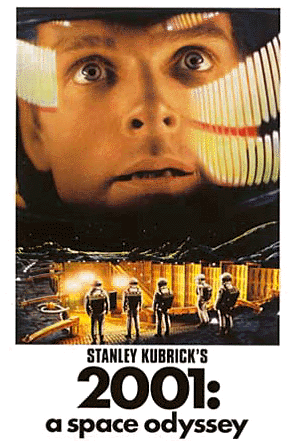
2001: A Space Odyssey (1968) *****
Dir. Stanley Kubrick
Starring Keir Dullea, Gary Lockwood, Douglas Rain

This is truly the greatest of them all. A collaboration between Arthur C. Clarke and Stanley Kubrick, this monumental picture is still ahead of its time and delivers what feels like the closest approximation of what it must be like to travel in space. Spanning the Dawn of Man through to a deep space journey to Jupiter, Kubrick takes all the time he needs to lavish attention over the simplest, though most gorgeous elements of space travel. In addition to the dazzling opening involving prehistoric man, we occasionally meet up with mysterious ancient alien monoliths which inspire continued leaps in mankind's evolution (or devolution) and its ability to traverse the universe in traditional spacecraft and by more spiritual means. 2001 is partially a muted thriller involving the famous robot HAL who attempts to murder the entire crew to carry on a mysterious mission into the netherworld of deep space. On the other side of the coin, it's a glorious head film that inspires audiences to accept the purely experiential aspects of Kubrick's visual genius - whether one chooses to see it stoned or straight. It also proves that 3D is completely unnecessary. In fact, it proves that 2-D is, in the hands of a real artist - multi-dimensional. I'm happy to say that my first few helpings of the film were as a kid in an old National General Cinerama theatre with the huge, deep, curved screen. Take that, IMAX!!!!!

SEE IT! NOW!
Armageddon (1998) ****
Dir. Michael Bay
Starring: Bruce Willis, Ben Affleck, Billy Bob Thornton, Liv Tyler, Owen Wilson, Will Patton, Peter Stormare, William Fichtner, Michael Clarke Duncan, Steve Buscemi

Pure roller coaster ride, but what a ride! A huge all-star cast propels this taut disaster epic wherein a team of pure testosterone blasts into outer space to drill into the core of a mighty asteroid hurtling towards Earth and to nuke the bugger to kingdom come before life as we know it ceases to exist. Visceral thrills of the highest order and loaded with plenty of true grit and heart. Critics crap on this, but audiences knew and still know the score. The movie rocks big-time!

SEE IT! NOW!
Journey to the Far Side of the Sun AKA Doppelgänger (1969) ***1/2
Dir. Robert Parrish
Starring: Roy Thinnes, Ian Hendry, Lynn Loring, Patrick Wymark

Moody and creepy space thriller from Britain's Gerry Anderson and Co. doing their first live-action feature after a successful canon of animated sci-fi TV shows like Thunderbirds which used marionettes in place of actors. No puppets here, though. Two terrific, underrated character actors play a pair astronauts who discover a planet in an identical orbital position to that of Earth located directly on the opposite side of the Sun. Well written and very strange. It certainly pre-dates the notion of parallel universe and is as fascinating now as it was in the 60s.

SEE IT! NOW!
Marooned (1969) ***1/2
dir. John Sturges
Starring: Gregory Peck, David Janssen, Richard Crenna, James Franciscus, Gene Hackman

Cool optical effects (as opposed to antiseptic digital F/X) rule the day in this genuinely suspenseful sci-fi melodrama involving a ship with major mechanical failures that's trapped in outer space. Three astronauts are sardine-tinned in the ship while mission control does what it can to bring the boys home and the wives weep and fret down below (as good wives should do). Though the movie inexplicably errs on a number of key technical elements of space travel, it gets far more of them absolutely dead-on. The film's release pre-dated the somewhat similar disaster that befell Apollo 13 and was spectacularly presented in 70mm, 6-track sound (which, Thank Christ, I had the joy of seeing a few times as a kid). The movie even inspired the Apollo-Soyuz Test Project in 1975 which was a result of the Apollo 13 disaster. Kick-ass manly-man director John Sturges (The Great Escape, The Magnificent Seven, Bad Day at Black Rock) handled the claustrophobic action brilliantly and a good deal of the picture is genuinely nail-biting. The performances are first-rate, but it's Gene Hackman who steals the show as a space flyer who starts to crack-up big-time. There's also absolutely no musical score. The interior soundscapes within the ship, and back on Earth works just fine, but one does have to ignore the exterior sound in zero gravity since it doesn't exist out there.

SEE IT! NOW!
Moon (2009) ****
dir. Duncan Bell
Starring: Sam Rockwell, Kevin Spacey

Space is thrilling, exciting and full of adventure, but when you get right down to it, the whole experience has got to be extremely creepy and Duncan Bell exploits this notion to terrifying effect as Sam Rockwell plays the sole human being presiding over a mining project on the dark side of Earth's Moon. His only companion is the Über-Creepy GERTY the robot (Kevin Spacey's voice, 'natch!). Shit is slowly hitting the fan and the entire movie plunges into nightmare territory.


SEE IT! NOW!
The Right Stuff (1983) *****
dir. Philip Kaufman
Starring: Fred Ward, Dennis Quaid, Ed Harris, Scott Glenn, Sam Shepard, Barbara Hershey, Lance Henriksen, Veronica Cartwright, Jeff Goldblum, Kim Stanley, Levon Helm

One of America's greatest living directors crafted one of America's greatest motion pictures about outer space. Based upon Tom Wolfe's book, Kaufman plunged us into a gorgeous, thrilling, supremely entertaining and utterly fascinating look at the history of modern space flight - telling the story of test pilot Chuck Yeager and the seven brave men who were part of America's Mercury space program. Every aspect of this film is pure perfection and it's not only infused with epic sweep, but it's deliriously romantic. One of a handful of genuinely great motion pictures from the otherwise horrendous decade of the 80s.

SEE IT! NOW!
Silent Running (1975) ***1/2
dir. Douglas Trumbull
Starring: Bruce Dern

A huge convoy of spaceships loaded with plant life floats amongst the stars to regenerate what's been lost to pollution on Earth. When Mission Control decides to abort the mission due to funding and general lack of interest in environmental concerns, Botanist Bruce Dern goes insane ('Natch!), murders the whole crew and jettisons in the netherworld to preserve the plant life. The whole movie is pretty much Bruce Dern, two drones he names Huey and Dewey, Joan Baez singing about flowers, trees, birds and bees (gotta love the 70s) and endless shots of whole forests under huge domes in outer space. You kind of need to ignore the fact that the Earth apparently has NO plant life at all, yet appears to be perfectly functioning. Just imagine that the interplanetary greenhouses are to build up plant life on the verge of extinction - or something - because it's a pretty damn fine movie in all other respects from F/X whiz Trumbull (2001).

SEE IT! NOW!
Solaris (1972) *****
dir. Andrei Tarkovsky
Starring: Natalya Bondarchuk, Donatas Banionis, Anatoli Solonitsyn, Sos Sargsyan, Vladislav Dvorzhetsky

From one of the great masters of Russian Cinema, you'll not see a space travel movie quite like it - steeped in sorrow, melancholy and a brand of cinematic humanity that could only have been achieved by Andrei Tarkovsky. A psychologist travels into deep space to investigate the mental health of a crew on an interstellar station perched above the planet Solaris - comprised of no known land mass and seemingly an orb of pure ocean. The crew has stopped communicating with each other. When our head doctor arrives, the space station is a complete disaster area, the crew of two ignores him, a third crew member has committed suicide prior to his visit, the space station appears to be full of crew members who shouldn't be there (and who don't communicate with anyone) and in the middle of the night, the doc wakes up in his room (which he's barricaded) to find himself in the company of his late wife. Things begin to get strange. Prepare to be alternately creeped out and moved to tears. One of the greatest movies of all time.

SEE IT! NOW!
A Trip To The Moon (1902) *****
dir. Georges Méliès

Scientists blast off to the Moon, its bright side adorned with the face of a man. The rocket lands in the eye of the Moon's face. The scientists are assailed by grotesque moon creatures. They're pretty easy to kill, but eventually they acquire strength in overwhelming numbers and a desperate fight ensues to safely board the ship and return to Earth. 18 minutes of pure movie magic from the great early magician of cinema, Georges Méliès - this film and its creator immortalized in Martin Scorsese's Hugo. Though shot and released primarily in black and white, Méliès generated and presented a limited number of painstakingly hand-coloured prints. They were all said to be lost. One was found and restored - frame by frame. One frame of this film has more magic, imagination and innovation than the entire running time of Gravity and, for that matter, most contemporary movies.


Here is the color restoration of A TRIP TO THE MOON - Please BUY the BLU-RAY - it Kicks Mega-Ass:


Thứ Sáu, 14 tháng 6, 2013

MEDIUM COOL - Review By Greg Klymkiw - The Haskell Wexler Classic is an important and influential work of the Cinema Vérité movement. It's exciting, urgent, vital and a worthy addition to the Criterion Collection.


Medium Cool (1969) *****
Dir. Haskell Wexler
Starring: Robert Forster, Verna Bloom, Peter Bonerz, Marianna Hill, Harold Blankenship

Review By Greg Klymkiw
“I hope we can use our art for love and peace.” So said cinematographer Haskell Wexler as he accepted an Oscar last April for his work on Who’s Afraid of Virginia Woolf? His seriousness and obvious sincerity startled the Academy Awards audience, long used to the standard thank yous to co-workers and producers. “I realized I might never get another chance at an audience of 60 or 70 million people. It seemed too big an opportunity to miss. What was I supposed to do – thank my gaffer and Jack Warner?”
Kevin Thomas
Los Angeles Times, 1 June 1967


A car off the highway. Metal twisted. Open door. Woman's body splayed on the asphalt. Blood gushing. A photographer attached to a movie camera hovers above - shooting - like a vulture circling its prey. One gruesome shot after another. Every conceivable angle caught on film. Real film. Real movie camera. Real cameraman - or so we think. We pray he isn't real because when he's sucked as much life out of his quarry as possible, he packs up and leaves the woman to bleed and presumably die. Alone.

The cameraman is John Cassellis. He is played by Robert Forster. Yes, we're watching a movie, but WHAT a movie! When Medium Cool was unleashed upon the movie-going public, nothing like it had ever been seen before and without question, not much (if anything) like it has been seen since.

Written, directed and photographed by Haskell Wexler, the celebrated cinematographer of such films as In The Heat Of The Night, The Thomas Crown Affair, One Flew Over the Cuckoo's Nest as well as two Oscar-winning turns for Who's Afraid Of Virginia Woolf and Bound For Glory, he crafted what might be the ultimate auteur film made in America. To this very day, Medium Cool is an important and influential work of the Cinema Vérité movement. It's exciting, urgent and vital - impossible to take your eyes off the screen while watching it, almost impossible to blink for fear of missing a frame and most of all, impossible to get out of your head once you've seen it.


On the surface, it might seem very simple - deceptively and cleverly so. Cassellis doesn't seem to care about much of anything unless he sees it through the lens of his camera. He loves shooting to the exclusion of all else. The only thing that matters is what he sees is what he shoots. The image is everything to him. It's not even especially important what story he's telling so long as he's telling it, so long as he's capturing his perspective on the world around him. He shoots, then hands off his negative (yes, kids - negative - ever hear of that?) to a helmeted motorcycle rider who crazily zips through the Chicago streets in the film's great opening title sequence.

The shots are in the can. What's next for him to plaster onto negative? He's like a junkie. He needs another shot. All that counts is the shot. From his eye, through the lens and bouncing back from his target and captured on unexposed stock greedily demanding a chemical bath in order to spool itself through the projection sprockets of a telecine and then, beamed over airwaves, mediated through a cathode ray screen and into the eyes, hearts and, hopefully, minds of its viewers.

His aim is true. What's done with it afterwards might not be.


Certainly Cassellis seems untroubled with his own part in journalistic exploitation and this is hammered home by his purely sexual relationship with a sex-drenched young fuck-buddy (Mariana Hill). He needs to SHOOT - film AND sperm. It's only once his life has been touched by a chance encounter with a pair of Appalachian expats in the slums of Chicago - a single mother (Verna Bloom) and her only child (Henry Blankenship) - that Cassellis opens his eyes to the insidious manner his images are being disseminated.

When he discovers that the corporate pigs running the stations and networks are furnishing his potentially incriminating footage of civil unrest to law enforcement officials (most notably, the FBI), he flies into a rage. The film builds to a harrowing climax involving a riot where his eye, so fixed on the events he's shooting, misses the plight of the people closest to him and eventually (and literally) jettisons both himself and the audience smack into a shocking conclusion.

The eyes of Cassellis remain shark-like, though the emotion fuelling his actions shifts from obsession to a form of vengeance. Nothing, however, can match the eyes of the mother and her son - especially her son - they're the battered and bruised receptacles of America's indifference and their part in Wexler's film reaches heartbreaking proportions.


The corruption and collusion of mainstream media and its relationship to both corporate interests and government are today a given fact, but in the late 60s, when Medium Cool was made, such a thing seemed unthinkable. When Wexler fashioned this film it was a shocker, but somehow in the context of today's world - our own strife amidst uncaring governments, in turn the puppets of a new world order of corporations - this picture is more important than ever. Its importance to both history and the art of cinema is virtually a given, but its importance to exposing and keeping all of us aware of contemporary political gangsterism has seldom been matched.

Films that focus upon media have never been uncommon, but only Federico Fellini in his 1960 film La Dolce Vita pre-dates Medium Cool with any significance. Via the character of Paparazzo (a name Fellini derived from Italian dialect to describe the buzzing of mosquitoes), the Maestro's masterwork is often credited with generating the etymology of paparazzi to describe the European phenomenon of photo journalists who use their lenses to capture celebrities in poses of compromise.

Certainly, Wexler's horrific opening pre-dates the death of Princess Diana and the photographers who chased and surrounded the twisted metal - shooting with abandon as life painfully drained from her. Years after Wexler's picture, writer Paddy Chayefsky and director Sidney Lumet delivered Network, the savage satire of news becoming "entertainment" and being rooted in corporate greed rather than any altruistic desire to deliver news in a traditional journalistic sense. Finally, though, Medium Cool is the yardstick to measure all cinema dealing with media and I'd argue that nothing even comes close to matching it.

America was on the precipice of massive upheaval and there was an overwhelming sense that major shit was going to hit the fan in Chicago during the 1968 Democratic Convention - which, of course, it did. Wexler designed his film to shoot on location during this time and what he captures is probably the most powerful cinematic game of "chicken" between documentary and drama ever made.

He populates his film with a mix of great actors, non-actors and the real thing in the midst of actual events Cassellis and, by extension, Wexler's film, both capture so indelibly.


Robert Forster is the revelation here. Handsome, rugged, nicely buff - he's handed the difficult task of being often mute, bereft of real passion or caring - until, of course, it's too late - and even then, he switches into obsessive auto-pilot. Forster's performance here is one of the great performances in contemporary American cinema. Cassellis is a superbly etched character - seemingly passive, but active where it counts. His early years as a boxer (which he continues to train as) are the sort of physical skills cameramen absolutely require to get the brilliant handheld footage they need.

His motion picture debut was a couple of years earlier in John Huston's magnificently insane adaptation of Carson McCuller's novel Reflections in a Golden Eye. This was a brave way for any actor to expose himself in his first film. Playing the apple of Marlon Brando's closeted military officer's homosexual eye, Forster taunts Brando by riding a horse nude in eyeshot of the smitten military man, and in turn, obsessed over Brando's sexually frustrated wife played by Elizabeth Taylor, he repeatedly enters her bedroom nude and jerks off into her dirty panties as she dozes deeply within the Land of Nod.


Most actors today would greet such a role as a bad career move, but if they were lucky enough to have a director as visionary as Wexler, they'd go from one great role to another, as Forster did by going from Huston to Wexler. Forster, by the way, never hit the heights of stardom he should have and instead had a hugely successful film and TV career as a "working" actor until Quentin Tarantino displayed the same vision Huston and Wexler were imbued with and cast him in the world weary male romantic lead bail bondsman opposite Pam Grier in the wonderful Jackie Brown.

If anything, though, Wexler might well have handed Forster the role of a lifetime here - especially within the context of a medium like cinema that has the power to inform, entertain and effect real change. The shooter Cassellis is always alert to the possibility of those images and Forster always commands our attention to this fact with his expressive eyes. His powerful body helps him hoist that camera and aim it where his eye wants to go.


Wexler captures so many genuinely real events during his drama and it is Forster who is always at the centre of them. Whether we see riots, national guardsmen in mock training during protest march scenarios, the lives and milieu of Chicago's most racially segregated areas of Chicago - it's Casselis who is our onscreen tour guide as we see what Wexler sees via Forster - and it is ALL TOO REAL; the looks of hatred and mistrust upon the faces of those living in the neighbourhoods, the poverty stricken naked kids splashing through fire hydrant water in the blistering heat, encounters with revolutionaries in tenement slums, Wexler uses this great actor to allow us into a world of reality.

It's a mediated reality, to be sure, and this is always Wexler's aim.

But where the film, its intentions and ultimately, its impact become all too clear is the breathtaking, salient moment when Wexler trains his lens upon Cassellis and Forster so evocatively utters one of film history's great lines:

"Jesus," he says with a hint of passion that escapes from his seemingly cold, detached demeanour, "I love shooting film."

And so he does. He loves shooting film with a purity that is eventually soiled by both corporate and government evil. What then is left for a man when he discovers that his lifeblood is being perverted, subverted and sucked out of him - not for the good of man, but for the good of profits and maintaining the Status Quo? What finally is left, is that which Wexler shockingly provides us in his movie.

It's not a pretty picture.

What's truly terrifying to me and utterly disgusting (because it continues today with even more frequency and intensity) is that Wexler was strongly urged to re-cut his film as the corporate giants at Paramount were being pressured from so many levels of influence to mute and ultimately emasculate the film's power. Wexler refused. He had the power to do so. Instead, a brilliant filmmaker who had just won a fucking Oscar had his work initially manhandled and censored by the Motion Picture Association of America (MPAA). For one brief scene of nudity and a handful of cuss words, the film was slapped with an X-rating which was effectively a kiss of death as it relegated Wexler's film to the same status of hard core pornography.

Nobody in their right mind would believe the rating was due to the aforementioned language and nudity.

Medium Cool was being censored for being too political and worse, not the capital "R" RIGHT political.

"Jesus, I love shooting film."

This is the sin more grave that those laid down in the Ten Commandments since loving to shoot film often means we must expose the evils of God and Country.

And God only knows, we can't have that now, can we?

The Criterion Collection Blu-Ray and DVD of Haskell Wexler's Medium Cool is perhaps one of the best packages the company has ever put together. Wexler's haunting images are gorgeously transferred for our edification and the entirety of this disc is bursting at the seams with a wealth of material.

There are two audio commentaries, one with historian Paul Cronin and the other with Wexler, editing consultant Paul Golding and actress Marianna Hill, as well as a new Wexler interview.

The real gems are extended excerpts from Look Out Haskell, It’s Real!, Cronin's documentary that has interviews with Wexler, Golding, Forster, Verna Bloom, Peter Bonerz, Chicago historian and the film's intrepid consultant Studs Terkel and a myriad of others, as well as excerpts from Sooner or Later, Cronin’s documentary about Harold Blankenship, who plays Verna Bloom's son in the picture. Both of these documentaries form an important and near-epic look at a film AND a time and place when America was on the precipice of the eventual decline it's experiencing now. They both look great on this disc and present enough salient details for most viewers, though, in fairness, versions can be accessed in full unexpurgated form outside of the disc. They don't look "pretty" and suffer a bit from the editorial decisions made by Criterion, but part of me wishes they'd been presented in their whole on this disc in addition to the excerpts.

The other absolute gem is Wexler's new documentary Medium Cool Revisited which focuses on the Occupy movement’s protests during Chicago's 2012 NATO summit.

As per usual, the disc includes a trailer and a fine booklet with a new essay by film critic and programmer Thomas Beard. This is a keeper. If you care about cinema, you'll want to own this. I've only had this disc for two weeks and I've already spent hours and hours pouring over it.


In USA and the rest of the WORLD - BUY Medium Cool - HERE!

In Canada - BUY Medium Cool HERE, eh!

In UK BUY Medium Cool HERE