Hiển thị các bài đăng có nhãn 1983. Hiển thị tất cả bài đăng

Thứ Hai, 10 tháng 8, 2015

VIDEODROME - Review By Greg Klymkiw at "Electric Sheep - A Deviant View of Cinema" (UK's premiere online journal of the most aberrant, heretically perverse and downright divergent motion picture product).


David Cronenberg, along with the likes of Atom Egoyan, Guy Maddin, Peter Mettler and a clutch of other visionary filmmakers in English Canada, generated product which can be viewed as Canadian by simple virtue of the fact that both the style and content of the films could only have been made in a North American context that prided itself on uniquely indigenous qualities in spite (and perhaps even because) of the southerly Behemoth of Uncle Sam. And though plenty of Canadian dramatic product was (and often continues to be) almost unbearably tasteful, this has happily never been a problem for any of the aforementioned filmmakers – especially not David Cronenberg. “Tasteful” has seldom reared its ugly head anywhere near his films. Videodrome is as Canadian as Maple Syrup, beavers and the MacKenzie Brothers, but with the added bonus of almost hardcore sadomasochistic snuff-film-style torture weaving its way throughout the picture as narrative and thematic elements.

Read Greg Klymkiw's
full review at:
Electric Sheep
- a deviant view of cinema
HERE


Here are the full specs on the Arrow Video release: LIMITED EDITION CONTENTS
Original uncompressed mono audio tracks for all films, Optional English subtitles for the deaf and hard of hearing for all films, Limited Edition packaging, fully illustrated by Gilles Vranckx, Limited Edition Exclusive Extras

VIDEODROME – BLU-RAY DISC 1 AND DVD DISC 2:
Restored high-definition digital transfer of the unrated version, approved by director David Cronenberg and cinematographer Mark Irwin, Audio commentary by Tim Lucas, the on-set correspondent for Cinefantastique Magazine and author of Videodrome: Studies in the Horror Film, David Cronenberg and the Cinema of the Extreme – A documentary programme featuring interviews with Cronenberg, George A. Romero and Alex Cox on Cronenberg’s cinema, censorship and the horror genre, Forging the New Flesh – A documentary programme by filmmaker Michael Lennick on Videodrome’s video and prosthetic make up effects, Videoblivion: A brand new interview with cinematographer Mark Irwin, A brand new interview with producer Pierre David, AKA Jack Martin – Dennis Etchison, author of novelizations of Videodrome, Halloween, Halloween II and III and The Fog, discusses Videodrome and his observations of Cronenberg’s script, The complete uncensored Samurai Dreams footage with additional Videodrome broadcasts with optional commentary by Michael Lennick, Helmet Test and Betamax – Two featurettes by Michael Lennick on effects featured in the film, Camera (2000) Cronenberg’s short film starring Videodrome’s Les Carlson, Fear on Film: A round table discussion from 1982 with Cronenberg, John Carpenter, John Landis and Mick Garris, Promotional featurette with behind-the-scenes footage and interviews with Cronenberg, James Woods, Deborah Harry and Rick Baker, Original theatrical trailer

DAVID CRONENBERG’S EARLY WORKS: BLU-RAY DISC 3 AND DVD DISC 4 [LIMITED EDITION EXCLUSIVE]: High Definition Blu-ray (1080p) and Standard Definition DVD presentation of four Cronenberg films, Transfer (1966) & From the Drain (1967), Cronenberg’s previously unavailable short films newly restored by the Toronto International Film Festival [7 & 12 mins], Stereo (1969) & Crimes of the Future (1970): Cronenberg’s early amateur feature films, shot in and around his university campus, prefigure his later work’s concerns with strange institutions (much like Videodrome’s Spectacular Optical) as well as male/female separation (Dead Ringers) and ESP (Scanners). Newly restored from original lab elements [65 & 70 mins], Transfer the Future – Author and critic Kim Newman discusses Cronenberg’s early works

COLLECTOR’S BOOKLET [LIMITED EDITION EXCLUSIVE]
An illustrated 100-page hardback book featuring new writing including Justin Humphreys on Videodrome in a modern context, Brad Stevens on the alternate versions, Caelum Vatnsdal on Cronenberg’s early works, extracts from Cronenberg on Cronenberg featuring Cronenberg’s reminiscences of getting started in filmmaking and shooting all the films in this collection, plus more, illustrated with original archive stills

DETAILS:
Region: B
Rating: 18
Cat No: FCD1133
Duration: 6/13/63/63/89 mins
Language: English
Subtitles: English SDH
Aspect Ratio: 1.85:1/1.33:1/1.66:1
Audio: Mono
Discs: 4
Colour/B&W

Thứ Năm, 25 tháng 6, 2015

THE OSTERMAN WEEKEND - Review By Greg Klymkiw - Unfairly Maligned Peckinpah Part 1


The Osterman Weekend (1983)
Dir. Sam Peckinpah
Starring: Rutger Hauer, John Hurt, Burt Lancaster, Dennis Hopper,
Meg Foster, Helen Shaver, Cassie Yates, Craig T. Nelson. Chris Sarandon

Review By Greg Klymkiw

I think the critics who trashed Sam Peckinpah's The Osterman Weekend when it first came out in 1983 were completely out to lunch about one key detail. Even though both Peckinpah and screenwriter Alan Sharp were dissatisfied with the script (based on Robert Ludlum's novel), the common critical complaint was the unintelligibility factor. My response on that front is: HOGWASH! Is the film a mass of confusion and mystery? It sure is, but none of this is detrimental to one's overall enjoyment of the film since it's the very inscrutability of the strange riddles haunting all its characters which keeps us guessing and which, is ultimately so simple, that we want to kick ourselves in the head for not getting "it".

I will admit that my first helping of the film theatrically was fraught with some disappointment at its lack of over-the-top bloodletting, but recent screenings (the DVD edition from ten-years ago and the new Blu-Ray release, both via Anchor Bay) restored my faith in Peckinpah's direction and his take on the material.

And back in the day, what in the Hell was I thinking about? The movie is incredibly violent (much of it submerged in the weird social dynamics of the "friends" who are getting together for weekend frolics) and eventually, all out nail baiting suspense and action during the final third of the picture.

In addition to all of that, there's a substantial creep factor to the whole affair which makes you feel like a vigorous scrub with a fresh, brand new loofah pad to exfoliate yourself of all the vile filth necrotizing upon your flesh.


John Tanner (Rutger Hauer) is a superstar TV journalist whose penetrating interviews are both feared and lauded by politicians and bureaucrats alike. His connections at all levels of government are deep seeded. His best friends from college include a number of successful power brokers all thriving in disparate, but successful fields and each year they have a weekend get-together spurred on by Bernie Osterman (Craig T. Nelson), a TV-news producer and John's closest friend.

This year's "Osterman" weekend is going to be a bit different for all concerned. John has been recruited by Lawrence Fassett (John Hurt), a mysterious CIA field operative. It seems Osterman and John's other pals, plastic surgeon Richard Tremayne (Dennis Hopper), his snarky, coke-snorting wife Virginia (Helen Shaver), sleazily brilliant stock trader Joseph Cardone (Chris Sarandon) and sexy, loopy wifey Betty (Cassie Yates) are all making scads of extra dough as Soviet spies. Fassett wants to surveil the entire weekend and use John to expose his friends, but to also broker a deal to "turn" them into double agents.

John agrees to this entire mad scheme because he's a genuine patriot, but most of all, he's promised a one-on-one no-holds-barred interview with Maxwell Danforth (Burt Lancaster), a kind of CIA equivalent to the FBI's J. Edgar Hoover.

The weekend, however, goes horribly awry - mostly because John is out of his depth. Coupled with a domestic dispute with his wife Ali (Meg Foster), his overt nervousness and the fact that he and his family are going into this after a harrowing kidnap attempt upon them by Soviet agents. Tanner is convinced all his friends know what he's up to and they in turn are besieged with their own domestic entanglements as well as fearing their old pal is using the weekend to nail them.

Peckinpah beautifully handles the sordid, nasty veneer of bourgeois excess which slowly descends into the kind of bitter acrimonious game-playing which would feel more at home in George and Martha's demented domestic set-up in Edward Albee's "Who's Afraid of Virginia Woolf". And let's not forget that everything, every nook and cranny of John's home is outfitted with hidden surveillance cameras as our fey, chain-smoking Fassett voyeuristically observes several banks of monitors, like some mad Peeping Tom.

Tensions amongst the friends mount to extreme proportions and one can feel the potential for an explosion of violence. And when it comes, it's one shocker after another, all filtered through Peckinpah's astonishing feel for the mad ballet of carnage when men and women transform into seething, stalking beasts of prey.

Survival instinct is one thing and Peckinpah amps it up to total Red Alert, but amidst it all is a completely unhinged psychopath who will stop at nothing to extract life from anyone and everyone at all costs.

This is dazzling stuff. Of course, it could have even been far more vile and demented, but once again, poor Peckinpah was assailed by producers who refused to acquiesce to his complete vision, one which took voyeurism and vengeance to borderline extremes of surrealism. In spite of this, what's left is plenty effective.

My most recent screening of the picture on Blu-Ray was like a veil had been joyously lifted from the images and dramatic action. Upon first seeing The Osterman Weekend in 1983, the CIA surveillance methods in the movie seemed like science fiction, but nowadays, what's all on display is, quite miraculously, a chilling mirror image of both the contemporary mainstream media manipulation we're assailed with and the 1984-like invasion of our privacy. I can't help but think that Peckinpah was all-too aware that his film would be released on the eve of the actual year of Our Lord, 1984. The Orwellian undercurrent is perfectly in synch with the film's narrative, Peckinpah's taut, imaginative mise-en-scene and a kind of newfound power the film has attained in light of all that currently plagues us.

The Osterman Weekend was clearly ahead of its time.

As such, "Bloody" Sam got the last laugh on all of us.

THE FILM CORNER RATING: ***½

The Osterman Weekend is available on Blu-Ray from Anchor Bay Entertainment Canada and Anchor Bay/Starz (in the USA). It ports over two key extras from the original DVD release from 10 years ago, a commentary track from by film historians/critics (and Peckinpah aficionados) Paul Seydor, Garner Simmons, David Weddle and Nick Redman. Best of all is the 80-minute making-of documentary Alpha to Omega. Sadly missing from this release is Peckinpah's cut of the film. Granted, it was a crude telecine transfer of the 35mm work print, but it provided considerable insight into Peckinpah's unexpurgated hopes for the film.

Thứ Bảy, 14 tháng 3, 2015

THE MAKIOKA SISTERS - Review By Greg Klymkiw - Lesser Ichikawa on Criterion Blu-Ray


The Makioka Sisters (1983)
dir. Kon Ichikawa
Starring: Keiko Kishi, Yoshiko Kasuma, Sayuri Yoshinaga, Yuko Kotegawa, Juzo Itami

Review By Greg Klymkiw

I wanted to love this movie for three reasons.

First of all, I must admit that even after having seen over 30,000 movies in my life, there are still so many more to see. Japanese director Kon Ichikawa, one of the foremost masters of his country's cinema, is - for example - a filmmaker who inexplicably fell below my radar. I knew he existed, but bad timing forced me to keep missing the handful of massive retrospectives of his work at the Toronto International Film Festival (TIFF) Cinematheque (now housed in the grand TIFF Lightbox complex in Toronto, Canada).

I had also been aware of Ichikawa's ongoing obsession with adapting the best of Japan's wealth of great literature and how this generally distinguished him amongst many of his contemporaries. Yasujiro Ozu and Akira Kurosawa were particularly interested in original screenplays - good on them, but I never look a road map in the mouth, so to speak. For me, Japanese literature (save for Yukio Mishima) continues to be an unknown commodity and I have been chomping at the bit to dine at the Ichikawa Buffet (as it were) to use his movies as a barometer and/or guide to some of these great literary works. In essence, I have been preparing to use Ichikawa like the "Classics Illustrated" comics from my childhood. They always promoted the notion of "now you've read the comic, read the full length book" and for me, that used to work wonders. I mean, really! What the hell! I'm technically not a kid anymore, but even adults with a bit of book learnin' can use some help now and again.

The second reason I wanted to love The Makioka Sisters is that the first half hour is utterly spellbinding. Though we focus only on the four sisters of the title (Keiko Kishi, Yoshiko Kasuma, Sayuri Yoshinaga, Yuko Kotegawa) and one husband (Juzo Itami, eventually a noted Japanese director in his own right), Ichikawa lays out an extremely complex backstory that forces us (not distractingly) to work overtime sorting out and digesting the relationships between the characters and the cultural/historical backdrop.

Add to the above, one of the most heart achingly beautiful visual set pieces imaginable - the sisters taking a lazy stroll to enjoy the cherry blossoms - and you feel like you're diving into what might be a life-changing masterwork (save for the intrusion of one execrable element I will mention much later in this piece).

The final reason I wanted to love this movie is that it's one of those potentially great Chekhovian stories I'm a sucker for - people looking desperately to make connections with each other (or ANYONE) against a major cusp period where it's easier to remain rooted in what's dying or dead than move forward and embrace or accept the new.

It's a world where the ghosts of the past - replete with all their sins and triumphs - want to be at peace, but the living will not let them go, much to the detriment of all concerned. Within this social/cultural/historical cusp period, some will make it, most will not - and out of this shift in the divide should come both tragedy and comedy - all the stuff of great drama.

Alas, The Makioka Sisters falls short of its goals. It is not even especially GOOD drama, let alone being great.

Its story is a simple one - as most great stories are. Four sisters in pre-war (1938) Osaka live a life of relative luxury. Buoyed as they are by the inheritance left to them by their late parents, all should be well. It isn't. Tradition dictates that the sisters marry in descending order of their age in order to qualify for their share of the loot - which is, essentially to be their dowries. This is all well and good for the two eldest sisters who are already hitched, but the third eldest is a major wallflower and the youngest is clearly a modern lass with a burning desire to get on with her life.

Tradition is holding her back, And ultimately, for the family as a whole to move "forward", marriage (and by extension, tradition) is seen as the only option - hence the central goal of the story being the marrying off of daughters three and four. Romance would be nice in the equation, but clearly low on the totem pole of what's seen as necessary for the preservation of the family. The needs of the individual are less than an afterthought. In fact, they're negligible.

What keeps the movie from soaring, even though it occasionally feels like it wants to, is Ichikawa's approach to rendering the narrative. He often hangs back in medium wide shots and lets long conversations play themselves out. God knows I'm happy to watch bearded warriors in lotus positions in Kurosawa pictures as they discuss WHY they're at war and HOW they will do battle. I'm especially happy to sit for hours on end while people talk to each other in tatami-level shots in Ozu. Their pictures are replete with emotion and narrative drive - unlike The Makioka Sisters.

For several reasons, Ichikawa's approach just doesn't cut it. Some will argue that his method is restraint - that he's avoiding the obvious pitfalls and clichés inherent in goosing every dramatic beat to the max. On the other hand, it could almost be argued that he's either lazy, incompetent or hampered by exigencies of production. Almost every single time he moves from his favourite (and I'd suggest rather dull) fixed camera position, so many of the cuts feel jarring and awkward (and not intentionally) while the variation of shots often seem to be from the wrong angle. Well, given the number of stunning set pieces in the movie, he's neither lazy nor incompetent, but I do think he was wrong to tell this story the way he chose to tell it.

This is a story that, while simple on the surface, is loaded with layer upon layer of complexity and yet, one is hardly compelled to even bother peeling back those layers as the director seems so disinterested in wrenching our guts for fear, I suspect, of being melodramatic.

Well, this is a bit of a problem when the story has all the hallmarks of great melodrama and none of the required execution. Ichikawa goes out of his way to mute every major melodramatic beat to the point where a handful of scenes compel you in a certain direction, then refuse to deliver up the goods. The movie has five major emotional set pieces (you'll discover those on your own) and they're exquisitely rendered on both visual levels and from the great cast (who are often wasted by Ichikawa's overall mise-en-scene).

Sorry, Kon. This is really annoying, bud. You need to loosen up a bit.

Ozu, for example, is able to wrench out drama from the smallest details and he is NEVER afraid of emotion. Some have suggested his approach is indeed restrained in order for the emotional core to open up and be real. I disagree. Ozu, like Kurosawa, is NOT afraid of being sentimental or even melodramatic. They are storytellers - first and foremost - and will use every trick up their sleeve to wrench emotion from an audience. As well, I'm not suggesting a measured, mannered approach can't work. It can. It just doesn't work in The Makioka Sisters due, at least based on this picture to Ichikawa either unwilling or incapable of achieving the heights his colleagues aimed for or worse, his inability to properly execute his own approach.

On a surface level, the movie's concluding moments come close to creating that heart breaking devastation that's as sad as it is soaring, but by then, it's too late. Ichikawa has spent most of the movie muting all the emotion, occasionally and sloppily tossing in a dollop of it here and there, then allowing it to all hang out at the end.

Great melodrama (or even straight-up drama) needs to build to such an explosion. Ichikawa seems so obsessed with his snobby attempts at restraint that he forgot he had an audience he needed to please.

I've thus far avoided any background on exigencies of production that might have lead to Ichikawa creating this supremely flawed work (wildly praised from people who really should know better). The above were my impressions knowing nothing about the making of the film (my preferred method of seeing anything for the first time). That said, upon discovering that Ichikawa was commissioned by Japan's Toho Company to make the feature as part of its 50th year celebrations and that he was subsequently and idiotically nickelled and dimed to death, is still not reason enough to change my mind. In fact, I watched the movie a second time and my conclusions stand - it's a movie with occasional beauty, tons of potential but finally, a mess.

I suspect this was probably not the best introduction to Ichikawa's work. I'll certainly see more and I'll eventually watch this again with the context of his fuller canon behind me. Maybe I'll change my mind., though I doubt highly I will - especially in light of the following:

The most bafflingly egregious element of The Makioka Sisters is the music. In spite of the fact that the movie was made in the '80s where the style of music chosen was popular for the RIGHT movies, it is completely, utterly and overwhelmingly incomprehensible to me why a movie that DEMANDED a full orchestral score is miserably fouled with synthesized music so god-awful it might as well have been crapped out by Harold Faltermeyer.

The problem with this is that The Makioka Sisters is not about a Detroit cop in Beverly Hills. Given the score, it might as well have been.

THE FILM CORNER RATING: *** 3 Stars

The Makioka Sisters has been lovingly restored and presented on a nice looking, but extras-lacking Criterion Collection Blu-ray.

Thứ Bảy, 5 tháng 10, 2013

10 Terrific Space Movies to see instead of GRAVITY or 10 Reasons NOT to see GRAVITY - By Greg Klymkiw

There's really no need to see this movie!
October 4, 2013 saw the release of Gravity, a dull, predictable, badly written and clearly expensive space thriller which opened wide on several thousand screens in uselessly annoying 3-D. It has already amassed a ludicrously high "Fresh" rating on Rotten Tomatoes and this highly touted trifle will be a huge hit. To the former, most critics aren't real critics and the real critics who've ejaculated on the film are probably so depressed over all the crap they have to see that Gravity did indeed feel special to them. The reality is this - it's really not very good. There exist, however, a clutch space travel movies that offer far more than what's on display in Alfonso Cuarón's trifle of a picture. Buy, rent, VOD or if, God willing, they're in rep somewhere, see them as they're meant to be seen. Any of these suckers deliver the real thing rather than wimpy, weepy eye candy. The most recent and obvious choice for this list is Europa Report, the phenomenal picture from this very same year that's received virtually no release of any consequence.
SEE IT! NOW!
Europa Report (2013) ****
Dir. Sebastián Cordero
Starring: Anamaria Marinca, Daniel Wu, Karolina Wydra, Michael Nyqvist, Sharlto Copley, Christian Camargo, Embeth Davidtz, Dan Fogler, Isiah Whitlock Jr.

Easily one of the best science fiction films I've seen in years. It had me charged with excitement from beginning to end. A private corporation launches a historic manned flight to Jupiter's Moon of Europa, a huge orb covered completely with ice and most probably having one of the likelier possibilities of life in our solar system due the presence of water. An international crew of six astronauts are onboard for the mission and director Sebastián Cordero astonishingly covers every key detail of the trip via an insane number of POVs from the cameras set up by the corporation. Europa is, of course, fraught with danger and the filmmakers work overtime to keep us on the edge of our seats. What drives the film is the potential to discover life - it might be simple or complex, benevolent or dangerous, but there will be life. And it will be awe-inspiring.

Here are more top picks for space travel movies (in alphabetical order):

SEE IT! NOW!

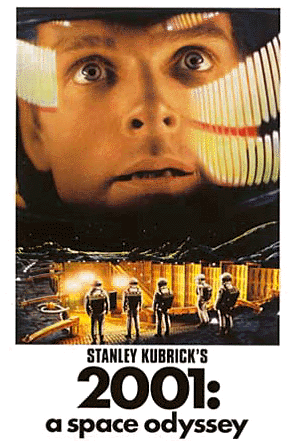
2001: A Space Odyssey (1968) *****
Dir. Stanley Kubrick
Starring Keir Dullea, Gary Lockwood, Douglas Rain

This is truly the greatest of them all. A collaboration between Arthur C. Clarke and Stanley Kubrick, this monumental picture is still ahead of its time and delivers what feels like the closest approximation of what it must be like to travel in space. Spanning the Dawn of Man through to a deep space journey to Jupiter, Kubrick takes all the time he needs to lavish attention over the simplest, though most gorgeous elements of space travel. In addition to the dazzling opening involving prehistoric man, we occasionally meet up with mysterious ancient alien monoliths which inspire continued leaps in mankind's evolution (or devolution) and its ability to traverse the universe in traditional spacecraft and by more spiritual means. 2001 is partially a muted thriller involving the famous robot HAL who attempts to murder the entire crew to carry on a mysterious mission into the netherworld of deep space. On the other side of the coin, it's a glorious head film that inspires audiences to accept the purely experiential aspects of Kubrick's visual genius - whether one chooses to see it stoned or straight. It also proves that 3D is completely unnecessary. In fact, it proves that 2-D is, in the hands of a real artist - multi-dimensional. I'm happy to say that my first few helpings of the film were as a kid in an old National General Cinerama theatre with the huge, deep, curved screen. Take that, IMAX!!!!!

SEE IT! NOW!
Armageddon (1998) ****
Dir. Michael Bay
Starring: Bruce Willis, Ben Affleck, Billy Bob Thornton, Liv Tyler, Owen Wilson, Will Patton, Peter Stormare, William Fichtner, Michael Clarke Duncan, Steve Buscemi

Pure roller coaster ride, but what a ride! A huge all-star cast propels this taut disaster epic wherein a team of pure testosterone blasts into outer space to drill into the core of a mighty asteroid hurtling towards Earth and to nuke the bugger to kingdom come before life as we know it ceases to exist. Visceral thrills of the highest order and loaded with plenty of true grit and heart. Critics crap on this, but audiences knew and still know the score. The movie rocks big-time!

SEE IT! NOW!
Journey to the Far Side of the Sun AKA Doppelgänger (1969) ***1/2
Dir. Robert Parrish
Starring: Roy Thinnes, Ian Hendry, Lynn Loring, Patrick Wymark

Moody and creepy space thriller from Britain's Gerry Anderson and Co. doing their first live-action feature after a successful canon of animated sci-fi TV shows like Thunderbirds which used marionettes in place of actors. No puppets here, though. Two terrific, underrated character actors play a pair astronauts who discover a planet in an identical orbital position to that of Earth located directly on the opposite side of the Sun. Well written and very strange. It certainly pre-dates the notion of parallel universe and is as fascinating now as it was in the 60s.

SEE IT! NOW!
Marooned (1969) ***1/2
dir. John Sturges
Starring: Gregory Peck, David Janssen, Richard Crenna, James Franciscus, Gene Hackman

Cool optical effects (as opposed to antiseptic digital F/X) rule the day in this genuinely suspenseful sci-fi melodrama involving a ship with major mechanical failures that's trapped in outer space. Three astronauts are sardine-tinned in the ship while mission control does what it can to bring the boys home and the wives weep and fret down below (as good wives should do). Though the movie inexplicably errs on a number of key technical elements of space travel, it gets far more of them absolutely dead-on. The film's release pre-dated the somewhat similar disaster that befell Apollo 13 and was spectacularly presented in 70mm, 6-track sound (which, Thank Christ, I had the joy of seeing a few times as a kid). The movie even inspired the Apollo-Soyuz Test Project in 1975 which was a result of the Apollo 13 disaster. Kick-ass manly-man director John Sturges (The Great Escape, The Magnificent Seven, Bad Day at Black Rock) handled the claustrophobic action brilliantly and a good deal of the picture is genuinely nail-biting. The performances are first-rate, but it's Gene Hackman who steals the show as a space flyer who starts to crack-up big-time. There's also absolutely no musical score. The interior soundscapes within the ship, and back on Earth works just fine, but one does have to ignore the exterior sound in zero gravity since it doesn't exist out there.

SEE IT! NOW!
Moon (2009) ****
dir. Duncan Bell
Starring: Sam Rockwell, Kevin Spacey

Space is thrilling, exciting and full of adventure, but when you get right down to it, the whole experience has got to be extremely creepy and Duncan Bell exploits this notion to terrifying effect as Sam Rockwell plays the sole human being presiding over a mining project on the dark side of Earth's Moon. His only companion is the Über-Creepy GERTY the robot (Kevin Spacey's voice, 'natch!). Shit is slowly hitting the fan and the entire movie plunges into nightmare territory.


SEE IT! NOW!
The Right Stuff (1983) *****
dir. Philip Kaufman
Starring: Fred Ward, Dennis Quaid, Ed Harris, Scott Glenn, Sam Shepard, Barbara Hershey, Lance Henriksen, Veronica Cartwright, Jeff Goldblum, Kim Stanley, Levon Helm

One of America's greatest living directors crafted one of America's greatest motion pictures about outer space. Based upon Tom Wolfe's book, Kaufman plunged us into a gorgeous, thrilling, supremely entertaining and utterly fascinating look at the history of modern space flight - telling the story of test pilot Chuck Yeager and the seven brave men who were part of America's Mercury space program. Every aspect of this film is pure perfection and it's not only infused with epic sweep, but it's deliriously romantic. One of a handful of genuinely great motion pictures from the otherwise horrendous decade of the 80s.

SEE IT! NOW!
Silent Running (1975) ***1/2
dir. Douglas Trumbull
Starring: Bruce Dern

A huge convoy of spaceships loaded with plant life floats amongst the stars to regenerate what's been lost to pollution on Earth. When Mission Control decides to abort the mission due to funding and general lack of interest in environmental concerns, Botanist Bruce Dern goes insane ('Natch!), murders the whole crew and jettisons in the netherworld to preserve the plant life. The whole movie is pretty much Bruce Dern, two drones he names Huey and Dewey, Joan Baez singing about flowers, trees, birds and bees (gotta love the 70s) and endless shots of whole forests under huge domes in outer space. You kind of need to ignore the fact that the Earth apparently has NO plant life at all, yet appears to be perfectly functioning. Just imagine that the interplanetary greenhouses are to build up plant life on the verge of extinction - or something - because it's a pretty damn fine movie in all other respects from F/X whiz Trumbull (2001).

SEE IT! NOW!
Solaris (1972) *****
dir. Andrei Tarkovsky
Starring: Natalya Bondarchuk, Donatas Banionis, Anatoli Solonitsyn, Sos Sargsyan, Vladislav Dvorzhetsky

From one of the great masters of Russian Cinema, you'll not see a space travel movie quite like it - steeped in sorrow, melancholy and a brand of cinematic humanity that could only have been achieved by Andrei Tarkovsky. A psychologist travels into deep space to investigate the mental health of a crew on an interstellar station perched above the planet Solaris - comprised of no known land mass and seemingly an orb of pure ocean. The crew has stopped communicating with each other. When our head doctor arrives, the space station is a complete disaster area, the crew of two ignores him, a third crew member has committed suicide prior to his visit, the space station appears to be full of crew members who shouldn't be there (and who don't communicate with anyone) and in the middle of the night, the doc wakes up in his room (which he's barricaded) to find himself in the company of his late wife. Things begin to get strange. Prepare to be alternately creeped out and moved to tears. One of the greatest movies of all time.

SEE IT! NOW!
A Trip To The Moon (1902) *****
dir. Georges Méliès

Scientists blast off to the Moon, its bright side adorned with the face of a man. The rocket lands in the eye of the Moon's face. The scientists are assailed by grotesque moon creatures. They're pretty easy to kill, but eventually they acquire strength in overwhelming numbers and a desperate fight ensues to safely board the ship and return to Earth. 18 minutes of pure movie magic from the great early magician of cinema, Georges Méliès - this film and its creator immortalized in Martin Scorsese's Hugo. Though shot and released primarily in black and white, Méliès generated and presented a limited number of painstakingly hand-coloured prints. They were all said to be lost. One was found and restored - frame by frame. One frame of this film has more magic, imagination and innovation than the entire running time of Gravity and, for that matter, most contemporary movies.


Here is the color restoration of A TRIP TO THE MOON - Please BUY the BLU-RAY - it Kicks Mega-Ass:


Thứ Ba, 27 tháng 11, 2012

CHAINED HEAT, RED HEAT, JUNGLE WARRIORS ("Third Strike" Deluxe 3-Movie DVD Collection from VSC) - Review By Greg Klymkiw - TRIPLE BILL OF WOMEN IN PRISON MOVIES STARRING LINDA BLAIR, SYLVIA KRISTEL and SYBIL DANNING - KLYMKIW CHRISTMAS GIFT IDEA 2012 #6 - FOR GENTLEMEN ONLY

Linda Blair in "CHAINED HEAT" discovers it's not best to shower alone in a prison for women. 

Here's your Greg Klymkiw Christmas Gift Suggestion #6 for 2012. The "Third Strike" Deluxe DVD Collection featuring Linda Blair, Sylvia Kristal and Sybil Danning is a must for all gentlemen. From VSC (Video Service Corp) this 3-movie delight that features CHAINED HEAT, RED HEAT and JUNGLE WARRIORS is aimed specifically at Gentlemen wishing to celebrate the birth of Jesus H. Christ with stylish sleaze of the highest order. Your MAN will love you forever if you bestow this fine set of neo-realist dramas upon him. Place it under the Tannenbaum and you'll feel like one of the Three Wise Men under the Star of Bethlehem as they lay their tributes before the feet of the virgin-birthed cherub.

The Late, Great Canadian Actor John Vernon surely deserved more accolades for his realistic portrait of a prison warden who forces female inmates to have sex with him in a hot tub while he videotapes their vile escapades to add to his insanely large collection of amateur porn.

Chained Heat (1983) *** dir. Paul Nicholas
Starring: Linda Blair, John Vernon, Sybil Danning, Stella Stevens, Tamara Dobson, Henry Silva, Louisa Moritz

Review By Greg Klymkiw

You like a decent chicks-in-prison picture? I thought so. Who doesn't. There's so much to like. An innocent woman or two lands behind bars and is unprepared for the horrors within. Two factions of female prisoners - each led by a tough babe, battle for inmate supremacy and pick on the fresh meat (and/or demand sexual favours from them). A corrupt warden (male or female), corrupt prison guards (male or female) and assorted corrupt prison personnel (male or female) all get a crack at exploiting inmates (usually as recipients/receptacles of unwanted sexual activity). Eventually, one of the innocent women has way more smarts than anyone else, learns to become tough as nails, bands together with likeminded ladies on both sides of the rivalry equation and - watch out!!!!! - Hell breaks loose in the form of a riot, major ass-kicking and eventual exposure of the corruption within the system. Dappled throughout is a smorgasbord of rape, torture and murder.

This is the general blueprint for most women in prison pictures. It's surefire. The only way to go wrong is when filmmakers deliver a sub-standard product within the aforementioned formula. Such is not the case with Chained Heat. It's first-rate all the way and might well be the one of the best chicks-in-prison picture ever made. If it's not that, it most certainly is one of the most vile of all.

The level of sleaze here is at its most taste-tempting. Chained Heat is, without question, a humungous bucket of scum - complete and utter filth. There are simply no two ways about it. Stick a Thermo-Trash-o-Meter up the picture's asshole and that ball of mercury is going to burst immediately upon insertion.

Now, is the movie any good? Yes and no. Director Paul Nicholas is barely competent in jockeying the camera, but - and it's a BIG BUT - the movie is so well produced in terms of filling it to overflowing with a genuinely GREAT cast, a bevy of unbelievably gorgeous babes and a screenplay that adheres to the formula perfectly, but throws in so many disgusting, nasty, jaw-dropping elements of utter moral putrescence that you'll constantly be in ever-increasing states of shock at just how foul and low a movie can go.

And frankly, it goes SO low, it's often a major laugh riot.

Here is where a barely competent director like Nicholas redeems himself - not as a camera jockey, but as a screenwriter. He is credited alongside one Vincent Mongol - an astounding nom-de-plume for a writer by the name of Aaron Butler, who decided to mask his given name in spite of the fact that he seems to be little more than a bit player and casting director so low on the totem pole of the movie industry, one wonders what he felt he needed to hide.

I'll refrain here from ripping off the delightful style of Trash Cinema Guru Joe Bob Briggs, but with Chained Heat, it's awfully tempting.

I first saw the film in one of the dankest, trashiest cinemas upon its first release in Winnipeg - a horrendous barn of a multiplex that was ALWAYS just a notch or two above a grindhouse (and still exists as a discount house and one of the few cinemas in downtown Winnipeg). The initial experience was laden with fond memories - sitting in the largest auditorium in the complex, I was surrounded by 500 drooling redneck 'Peggers adorned in plaid shirts, toques and armed with copious amounts of smuggled beers.

To say the audience was vocal would be a major understatement. This screening was not unlike sitting in the now-departed Tourist Hotel gentleman's club Teaser's in the lovely Francophone enclave of the Windy City - bonny St. Boniface - where fine fellows greedily slopped down hunks of ground beef and boiled potatoes drenched in watery gravy during the ever-popular "Business Man's Luncheon" wherein between bites, you quaffed a stubby of Extra Old Stock, hooted with gusto whilst a jamboree of scantily clad (and eventually buck naked) ladies strutted the stuff of womanhood, thrusting glorious depilated pudenda mere inches from your nose.

It's no wonder the inaugural audience was so infused with frenzied glee. Linda Blair, no longer a chubby teen, was now a chubby, amply-breasted young lady, but with a fine curriculum vitae of suffering - from The Exorcist (where she masturbated with a crucifix) through to the magnificent Born Innocent (where she is raped with a broom handle).

AND NOW, LINDA BLAIR IN AN ALL-FEMALE PRISON!!!

Linda Blair is a good girl. Linda Blair is innocent. Linda Blair is now incarcerated in a maximum security prison where the evil, corrupt warden (John Vernon) plies female inmates with booze, drugs and then has sex with them in his office hot tub, videotaping all his sexploits and keeping a huge DIY porn collection on hand for his edification. Many of these same women are bribed into being snitches for him and his head of security (Stella Stevens) who is in cahoots with a drug dealing prison employee (Henry Silva).

The entire plot follows the formula above and the movie is replete with rape, more rape, beatings, torture, rape, shower scenes, cat fights, more cat fights, rape, more shower scenes, sex (of a non-violent nature), a major riot and most importantly . . . a nude John Vernon in a hot tub with a bevy of buxom beauties.

The film is ultimately so morally reprehensible that it borders on surrealism. In fact, Chained Heat has no equals amongst the women in prison genre and is beaten hands-down by only one picture in film history, the notorious Ilsa: She-Wold of the S.S.

The VSC (Video Services Corp) "Third Strike" DVD is a must own collection. The other two films are a mixed bag: Red Heat is a ** (two-star) picture at best, but is worth seeing if only to witness Linda Blair duking it out with the gorgeous star of Emmanuelle, Sylvia Kristel. Jungle Warriors, a * (one-star) effort is worth seeing ONLY for the presence of John Vernon.

No matter. Chained Heat be in da house.

Ladies! Do your man a big favour. Shove this DVD in his Christmas stocking, let him force you to watch it after all the presents are open and then lie back as he performs his husbandly duties upon you in a manner that's guaranteed to induce multiple orgasms.

The CHAINED HEAT, RED HEAT, JUNGLE WARRIORS ("Third Strike" Deluxe 3-Movie DVD Collection from VSC) is the Christmas that keeps on giving - again and again and again.

Thứ Ba, 28 tháng 2, 2012

L'ARGENT - Review by Greg Klymkiw - Bresson's adaptation of the great Tolstoy novella, "The Forged Coupon" is a masterpiece. To not see it, to not acknowledge its greatness, to not revisit the work again and again and again is to deny the power of cinema and frankly, to deny cinema altogether. "L'Argent" is screening as part of the TIFF Cinematheque's major retrospective organized and curated by the legendary programmer James Quandt.


L'Argent (1983) dir. Robert Bresson
Starring: Christian Patey, Caroline Lang, Sylvie Van den Elsen, Vincent Risterucci

*****

By Greg Klymkiw

Robert Bresson died in 1999. During his forty years as a director, he made only 15 feature films. On one hand, it's somewhat disgraceful that his uncompromising vision made it so difficult for him to secure financing. On the other, when one looks at filmmakers of equal genius (albeit very different filmmakers), the ease with which they were able to grind out film after film left quite a few stinkers in their canons and as their careers progressed into their august years, the work itself adhered strictly to the law of diminishing returns. For me, Ford and Capra (who, in fairness often took gun-for-hire gigs with studios) are those who fall into this category. There were exceptions to the rule like John Huston, who made his fair share of stinkers, but in his last years generated several terrific pictures and in the case of The Dead, his last film, a bonafide masterpiece.

L'Argent was Bresson's last film and made 15 years before his death. I hate to imagine what those final 15 years were like NOT making a film, but one hopes he took some solace in the fact that this was exactly the sort of final work that every artist dreams of leaving behind. Not only is this picture the ultimate Bresson film - a culmination of his deeply original approach to cinematic storytelling - but is, in fact, a deeply important film; artistically and morally. This is a film that, on its surface seems utterly stripped of redemption for its lead character, for the world and finally, for humanity. This, I believe, IS purely surface. L'Argent may well be one of the great humanist works of the 20th century - up there with the greatest films of Jean Renoir, if not in a stratosphere far above.

While Bresson's work was always secular in its humanism, there was also an adherence to faith - lapsed or otherwise and importantly, never in the sense of religious humanism. L'Argent presents a world where any sense of faith is betrayed and/or quashed and yet, in spite of this (and in spite of the almost cold, calculatingly precise manner in which the tale is rendered), this might well be Bresson's most emotional and affecting film - his most profoundly moving work.

It should probably come as no surprise that L'Argent is based on a literary work by Leo Tolstoy - a writer who practically defined the modern art of narrative (as I'd argue Bresson did with cinema), a great thinker/philosopher (again, not unlike Bresson) and a believer in both faith and a higher power, but ultimately eschewing the corruption and hypocrisy of organized religion (and again, Bresson being cinema's Tolstoy in this regard). Where Bresson and Tolstoy appear to part, at least literally, is that Bresson chose to base his film upon only Part I of Tolstoy's novella "The Forged Coupon" and not touch Part II of the work - the part wherein redemption was sought and found.

For Bresson's great film, this was a brave, brilliant and strangely apt choice.

There is, finally, something mysteriously affecting in Bresson's almost under-a-microscope study of how one immoral action sets off a chain of events, domino-like, of one unethical act after the other until we are faced with the ultimate evil, actions of the most viciously immoral kind - conducted with no remorse, no feeling (not even hate, it seems) and certainly - no redemption.

The tale Bresson spins is relatively faithful to Tolstoy's (though updated to contemporary France). A forged bill is passed on to a hapless soul who is powerless to fight the punishment he receives after unwittingly passing on the fake money. Losing his job and any reasonable prospect of employment to support his wife and child, he takes on the job of a getaway driver during a heist. He is caught, sentenced to prison and loses his child to a fatal illness and his wife who decides to move on and begin a new life. Upon his eventual release from prison, he has nothing. His soul seems drained and his actions become increasingly violent.

Upon committing an utterly heinous and unpardonable sin/crime, he calmly turns himself in - not out of redemption or guilt or compassion, but to further an opportunity to be incarcerated with the person who passed him the bill in the first place - to extract cold, calculated revenge (and by this point, without even the extreme emotion of hatred - revenge becomes almost a base need).

It is here where Bresson offers one of the most astonishing final images and cleaves it off literally with a picture cut to black that is so exquisite, so precise, so emotionally and viscerally powerful, that experiencing it invokes a physical response that is literally breathtaking.

Tolstoy offered us redemption. Bresson denies it to us. Two different approaches to the same material, however, yield similar results. We so desperately cling to the hope that redemption will come to Bresson's central character, that it's OUR HOPE, that IS, finally the redemption. Bresson allows us to seek humanity in ourselves through the inhuman actions of another.

This is a masterpiece.

To not see it, to not acknowledge this, to not revisit this great work again and again and again is to deny cinema and the power of cinema - one that even Tolstoy himself in his final years lamented not having an opportunity to tackle.

Cinema is a great gift.

Bresson, however, was the greatest gift to cinema.

L'Argent is his greatest film.

"L'Argent" is screening as part of the TIFF Cinemtheque's major retrospective organized and curated by the legendary programmer James Quandt. Aptly titled "The Poetry of Precision: The Films of Robert Bresson", this and every other Bresson film is unspooling at the TIFF Bell Lightbox in Toronto and over a dozen cinemas across North America. The film is screening at TIFF Bell Lightbox Saturday March 17 at 4PM and Sunday March 18 at 4:45PM . Tickets are available HERE. "L'Argent" is also available on DVD.