Hiển thị các bài đăng có nhãn Hammer Horror. Hiển thị tất cả bài đăng

Thứ Ba, 7 tháng 1, 2014

THESE ARE THE DAMNED - Review By Greg Klymkiw - Teddy Boys, Incest, Oliver Reed, Sci-Fi, Joseph Losey - YOWZA! YOWZA! YOWZA! YOWZA! YOWZA! YOWZA! YOWZA! YOWZA! YOWZA! YOWZA! YOWZA! YOWZA! YOWZA!

These are THE DAMNED (1961) ***1/2
dir. Joseph Losey
Starring: MacDonald Carey, Shirley Anne Field, Oliver Reed, Viveca Lindfors and Alexander Knox

Review By Greg Klymkiw

Blacklisted American filmmaker Joseph Losey’s compelling science fiction thriller These are THE DAMNED, made for Britain’s Hammer Studios in 1961 and released in the U.S. during 1963 in a severely truncated form, is much closer in spirit to the company’s more subdued 50s efforts such as X – The Unknown (which Losey was fired from when the right-wing star Dean Jagger threatened to walk rather than submit to the direction of a “communist”), as well as the marvellous Quatermass pictures with Brian Donlevy.

In spite of this, These are THE DAMNED is still as unlikely a Hammer picture and certainly an even farther cry from the company’s deliciously overwrought 60s and 70s colour horror films starring Christopher Lee and Peter Cushing. In fact, Losey’s near-masterwork goes further than most Hammer pictures, and frankly, most science fiction pictures of the 50s and 60s as it seems even more in tune with the early beginnings of the British New Wave than any of its fantastical genre counterparts.

Imagine, if you will, a kitchen-sink angry-young-man story (an incest-obsessed Teddy Boy) merged with a fantastical fairy tale (involving a strange, sad race of "super" children) and fraught with 50s/60s apocalyptic paranoia (on behalf of everyone in the film). It’s a mad vision, which inhabits a time gone by, yet possesses a timelessness that makes it as relevant today, if not more so. These qualities are inherent in the work, due very considerably, to Joseph Losey.

His staggering and original mise-en-scéne is a patchwork quilt of movement and composition that ultimately becomes surprisingly linear in creating a world that seems at home, ONLY on the silver screen, yet also possessing mirror-like qualities of our own world. It's a universe where one can recognize a planet - our planet - that’s as fraught with the same kind of orderly disorder we continue to face in these times of economic uncertainty and war – a world fraught with crime, poverty and boneheaded, exploitative government policy and all seemingly on the verge of collapse.


The film’s opening credits run over a bird’s eye view of the sea, waves crashing on a remote shore below, panning ever so smoothly to reveal that we’re on a rocky cliff. The camera dollies gently to reveal a series of grotesque sculptures along the edge of the barren outlook until it settles on a tortured figure – a semi-mermaid with a hawk-like visage and a vaguely human torso. The figure is frozen and faces away from the majestic sea and sky, yet it seems desperate to face the beauty of the horizon. Losey’s “directed by” credit appears in a patch of sky on the upper left of the contorted beauty of the sculpture, then recedes into the clouds.

What a credit sequence! The bronze outdoor sculptures seen here and throughout the film are credited to the iconoclastic British artist Dame Elisabeth Frink and they are very much stars of the film - in addition to the warm-blooded ones.

As if this weren’t enough, we move from these images of nature and art, all presented with stalwart Hammer composer James Bernard’s suitably malevolent score to a smash cut revealing a gorgeous wide shot of the seaside resort of Weymouth perched from a gently lolling camera on the water. Thus begins the movie’s opening dramatic sequence – a brilliantly shot and edited montage which may well be the ultimate British predecessor to Lester’s “rock videos” in A Hard Day’s Night and clearly an influence on Kubrick’s A Clockwork Orange. With music written by Bernard and lyrics by both screenwriter Evan Jones and Losey himself, an unnamed band (worthy of some of the amazing tracks on the “Las Vegas Grind” series) sings:

Black leather, black leather, rock-rock-rock...
Black leather, black leather, smash-smash-smash
Black leather, black leather, crash-crash-crash
Black leather, black leather, kill-kill-kill
I got that feeling – black leather rock!
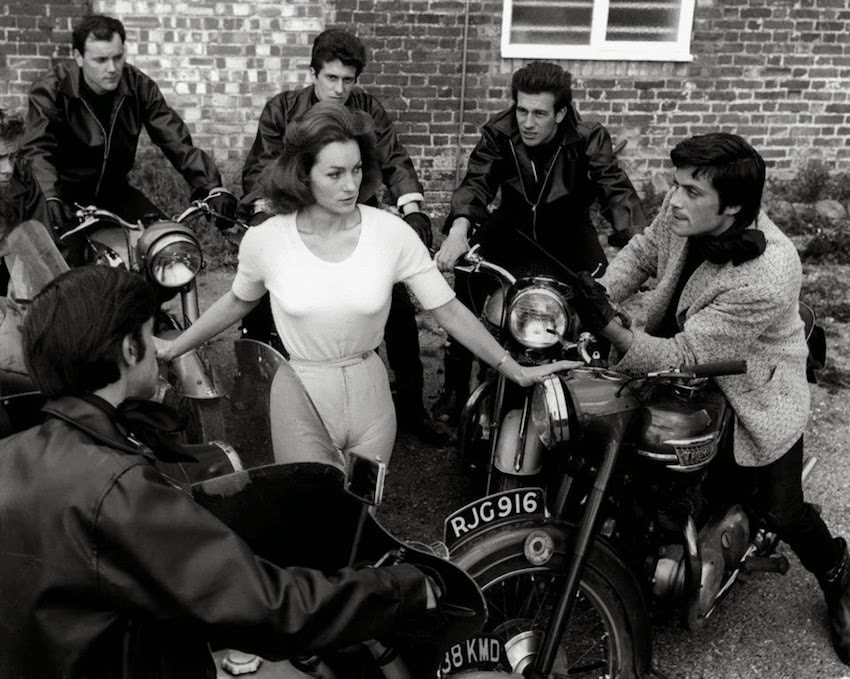

As the song be-bops along, the camera begins atop a clock tower, makes its way down and reveals a load of leather-clad Teddy Boys led by the suave King (played by an ultra-cool and very young Oliver Reed), adorned smartly in a crisp white shirt, thin black tie and a plaid sport coat to end all plaid sport coats. Perched against a perfectly symmetrical sculpture of a white unicorn (juxtaposed beautifully with the architecture of Weymouth and Frink's sculptures from the previous sequence), King surveys the square as Simon Wells (Macdonald Carey, who starred – for thirty years!!! – on the soap opera “Days of Our Lives”), an American tourist, admires a historical plaque and is quickly seduced into following a fetching, nubile Joan (British ingénue Shirley Anne Field). At first, Joan appears to be King’s squeeze, leading the American along with promises of carnal delight, but it's clearly a trap. King and his Teddy-Boys beat the American to a pulp and steal his watch and wallet.

Joan feels some guilt over her part in this act of savagery and soon tracks Simon down to apologize and, with a strange Daddy-fixation, throw herself at him. This enrages King – not because she’s REALLY his main squeeze, but is in fact, his sister!!! King has rather obsessive and overtly incestuous feelings towards Joan and refuses to let her touch or be touched by any man. Add to this mix, a mysterious military bureaucrat Bernard (Oscar-nominated Alexander Knox for his role in “Wilson”) who seems to be overseeing a secret research operation just on the outskirts of property owned by the sultry, cynical sculptress Freya (the vivacious Viveca Lindfors).

The movie eventually brings all of these seemingly disparate characters together – first at Freya’s studio on the cliffs and finally, behind the barbed wire of the military research facility where a strange group of children are incarcerated within a seawall fortress – subject to observation, experimentation and indoctrination.

This is one crazy movie! And what a movie it is! Dealing with such heavy themes as haves and have-nots, incest, art versus science, science as creation, secrecy yielding paranoia, childhood innocence being exploited for a greater “good” and ultimately, the horrors of nuclear radiation – These are THE DAMNED is some kind of lost and decidedly insane masterpiece (albeit with some of the flaws associated with its bare-bones budget).

Based upon a novel by Evan Jones, neither the British nor American titles seem to adequately encompass what this film is about. The novel’s original title was “The Children of Light” which seems to be a far more evocative summation of the picture itself – a film devoted to the ironic loss of innocence of an entire post-war generation to the mad powers that gripped everyone and created a platform that forced subsequent generations to live in a world of fear, paranoia and exploitation with each successive government blunder and lust for power - or, in the parlance worthy of a Teddy Boy: same shit, different pail.

Joseph Losey made a B-movie, all right. He who would go on to direct many more fine pictures, including a rich collaboration with Harold Pinter, but These are THE DAMNED is one hell of a great B-movie!

“These are THE DAMNED” is included in the recent Sony Pictures DVD release entitled “Hammer Films: The Icons of Suspense Collection” which also features the very good child molestation thriller "Never Take Candy From a Stanger" in addition to four other pictures from the same period.

Thứ Hai, 16 tháng 7, 2012

THE MAN WHO COULD CHEAT DEATH - Review By Greg Klymkiw - Terence Fisher's eerie horror classic from Hammer is up there with his best work and stars the insane Anton Diffring from "Circus of Horrors" and the stunning Hazel Court - she of the soft, milky protuberances. Available on Blu-Ray as a double-feature with "The Skull".


The Man Who Could Cheat Death (1959) dir. Terence Fisher
Starring: Anton Diffring, Hazel Court and Christopher Lee

***

Review By Greg Klymkiw

Even if The Man Who Could Cheat Death were an awful movie (and it is far from that), it would have one big thing going for it. Well, actually two big things – those soft, milky protuberances heaving ever so-delicately beneath the low-cut velvet dress of Heaven itself; namely, the breasts of that utterly flawless example of womanhood, Hazel Court.

These bounteous pillows of perfection are, however, not all that mesmerize Dr. Georges Bonnet (Anton Diffring) the title character of this delicious Hammer Horror picture from master Terence Fisher. When his (and our) eyes gaze above her cleavage, then glide upwards along her perfect breastplate and delicate neck, they run smack into a delectable puss replete with full lips, exquisite cheek bones and eyes you want to dive into. There’s also that pile of soft scarlet atop her crown, tied and trussed in a manner that hints, ever so invitingly, at the cascading waterfall that awaits when the pins are removed and the locks tumble down.

And beneath it all – beneath her upper bounties – is a svelte torso, supple, childbearing hips and, no doubt, other hidden fruits best left to our imaginations.


The estimable Miss Court as the comely model Janine Dubois makes her first appearance in the picture on the arm of the dashing Dr. Pierre Girard (Christopher Lee) during a private gathering in Bonnet’s home where the mad-scientist/artist is about to unveil his latest sculpture to a small, but admiring public of society people. It is obvious to all, including Girard, that she and Bonnet are former lovers and it is here we discover that Bonnet’s artistic output has been reserved to sculptures only of the upper portions of the most beautiful women imaginable.

Once the party disbands, we are treated to the revelation that the 30-something Bonnet is, in fact, over 100 years old and that he’s found the secret to eternal youth through the occasional implantation of a fresh gland in addition to a lime-green potion. His goal is to steal, Janine from Pierre, implant a new gland – making her “immortal” – and to spend the rest of eternity in bliss.

And who wouldn’t want to spend an eternity with Hazel Court? Only a madman, right?

Well, there’s the rub. Implantation of the gland and adherence to steady doses of the lime-green bubbling Kool-Aid renders all those under its influence to go stark raving, psychotically bonkers. This, of course, will not do and it’s up to Girard (one of Christopher Lee’s few heroic roles) to save the day.

With a Jimmy Sangster screenplay adaptation of a creaky, but oddly literate play by Barre Lyndon (The Man of Half Moon Street, already made as a film in the 40s) is one part The Picture of Dorian Gray, with dashes of Dr. Jekyll and Mr. Hyde and Dracula.

It’s perfect material for Terence Fisher who delivered some of the finest and most stylish British horror films of all time. Though much of the action is constricted to a few rooms, it’s an always engaging thriller thanks, in part to Fisher’s splendid direction and, most of all, because of the superb cast. Peter Cushing look-alike Anton Diffring (star of the luridly magnificent Circus of Horrors) is the perfect tragic villain with his aquiline features and sorrowful eyes, Lee handles himself expertly as the hero and Miss Court is breathtakingly engaging in her role.

The Man Who Could Cheat Death is a welcome addition to Fisher’s fine work from the 50s (including Curse of Frankenstein and Horror of Dracula). In fact, it’s kind of cool seeing Fisher work his magic in a genre film that is bereft of an already identifiable monster (he also helmed versions of The Mummy, The Werewolf and Phantom of the Opera) and if the picture seems a trifle dated and a smidgen derivative, these are but minor flaws in an otherwise delightful chiller.

Besides, it stars Hazel Court and that is, of course, reason enough to see pretty much anything.

"The Man Who Could Cheat" is one of several British genre pictures distributed in North America by Legend Films. It's currently available as a double-disc Blu-Ray with the added Amicus attraction, "The Skull".

This is a must-have Blu-Ray disc for vintage horror fans and the price is certainly right. The movies are also available as single-disc DVDs. If you plan to buy, please consider supporting the maintenance of this site by ordering it via the links below:


Thứ Năm, 2 tháng 2, 2012

THE WOMAN IN BLACK - Review by Greg Klymkiw: This attempt to rekindle the atmospheric glory of Hammer Horror films pretty much flops. Good intentions are not enough. Sometimes movies need something resembling a real filmmaker at the helm. Besides, what defines Hammer Horror? Daniel Radcliffe Porn or Christopher Lee ogling a heaving bosom and tender neckline?


The Woman in Black (2012)
dir. James Watkins
Starring: Daniel Radcliffe, Ciarán Hinds and Janet McTeer

*1/2

By Greg Klymkiw

Hell, as the influential man of letters Samuel Johnson was quoted as saying in Boswell's late 18th century biography, is paved with good intentions. Chances are pretty good that Johnson, if transported via time machine to the present might well have equated the act of sitting through the new James Watkins-directed film version of Susan Hill's insanely over-regarded novel as being paved with the same good intentions. Alack and alas, the roiling lava of the aforementioned Mephistophelean domicile is hardly a suitable mortar when the construction chief is a woefully unimaginative by-the-numbers (when he's able to actually put two and two together) hack.

The Woman in Black is a decent enough ghost story, adapted here by the normally reliable screenwriter Jane (Kick-Ass) Goldman and featuring a pleasing post-Harry Potter Daniel Radcliffe as the tortured leading man. The unfortunate fact of the matter though, is that director James Watkins is at best, bland, and at worst, hampered with a set of tin eyes. Watkins gives it the old college try, but falls painfully short of what this movie might have been if directed by someone endowed with even a smidgen of style and a sense of humour.

This lackadaisical horror movie, in spite of its lofty goals in the portentous atmosphere sweepstakes, settles for occasional cheapjack chair-tossers whilst alternatively providing yummy shots of the very pretty Mr. Radcliffe to respectively elicit screams of terror and lust from its primary demographic - the same tween-er, teener and twenty-er-something members of the "weaker sex" (in the parlance of those days of yore when such tales are oft set), who pathetically continue to look for their thrills amidst the dross of such lame items as the execrable Twilight series.

On the surface, I have little quarrel with the narrative. The widowed young 19th-century London`lawyer Arthur Kipps (Radcliffe) journeys to a small town in north country to save his ailing career and settle an estate which, not surprisingly, bears a heavy curse that befalls anyone who spies the creepy title apparition. The tragic death of a child is the result when anyone catches a glimpse of the funereally-attired residue of ectoplasm. Arthur, spending an insanely inordinate amount of time within the walls of the crumbling and creepy Victorian manse, the evocatively-named Eel Marsh House, gets not one, but several up-close-and-personal ocular treats of this pseudo-J-Horror ghost.

Well, gosh darn it all, this is enough to create a few deaths of children in the village, but worst of all, the fey, tortured Mr. Kipps is a single father to a winsomely cute tyke who will be visiting the northern English countryside with his Nanny.

Yikes! We can see what's coming a few miles away. (This is not, by the way, a narrative flaw, but one that could have fuelled the proverbial fire if the film had actually been directed.)

Kipps receives the helpful assistance of Mr. Daily (Ciarán Hinds), a friendly country gent who also lost a child many moons ago under similar circumstances, but eschews the superstitions plaguing the local townsfolk and laments how the said back-country hayseeds' belief in the ghost has influenced his wife (Janet McTeer) to the point where she's been driven completely bonkers.

The goal, as in many ghostly tales, is to right a wrong to put the malevolent spirit on its way to the white light - hopefully ending the curse. (I must admit, though, to always wondering why nasty ghosts engaging in all manner of evil behaviour wouldn't end up in Hell instead of the open arms of Jesus H. Christ?)

So what's the problem?

Decent story + good acting + decent production value SHOULD = Good Movie.

Ya' think?

Well, if said movie is rendered by a director with no discernible style, the results are dire. Some critics and genre geeks have extolled James Watkins's direction of his previous film Eden Lake. I had little use for the movie. It was a by-rote and moronically written wilderness thriller with a camping couple (the male half played by the ubiquitous Michael Fassbender) being terrorized by thugs - lower drawer Deliverance material at best and yet, on the basis of this lame picture he's handed an opportunity to direct a pretty decent screenplay by Jane Goldman (though in fairness to the great writer Nigel Kneale, I rather preferred HIS screenplay for the much-better British television version of the tale made in 1989).

What, pray tell, is happening in commercial cinema these days?

Hacks with no voice are becoming the order of the day.

This is especially disappointing here.

I'm no fan of the novel, but it's reasonably readable crap that provided a decent enough groundwork for the solid TV movie from Blighty, the second-longest running play behind Agatha Christie's "The Mousetrap" and could have made for an excellent addition to the canon of the newly resurrected Hammer Horror company. To date, however, the contemporary Hammer output has been a major disappointment save for the decent Let Me In, a well crafted, though utterly unnecessary English-language remake of Tomas (Tinker Tailor Soldier Spy) Alfredson's great Swedish original Let The Right One In.

Much has been made about the early Hammer output in terms of its atmospheric horror and while I will not dispute its value in that regard, let's also not forget that some of the greatest pictures it delivered were replete with globs of dry and/or dark humour, tasty dollops of garish colour in the mise-en-scene (especially in those Hammers directed by Terence Fisher), endless views of milky heaving bosoms and great actors working overtime to provide - on the hero front: the crazed business of Peter Cushing, and on the villain front: the sheer, sex-drenched malevolence of the cooler-than-cool Christopher Lee.

And the production value was impeccable. Though the movies were cheaply made, they never looked it. Again, so much of this was delivered by stylish filmmakers like Fisher or the magnificent cinematographer Freddie Francis who on many occasions dabbled/doubled at the Hammer studios as a director.

The production value on display in The Woman in Black is not without merit, but it's wasted in the hands of the tin-eyed director Watkins. The camera is either in the wrong place at the wrong time, or worse, it's resting easy on the side of competence. I don't necessarily want to blame cinematographer Tim Maurice-Jones for the murky, milky look of the movie - he's done great work with real directors in the past - but this movie never once comes close to the pulpy colour palettes of the classic Hammer pictures. It's all so very dreary and I can only assume this has more to do with Watkins's vision or lack thereof.

The most disturbing element in the movie has nothing to do with eliciting scares. It's the preponderance of Radcliffe-porn - pure and simple. For example, one of the first shots of the ghost in the house could/should have been a corker with Radcliffe in the foreground and the ghost just being there - creepily and horrifically in the background. Unfortunately, the angle seems slightly off for maximum dramatic/visceral impact and favours Radcliffe from a perspective that's more interested in making our dreamboat teen-throb as yummy as possible to the young ladies (and assorted gentlemen) in the audience. In fact, poor Radcliffe is almost in every shot of the movie and working his thespian tukhus off and sadly, it's all for nought - at least in terms of enabling the movie. Radcliffe becomes a stylishly attired schwance to be ogled, desired and deified.

The scares in the movie, such as they are, are not genuinely rooted in atmosphere, since so much of it is of the stock variety and without the panache needed to make it rise above a merely pallid reproduction. This leaves endless shock scares to elicit screams and/or jumps from the audience.

Ho-hum.

God knows the legendary Terence Fisher didn't need to rely solely on such dull cheapjack gimmicks - his horror was rooted in relentless bloodcurdling evil incarnate and bolstered by genuine style. It was voyeuristic, fetishistic and deliciously, exploitatively nasty. This is what was creepy and scary and yes, exciting! And whilst Fisher, Francis and all the other Hammer directors engaged in bosom-porn it had the creepy-crawly effect of eyeing the plunging cleavage of a female victim-to-be, then moving up along her heaving bosom and following the slender handsome hands of Christopher Lee as he cradled the lassie tenderly, eyeing her delectable neckline which he would eventually plunge his teeth into and suck and suck and suck as the young victim would swoon and writhe in orgasmic pleasure and pain.

This is the ATMOSPHERE of Hammer Horror - not murkily photographed swamps and graveyards and nooks and crannies of old houses. Oh yes, the aforementioned existed in Hammer Horror, but they were photographed with aplomb - crisp blacks, exquisite key lighting and splashes of crystal clear colour of the deepest, richest, gaudiest kind.

Never, oh never, would a Hammer Horror film indulge in the sort of boy-toy-porn as poor talented Daniel Radcliffe is subjected to in Watkins's abominable helmsmanship. Oh yes, traditional Hammer Horror was replete with handsome men, but they were wickedly, dangerously handsome.

And finally, the best Hammer Horror had humour - not of the tongue-in-cheek variety, but vicious, dark and always rooted in the melodrama. The Woman in Black is humourless as all get out. I mean, really. This is a movie with little kiddies dying. This could surely have engendered some horrendously nasty knee-slappers. (Much of this potential is actually there for the taking in Goldman's script, but Watkins is too much of a cinematic dullard to see it in order to exploit it.)

When young Mr. Kipps' cherubic lad shows up with nanny at the train station, I'd have been more than prepared to howl at the very sight with thoughts of potential carnage dancing about in my brain. God knows, Mr. Fisher might have elicited some yucks and certainly someone like Brian DePalma would have been all over this one.

Whilst one might argue that the movie is aimed almost solely at a female audience and requires a kinder and gentler approach than what Hammer traditionally stood for in its heyday, I sincerely believe this lack of vision and faith in truly adhering to the work of Terence Fisher et al, is precisely what's wrong with movies, and in particular horror movies these days.

Interestingly enough, Hammer in the 70s began to seem tremendously old fashioned in the wake of William Friedkin's The Exorcist and in terms of what nearly destroyed the company were increasing levels of sex, violence and visceral horror that skyrocketed well beyond anything Hammer was capable of delivering in its final throes. And now, here we are in a world where female audiences are offensively treated with kid gloves - as if they need to be handled daintily. If I were a woman, this would make my blood boil. In fact, I know plenty of women who detest how mostly male movie makers go out of their way to gentrify the horror experience and render it into a maw of mawkish sentiment.

Furthermore, as horrific as Friedkin's vision was, he actually rooted his horror in an approach pioneered by Val Lewton at RKO in the 40s. Lewton decided that two things were the scariest elements of all. Firstly, the dark scared the bejesus out of people and he infused his films with plenty of shadows. Secondly, and closer to the genuinely atmospheric horror of Friedkin's The Exorcist, is that Lewton believed elements of everyday life were the stuff of horror - mental illness, loneliness, cults, marital strife, disease, sickness, despair. Lewton blended these elements of contemporary life with literal darkness, just as Friedkin did (in spite of the delightful addition of spinning heads, vomit, foul language and crucifix masturbation). Who can ever forget the endless poking and prodding poor Linda Blair is subjected to at the hands of her doctors? Amidst the supernatural, Friedkin wrung every drop of Lewton's belief in here and now horror having as much power as green-pea soup spewing upon Max Von Sydow's face. The Woman in Black has these Lewton-esque elements, but none of them are properly exploited - primarily because Watkins has no style as a director, whereas as Lewton, Friedkin and the Fisher Hammers were ripe with a voice that went beyond mere craft.

Finally and sadly, The Woman in Black leaves me with one burning question.

I ask, in all seriousness:

What's the point of giving Radcliffe's child a comely nanny, but then not, in true Hammer Horror fashion, focus at some salient point, upon her bosom?

Well, that would be exploitative, now, wouldn't it?

In reality, though, The Woman in Black, in addition to its lack of style, is exploitative in a far more insidious fashion. It believes, promotes and exploits the fact that female audiences are far too delicate and genteel to serve up the real goods.

"The Woman in Black" is currently in wide release via Alliance Films and CBS Films.