Hiển thị các bài đăng có nhãn Music. Hiển thị tất cả bài đăng
Thứ Tư, 24 tháng 6, 2015
EDEN - Review By Greg Klymkiw - Tedious look at life of Paris D.J. still oddly compelling.
Eden (2014)
Dir. Mia Hansen-Løve
Scr. Mia Hansen-Løve, Sven Hansen-Løve
Starring: Felix de Givry, Pauline Etienne, Greta Gerwig, Golshifteh Farahani,
Vincent Macaigne, Roman Kolinka, Hugo Conzelmann, Vincent Lacoste, Arnaud Azoulay, Arsinee Khanjian
Review By Greg Klymkiw
Whilst watching all 131 minutes of Eden, at least forty-one of them unnecessary, I kept asking myself if a rambling dramatic immersion into twenty years in the life and career of a D.J. was something I really needed to see. After it was over and done with, I had to grudgingly conclude that yes, it was.
In spite of its longueurs, the picture has so many evocative sequences which capture an indelible sense of time and place and yes, introduced me to a world I'd otherwise have had absolutely no interest in knowing anything about. Yeah, okay. I was glad I stuck with it. It's not a bad picture and I suspect that those who actually care anything about house music might even love it.
In a nutshell, it's the Inside Llewyn Davis of the dance club scene. Though that's a perfectly appropriate encapsulation of Eden, I hope nobody thinks I'm suggesting it's even a public hair as great as the Coen Brothers masterpiece. It's not. It barely registers half of a crab louse in those particular sweepstakes.
What we have is the not-so-inspiring story of Paul (Felix de Givry), a promising young literature student who should really be listening to Arsinee Khanjian who plays his continually disappointed and disapproving Mom. She keeps encouraging the lad to finish his thesis, especially since his academic advisor is so high on him. Alas, Paul is far too high on electronic music as well as the drugs and sex that go along with it, that he pretty much wastes two decades of his life instead of getting an early jump on his writing career. (Though at least he does garner enough life experience to actually write about something, no matter how empty it is.)
Ah, such is the folly of youth. Paul does, however, have one hell of a good time. He has several main squeezes (Pauline Etienne, Greta Gerwig, Golshifteh Farahani) amongst the bountiful pickings of babes in the dance club scene and he certainly creates some cool sounds in the Parisian garage tradition along the way, including a très cool tour of America.
Paul also has the fellowship of his best friends and collaborators: brooding visual artist Cyril (Roman Kolinka), the good-natured D.J. partner Stan (Hugo Conzelmann), the often hilarious Arnaud (Vincent Macaigne), a baby boomer club impresario who also has an obsessive penchant for Paul Verhoeven's Showgirls and, of course, Paul's friendly contemporaries in the scene, Thomas and Guy-Man (Vincent Lacoste, Arnaud Azoulay). The latter duo go on to stage their own music as Daft Punk, the brilliant pair of real-life music-makers who find the kind of world-wide fame which Paul gets brief tastes of, but never truly attains. The Daft Punk characters are also used to great effect in the film's one and only running gag (and a pretty funny one at that).
Eden often has a pleasing spirit of free-wheeling, not unlike some of director Hansen-Løve's French New Wave predecessors, but for every glorious dash through the streets of Paris and New York, every tumble in the sack with a bevy of babes, every snort of coke, as well as a myriad of party/club scenes, there are an equal number of them which feel like over-indulgent wheel-spinning. Clearly some of the elements of realism can be attributed to the screenplay co-written by the director's brother Sven Hansen-Løve, a former two-decades-long D.J. in real life.
Alas, so much of the film straggles about in a kind of self-importance within a musical, social and cultural scene that's notable only because it did (and continues to) inspire a generation of young people within a relatively slight blip on the overall radar of music history. The entire scene finally feels utterly inconsequential and the film makes virtually nothing of the political and historical backdrops which surely had some effect upon driving people into this world of thump-thumping partying.
Maybe ignoring the turbulence of the outside world is the point, but if so, it says a lot about the young people immersed in it and/or the missed opportunities for the film to have genuinely earned its 131-minute running time by scratching below the surface of its pseudo-neo-realist tendencies.
Personally, I've never been able to comprehend the "joys" of any club, bar, party, restaurant or celebratory event which played music so loud that one was forced to shout sweet nothings into people's ears. Some might argue it's all about the "physical" connection, but most of the denizens/fans of this crap are so hopped up on drugs, the only connections they're really making, are with dealers to buy more drugs.
Before you assume I'm some old grump, I can assure you my wayward youth was spent in many a punk, hard rock, heavy metal and jazz club, but between live sets, taped music was dialled down so one could actually converse with one's fellow party-hearty partners in crime. To me, house is like elevator music, only it splits your eardrums.
By the end of Eden and certainly in retrospect, all I kept/keep thinking about are the seemingly endless scenes in the movie of Paul's Mother forking over money into his empty, outstretched palms because he's unable to earn a proper living in his chosen art.
The real moral of the story is thus: Kids, listen to your Mothers, for Christ's Sake!
They're usually right.
THE FILM CORNER RATING: ***
Eden begins its theatrical release in Canada at the TIFF Bell LightBox via FilmsWeLike and will widen out across the rest of the country in specialty venues.
Thứ Hai, 13 tháng 4, 2015
HIP HOP, EH - Review By Greg Klymkiw - Baby Cuz Make Feature Doc on Canuck HipHop
In anticipation of the upcoming 2015 Toronto Hot Docs International Festival of Documentary Cinema, The Film Corner continues its thrill-packed countdown to said event with a review of Hip Hop, Eh, my baby cousin Joe Klymkiw's feature documentary, that, to my knowledge, never played at Hot Docs, but most definitely should have played there since every screening would have been sold right the fuck out and every theatre would have been permeated with clouds of glorious ganja.
Hip Hop, Eh (2012)
Dir. Joe Klymkiw
Starring: Maestro Fresh Wes, Tom Green, Buck 65, Kardinal Offishall, Dj Kemo, Dream Warriors, Michie Mee, Cadence Weapon, Classified, Swollen Members
Review By Greg Klymkiw
Once upon a time, a nice Ukrainian boy,
Directed a doc, about his greatest joy.
You'd think this little Hunky from Winter-peg,
Would invite Heavy Metal to swell his mighty third leg.
The thing to remember as you, lock up your daughters,
Izz'zat da 'Peg's got asbestos in its muddy, muddy waters.
Little Joe quenched his thirst from those gnarly rusty pipes,
And before he damn well knew it,
He formed super-different likes.
So off to Vancouver did our little Joe go,
Cuz he needed to groove, without all the fucking snow.
His love for Hip Hop, led to lots of cool shit
And he started spinning tunes, with some mighty true grit.
For many long years, he was on the radio,
Playing Hip Hop a-plenty in that lonely studio.
And when he met dat Nardwuar, the human serviette,
He made kick-ass music vids, smooth as anisette.
Joe did wonder, long and hard, 'bout the true identity
Of dat Maple-syrup-hip-hop and its supreme-o destiny.
So he saddled up his camera, to travel far and wide,
Shooting dope Hip Hop artists, who'd not motherfucking hide.
K'naan wiped his ass, with dat bullshit waving flag.
Even Drake took a powder, what a motherfucking drag.
It mattered not to Joe, Canuck Hip Hop's loyal Ukie Son,
So good riddance to bad rubbish, cuz he interviewed a ton.
That's exactly what he did,
in his noble Hip Hop quest.
He got a mess, of super mensches,
who fuckin' proved to be the best.
And he shot 'em and he cut 'em,
till their mighty souls did bleed,
Now you got this Hip Hop movie,
So let's all watch and smoke some weed.
Kubassa and Oxtail,
kishka flavoured with dat jerk,
Jugs of tasty maple syrup,
and a hoser's best plaid shirt.
We gotsa film that answers questions,
Bout our very own Hip Hop
Lez go tuh Stevie Harper's rec-room,
Where he grow dat mighty crop.
And believe me when I say,
We not be smoking prairie wheat.
We be partyin' with our P.M.
to that Canadian Hip Hop beat.
- Greg Klymkiw,
. The Ballad of Hip Hop Joe
. (with apologies to Hip Hop lyricists the world over)
What IS the identity of Canadian Hip Hop? The fuck if I know. In fact, other than Drake (who mega-kicks) and K'naan (whom I never hope to hear again after that fucking Waving Flag shit), I know diddly about the Dominion of Canada's Hip Hop scene.
After seeing my cousin Joe Klymkiw's movie, Hip Hop, Eh, I now know more than I knew before. And screw it - so Joe's my cousin. The fuck am I supposed to do that half my family is in the entertainment business? If I didn't enjoy the movie, I'd be a man, tell him it sucked shit and then not bother writing about it. So, I'm writing about it. FUCKING SUE ME! Go ahead, motherfucker! I'll whup your ass with a glorious chub of Ukrainian garlic sausage.
The bottom line is - cousin or no cousin - I had a rip-snorting good time watching this mega-ragged indie nose dive into a uniquely Canadian world of contemporary culture I know nada about. The style, kind of like the grassroots Canadian Hip Hop scene, is raw, loose, a bit messy and jumpy, dirty, grainy, blasted-the-fuck-right-out with wall-to-wall music and the most incessantly insane parade of talking heads I've seen in some time.
But fuck me and a month of Sundays, this movie's got one mega cool talking head after another. In fact, I have never seen so many cool people wearing baseball caps assembled in one movie.
Hip Hop, Eh is short, breezy, fun, infused with genuine passion for its subject and as one of my esteemed colleagues noted in his review, the movie does at times feel like an extended music industry panel discussion on the subject.
For me, I didn't mind. I've personally never attended any music industry panels and most certainly none that smacked me in the face with the subject of Canadian identity in our country's Hip Hop scene.
THE FILM CORNER RATING: *** 3 Stars
Like the pic above says, Hip Hop, Eh is available on VOD. For further info on Joe's ultra-cool films, visit HERE.
Nhãn:
***,
2012,
Buck 65,
Cadence Weapon,
Canada,
Dj Kemo,
Documentary,
Dream Warriors,
Hip Hop,
Joe Klymkiw,
Kardinal Offishall,
Maestro Fresh Wes,
Michie Mee,
Music,
Projection Booth,
Tom Green
Thứ Sáu, 3 tháng 4, 2015
GLEN CAMPBELL: I'LL BE ME - Review By Greg Klymkiw - Portrait of Alzheimer's & Artistry
In anticipation of the upcoming 2015 Toronto Hot Docs International Festival of Documentary Cinema, herewith is Greg Klymkiw's review of James Keach's poignant and powerful feature documentary Glen Campbell: I'll Be Me which details the effects of Alzheimer's Disease upon the legendary country and western star as he embarks upon a farewell tour. Released in Canada via VSC, the film is now playing at The Bloor Hot Docs Cinema and opening in Vancouver May 11, 2015 at the VanCity with further playdates to follow.
Glen Campbell: I'll Be Me (2014)
Dir. James Keach
Starring: Glen Campbell, Kim Campbell, Ashley Campbell, Cal Campbell, Shannon Campbell, Jay Leno, John Carter Cash, Sheryl Crow, Steve Martin, Paul McCartney, Bill Clinton, Nancy Pelosi, Bruce Springsteen
There's always the debate in one's mind with documentary cinema as to the balance and/or separation between "artistry" and "subject matter". Some films within the genre work in spite of less-than-exemplary artistic/stylistic vision when the subject matter is so compelling that it supersedes all aesthetic considerations. Glen Campbell: I'll Be Me could almost fall squarely into this critical rumination, but the fact that it is a fairly straightforward document of extraordinary events, still allows it worthy consideration as solid, if not genuinely great filmmaking. The fact that director James Keach expertly focuses upon the task at hand is hardly a reason to dismiss the picture as art of a very high order. Besides, not every documentary film can, should and/or will be Malik Bandjellou's Searching for Sugar Man. Keach's powerful and poignant work, in spite (or because) of its veracity, delivers the goods and then some.
It doesn't get more harrowing, touching, uplifting and yes, even downright entertaining than this. When the legendary country and western star Glen Campbell was diagnosed with the extreme progression of dementia known as Alzheimer's Disease (wherein memories eventually fade to less-than-zero), he not only recorded new material, but embarked upon what would, even under normal circumstances be a gruelling Farewell Concert Tour. He also agreed to allow actor-director James Keach unfettered access to virtually every aspect of this undertaking and, in fact, his life. The desire was, on one hand, for Campbell to surround himself with family, friends and colleagues to do what he loved doing best, and on the other, to provide an important document of the effects of the disease so that the film, album and tour could be an important tool in creating far more support for the research necessary to attack this horrendous disease.
The resulting film will not only appeal to Campbell's multitude of fans, but anyone and everyone who has either suffered with the debilitating effects of the disease upon loved ones, but the general populace at large. The film succeeds more than admirably in all these respects; it's a tremendous concert picture and behind-the-scenes look at mounting this challenging event in the face of a horrendous affliction.
Utilizing concert footage, new interviews, sequences at home and in clinics, plus a choice selection of archival footage, Glen Campbell: I'll Be Me succeeds as one of the best documentaries about the creative process ever made.
We see intimate sequences with Campbell and his gorgeous, devoted wife Kim, watching home movie footage in which he continually expresses confusion as to what and whom he's watching while she patiently reminds him of what these key events in his personal and professional life are. There is an astonishing visit to Washington, D.C. wherein Campbell and his smart, total-babe and mega-talented daughter present a plea for more federal funding of Alzheimer's research. There are two very sweet interviews - one with Steve Martin recounting his experiences as a junior writer on the hit TV variety series "The Glen Campbell Goodtime Hour" and the other with Bruce Springsteen, not only extolling Campbell's artistic virtues, but revealing his own personal experiences with seeing close loved ones being afflicted with Alzheimer's. One of the most alternately moving and hilarious moments is when Paul McCartney visits Campbell backstage to tell him how much he loves him while Campbell looks at the former Beatle with a bemusedly blank expression as in, "Who is this guy, again?" and essentially, though very politely regarding McCartney, as if he were some anonymous member of the singer's humungous public fan base.
It's the music, however, that soars and even more extraordinary are the words of shock from any number of leading doctors in the field of Alzheimer's as they express how someone at Campbell's juncture in the disease should not be so skilled and downright brilliant when he's on stage performing live. Campbell transforms from the addled, befuddled old man backstage and at home into a graceful senior practitioner of musicianship when facing adoring audiences. Campbell does prove to be "un-rehearsable", a bit too chatty and occasionally confused when the cue cards for lyrics are not where he expects them to be. Not that these matter to the live audiences captured on film, nor for that matter to us as we're watching the movie - they all seem an integral part of Campbell's appeal, showmanship and unwavering joy in performing.
And damn! Sometimes it's easy to forget what an astounding guitar player, entertainer and songwriter Campbell was and, certainly during the time of the film's shooting, still is. Campbell even displays a common tic amongst Alzheimer's patients when they're feeding on positive sensory vibes and once it's identified as such, we're even more moved and transported to a kind of grace when we see it as he performs. (One of the most astonishing and heartrending scenes has Campbell on guitar performing "Duelling Banjos" with his brilliant, radiant daughter Ashley on banjo - star Daddy and star-in-the-making Daughter - it's pure movie magic.)
Yes, this is a straightforward document, but as such, it's an ideal and skilful approach to material which needs no stylistic directorial flourishes, but rather showcases a filmmaker intent upon capturing rare truths. My hat is off to James Keach for his unerring, unwavering eye.
What a wonderful picture. I'm so glad it exists and look forward to seeing it again and again.
So too, will you.
THE FILM CORNER RATING: **** 4-Stars
Glen Campbell: I'll Be Me is a VSC release currently playing at The Bloor Hot Docs Cinema in Toronto, to be followed by added playdates across Canada including the VanCity Theatre in Vancouver.
Chủ Nhật, 7 tháng 12, 2014
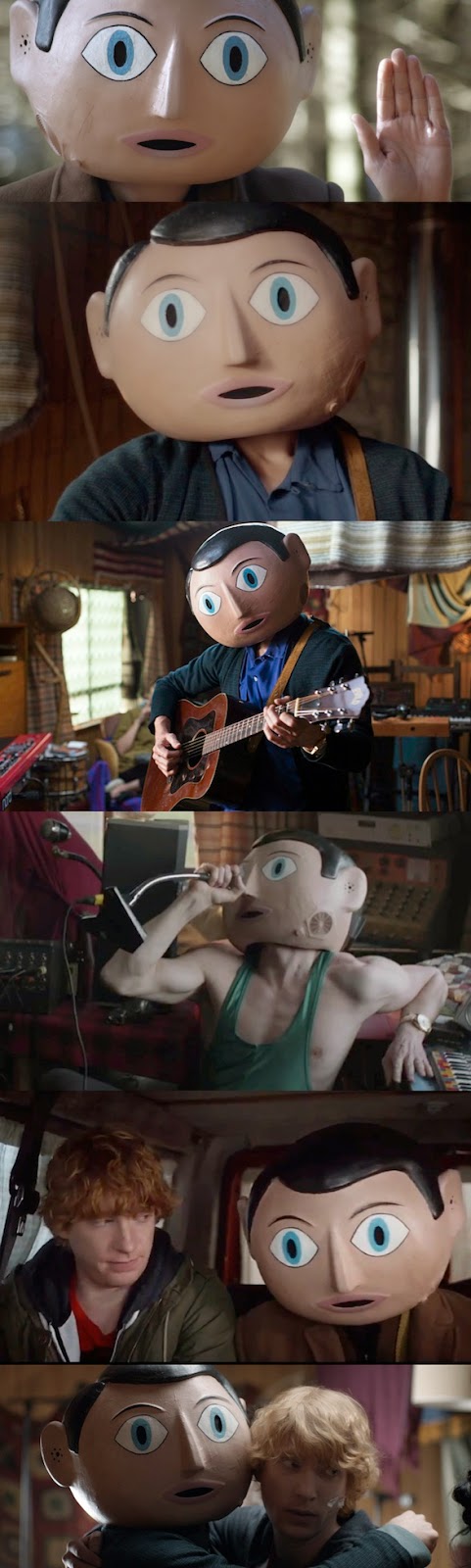
FRANK - Blu-Ray Review By Greg Klymkiw - Poignant indie gets terrific Magnolia/VSC BRD
![]() |
| THE MANY FACES OF FRANK |
Dir. Lenny Abrahamson
Scr. Jon Ronson, Peter Straughan
Starring: Michael Fassbender, Domhnall Gleeson, Scoot McNairy, Maggie Gyllenhaal, Francois Civil, Tess Harper
Review By Greg Klymkiw
Give an actor something to obscure their best feature and then see what they can deliver. I had occasion recently to recall Jack Nicholson in Tony Richardson's 1982 The Border where he was forced to wear sunglasses in virtually every exterior shot. Given that Nicholson was playing a Texas border guard, this not only made sense in terms of his character, but it shielded us from one of Nicholson's most expressive facial features. This resulted in one of his all-time best performances.
Given that by 1982 Jack's eyes and what he could do with them had already began to border on the cliched, we the audience were afforded the opportunity to see him render work that felt as fresh and vital as it had always been. It's as if the shades rendered the character even more internal - we had to work hard reading him, which made the proceedings rooted in a kind of reality it might not have otherwise had. Nicholson's movements became stiffer, slower and as he was playing someone who was on a slow burn, especially as he began to respond to the horrendous corruption and unfairness with respect to Mexicans sneaking across the border for a slice of America's pie of opportunity, we were able to almost put ourselves inside the character.
Most importantly, we had to respond to what he saw without necessarily having a full picture of how to read him.
Michael Fassbender is easily as great an actor as Nicholson, yet he's not quite crossed over into rendering performances rooted in cliches, so it's all the more astonishing to witness his work in Frank.
Co-writer Jon Ronson had been in Chris Sievey's Oh Blimey Big Band once the eccentric musician-comedian frontman of The Freshies had established his "Frank Sidebottom" persona for stage and television. "Frank" was a kind of Pee Wee Herman-like persona who wore a humungous fake head that resembled characters in the early cartoons of the legendary Fleischer Brothers (Betty Boop, Popeye). Though the screenplay for Frank is ultimately fictional, it's based in part on Ronson's journal entries during this period.
The first hour of Frank is especially lovely. It focuses on Jon (Domhnall Gleeson) a young keyboardist/songwriter who is miraculously swept out of his suburban ennui by Don (Scoot McNairy), a taciturnly amusing road manager and plunged headlong into a band led by the title frontman played by Fassbender. At first, Jon's ignored and/or reviled by Frank's eccentric band members (Maggie Gyllenhaal, Francois Civil, Carla Azar), but when he invests his "nest-egg" inheritance into the recording of a new album, their disdain transforms into guarded acceptance. Gyllenhaal even grudgingly prongs herself upon Jon's root, claiming disgust, but partaking of it with relish nonetheless. Jon, unbeknownst to the others, has been tweeting his adventures and even uploading clips to YouTube. Eventually, the band develops a sizeable cult following and is invited to launch themselves at the famed SXSW music festival in Austin, Texas.
Both the screenplay and Abrahamson's solid direction keep us delighted and enthralled in the odd creative process, and once the band heads to America, we're equally tantalized by the juxtaposition twixt the bucolic Irish cottage they're initially holed up in and the Big Sky of Texas. Though success looms, the film successfully shifts gears and we're plunged into the reality of the title character which, up until this point, has been mysterious to say the least. What's been funny and borderline (thank Christ for "borders") whimsical, becomes deeply and painfully moving.
Fassbender is the engine which ultimate drives the film. Saddled with his fake head, which he never removes, is what forces the great actor to utilize his innate gifts. With both his oft-muffled voice and body (as well as eventual sign language and verbal descriptions to convey his facial expressions under the mask), Fassbender extraordinarily delivers a myriad of emotions.
For anyone who discovered the world of true musical iconoclasts like Captain Beefheart, David Thomas of Pere Ubu fame and the multitude of genuinely alternative musicians during the punk and new wave phases in the late 70s and early 80s will especially be filled with a nostalgic glow that occasionally borders on epiphanies of the most hallowed kind. Frank is a film that seems featherweight, but its depiction of both the creative process and mental illness creeps up slowly and grabs you. Most of all, it doesn't ever really let go, long after the movie is over.
THE FILM CORNER RATING: **** Four Stars
Frank is a Magnolia/VSC Blu-Ray release that features a gorgeous sound and picture transfer. The disc comes equipped with a variety of bonus features including a variety of interviews with the director and pacifically on the look, sound and music of the film. A decent commentary track could have been far less all over the place with a moderator in tune to the film and its makers. The best special feature on the disc is a superb featurette focusing upon the sound designers and mixers. This is precisely the kind of detail that would have been ideal on the commentary track and even some of the interviews if they had been up to the level of this great bonus material. All in all, the film is so good that the film's ultimately the thing and makes for an ideal keeper Blu-Ray.
PLEASE FEEL FREE TO ORDER ANYTHING FROM AMAZON BY USING THE LINKS ABOVE OR BELOW. CLICKING ON THEM AND THEN CLICKING THROUGH TO ANYTHING WILL ALLOW YOU TO ORDER AND IN SO DOING, SUPPORT THE ONGING MAINTENANCE OF THE FILM CORNER.
AMAZON.CA
AMAZON.COM
AMAZON.UK
Nhãn:
****,
2014,
Blu-Ray,
Chris Sievey,
Comedy,
Frank Sidebottom,
GAT PR,
Greg Klymkiw,
Ireland,
Lenny Abrahamson,
Magnolia,
Music,
The Freshies,
UK,
Video Service Corp,
Video Services Corp.,
VSC
Thứ Bảy, 29 tháng 11, 2014
WHIPLASH - Review By Greg Klymkiw - J.K. Simmons & great editing ignite screen in searing drama so delectably reminiscent of the best 70s existential male angst cinema
![]() |
| Student and Teacher: FULL METAL JACKET - as it should be! |
![]() |
| "GOOD" is never good enough! "You are a worthless pansy-ass who's now weeping and slobbering all over my drums like a nine-year-old girl! |
Dir. Damien Chazelle
Starring: Miles Teller, J.K. Simmons, Melissa Benoist, Paul Reiser, Chris Mulkey
Review By Greg Klymkiw
"If you deliberately sabotage my band, I will fuck you like a pig." - Teacher to Student, WhiplashSo barks Terence Fletcher (J.K. Simmons), a jazz instructor at a tony private music conservatory in the dirtiest of towns, the glorious NYC. Fletcher is a character who makes Gny. Sgt. Hartman (R. Lee Ermey) in Stanley Kubrick's Full Metal Jacket look like your kindly old Grandma Apple Doll.
There's no two ways about it.
Fisher's a major-league prick-to-the-nth-degree, but his aim is true.
![]() |
| Do you think I'm fuckin' stupid? I know you were "the one"! |
I personally believe in this philosophy and perhaps it's why I partially and so strongly responded to Whiplash, the searing story of Fletcher and his cruel, brilliant and passionate relationship with Andrew Neyman (Miles Teller), a drumming prodigy who seeks to be greater than great.
![]() |
| Being the greatest musician of the 20th century is anyone's idea of success. |
![]() |
| NOT MY TEMPO |
What I love most about Cross's cutting is the fact that neither he nor Chazelle back away from making bold (some might erroneously say "obvious") cuts that draw attention to the virtuosity of the cinematic storytelling. I'd argue, however, it works in tandem with the mise-en-scene and the screenplay to drive a story about the sheer intensity of creation. As well, one cannot deny the tale's rhythms of mano a mano twixt Fletcher and Andrew. The act and art of creation is a war zone and Cross understands the macho tempo of this dynamic. Though Cross's cutting is flashy, it never once descends to the herby-jerky of so much contemporary cutting. Part of this comes from the wise compositions Meir and Chazelle have settled upon as well as a spectacular retro lighting scheme that plunges us into that astonishing world of 70s existential male angst - more than appropriate given the natural of the story.
The climactic sequence Chazelle delivers is a musical equivalent to a great action-suspense set-piece. Here is where the aforementioned collaboration between Cross, Meir and Chazelle explodes in all its richness. It had me breathless and on the edge of my seat upon a first viewing. Subsequent viewings have allowed me to bask in its sheer cinematic razzle-dazzle.
The movie is not at all pleasant, but its very disagreeable tone transcends all pathetic notions of palatability and finally serves up one entertaining and provocative series of cinematic blows to the gut.
The Film Corner Rating: **** 4-Stars
Whiplash is currently in release via Mongrel Media.
Thứ Bảy, 1 tháng 11, 2014
A HARD DAY'S NIGHT - Criterion Blu-Ray Review By Greg Klymkiw - TheOnlyWay2-C@home
The mega Criterion Collection dual-format (Blu-Ray/DVD) box of Richard Lester's groundbreaking A Hard Day's Night starring The Beatles might be one of Criterion's best releases in their entire history of issuing first-rate cinema for the home market. The picture and sound are the best you're EVER going to see on a home format. The accompanying 82-page (82 pages !!!) booklet (which includes a decent essay and a terrific Richard Lester interview) devotes one full page to the picture restoration (supervised on 4K by Criterion with Lester's approval) and an additional full page to the sound (the mono, as per usual is my favourite, but the new 5.1 track is worth a listen as it's pretty amazing and mastered by Apple Records techs).
The extra features are so amazing, it's kind of ridiculous. A few items from the ho-hum Miramax/Alliance/E-One Collector's Edition transfer don't find their way here, but they're not missed in the least. In addition to what has been ported over and what Criterion has added to the mix is phenomenal.
My favourite feature of all is David Cairns' Picturewise, a half-hour visual essay focusing on the great Richard Lester and his work and influences on A Hard Day's Night and numerous other films that followed, including the stylish and somewhat overlooked The Knack. In many ways, this might prove to be the most concise, yet valuable visual essay commissioned and presented on a Criterion disc to date. Other pedagogically valuable materials include Richard Lester's 11-minute Academy Award-nominated The Running Jumping & Standing Still Film from 1959, a mad, anarchic piece featuring Lester's Goon Show cohorts Peter Sellers, Spike Milligan, Graham Stark and Bruce Lacey. Given the verbal gifts of the Goons, the film is especially interesting as it's completely wordless. Story editor Bobbie O'Steen and music editor Suzana Peric serve Anatomy of Style, a terrific 17-minute piece which offers intimate analysis of five key scenes from the film and my only complaint is that I'd have LOVED a feature-length version of this - it's that valuable in terms of practically approaching screen-specific cinematic storytelling.
The commentary track was assembled by Martin Lewis, a music and Beatles historian who cut together a raft of 2002 interviews with Director of Photography Gilbert Taylor, numerous supporting actors, a variety of editors and other production personnel. It's quite a collision course of voices, but always informative and entertaining. The 40-minute Martin Lewis-produced short Things They Said Today is a fine carry-over from the earlier DVD release and features interviews with Richard Lester and others.
The wonderful one-hour 1994 documentary hosted by Phil Collins, You Can't Do That: The Making of A Hard Day's Night, made to celebrate the film's 30th anniversary, is classic TV-doc material and shines with the inclusion of the movie's biggest fans (including Mickey Dolenz) and the late Roger Ebert (as well the famous "You Can't Do That" outtake. Other items focusing specifically on The Beatles includes In Their Own Voices, a clever 18-minute amalgam of audio interviews with the Lads from Liverpool over footage from the movie and a half-hour doc about their early years, The Beatles: The Road to A Hard Day's Night. You'll also find a whole whack of trailers for the film if that sort of thing interest you.
This Criterion Dual Format box is a true gem in every respect, but of course, the prize treat is the restored, director-approved transfer of the movie itself. Without further delay, here then is my review of the movie proper:
A Hard Day’s Night (1964)
Dir. Richard Lester
Starring: John Lennon, Paul McCartney, George Harrison, Ringo Starr, Wilfrid Brambell, Norman Rossington, Anna Quayle, Victor Spinetti
Review By Greg Klymkiw
This is one great picture. I first saw A Hard Day's Night at the age of five. It is now almost half a century later and I have seen it innumerable times and in several formats – more times on a big screen in 35mm than I can remember, on 16mm with my own Bell and Howell Auto-load projector, Beta, VHS, laser disc, DVD and now Blu-Ray. It is a movie that never gets stale. Each time I see it, it seems like I’m seeing it for the first time and in this sense, it is truly timeless on a personal level. On every other level, it's just plain timeless. As a movie and in the larger scheme of things, it’s a gleefully entertaining movie - a mad, freewheeling portrait of the greatest rock and roll band of all time and surely one of the most influential motion pictures during the latter half of cinema’s relatively short history.
As well, it is one of the truly important works to come out of a period often referred to as the British New Wave where the silver screens lit-up with a new way of telling stories on both a stylistic and content level. A series of comedies and dramas from a combination of foreign expat directors living in the United Kingdom as well as indigenous talent were the order of the day. These pictures delivered cutting edge satire, anarchic laughs, kitchen sink realism, grim and/or humorous looks at working and middle class society and more often than not, focusing upon the hopes and dreams (both dashed and realized) of young adults.
There were, for example, the "angry young man" pictures featuring the likes of Richard Burton, Richard Harris, Albert Finney and Tom Courtenay - grimy little affairs that were depressingly cool. And then, there were the comedies - the best of which came from a director who contributed a great deal to changing the face of how movies could be made.
Richard Lester, the gifted American-born expatriate in London, was this very director and A Hard Day’s Night is unquestionably his masterpiece. Conceived just before the “Beatlemania” craze really exploded on an international level, Lester was probably the best man for the job of creating the sort of work that would have the greatest impact. Having directed and produced several British TV comedy programs featuring the iconoclastic Goons (including the likes of Peter Sellers, Kevin Connor and Spike Milligan) and with an Oscar nominated short film and a hit feature The Mouse on the Moon under his belt, Lester not only wore the shoes of director ever-so-comfortably on The Beatles' big-screen debut, he dove into the job with the mad passion of a Welles or an Eisenstein. This was not going to be just any rock and roll musical – it was going to be THE rock and roll musical – and as such, it informed filmmaking technique and style in ways we still experience in cinema even now.
Lester’s approach was to capture the slender tale in a documentary style with black and white photography; handheld cameras galore with freewheeling movement, but always gorgeously composed, all stunningly shot by the great Gilbert Taylor of Dr. Strangelove and Repulsion fame. Even more insanely, all sequences aboard moving trains were shot on, uh, moving trains! The approach to editing via John – Frenzy, Zulu, A Fish Called Wanda – Jympson's exquisite shearing would have made Sergei Eisenstein both dizzy and sick with envy.
The usual approach to rock movies at this time was to assemble a gaggle of performers and have them deliver a series of tunes in the dullest, most conservative fashion or worse yet, to plunk the likes of Elvis into (mostly) silly vehicles that were far below the dignity levels such performers demanded. Lester, on the other hand, wanted to propel us with lots of humour (sheer silliness mixed with sharply tuned wit), a dizzying camera and cool cuts that drew attention to their sheer virtuosity as well as performing the task of always moving us forward.
What this approach needed was a script like no other. Securing the services of the Welsh-born and Liverpool-raised actor, comedian, playwright and screenwriter Alun Owen. He proved to be a godsend to both Lester and the Beatles by crafting a simple narrative involving a day and a half in the life of the mop-topped Liverpudlians wherein they repeatedly shirk their responsibilities as rock stars and just have tons of fun – much to the consternation of their road manager (Norman Rossington), the bemusement of his assistant (John Junkin), the exasperation of a harried live TV director (Victor Spinetti) and to the delight of Paul McCartney’s (fictional) Grandfather (Wilfrid Brambell) who exploits his proximity to the rock stars to show himself a grand old time.
Amidst all this frivolity, Owen concocts several brilliant character-elements and plot-plots that tie both absurdly and realistically into the personae of the Beatles themselves. The one that infuses the movie with considerable conflict, but also knee-slapping laughs is when Ringo goes missing on a soul search.
Ringo on a soul search?
Ladies and gentlemen, I reiterate and give you - ONE GREAT SCRIPT!
Eventually, all are reunited for a totally kick-ass show in front of thousands of screaming, swooning kids and WOW! Can it get more simple and pure than this? Thankfully no! It’s just what the doctor ordered for this picture. Even more impressive is Owen’s brilliant dialogue and the endless opportunities to have the boys duck in and out of cabs, run from screaming teenyboppers and find as many different means of escape from both their fans and responsibilities – crashing through service doors, cascading down fire escapes and partying up a storm against the backdrop of the swinging-est London imaginable.
Not surprisingly, given the auteurist tendency to downplay the importance of screenwriters that aren’t the auteurs themselves, Richard Lester has uncharitably stated that much of Owen’s script was jettisoned in favour of letting the Beatles ad-lib. Enough statements from many others refute this assertion to support what really seems to be the truth of the matter – Owen spent a considerable amount of time with The Beatles on their journeys before setting narrative and dialogue to paper and went out of his way to create words perfectly suited to John, Paul, George and Ringo so that they’d be comfortable playing them and, on rare occasions have a solid springboard to ad-lib (which according to most reports is no more than 10 to 15% anyway).
And then there is the music! The title track “A Hard Day’s Night” (taken from one of Ringo’s delightful malapropisms), “Can’t Buy Me Love”, “Tell Me Why”, “She Loves You (Yeah, Yeah, Yeah)”, “I Should Have Known Better” and then some are featured in stunning concert footage and/or within the narrative body of the film, and most notably are not unlike music videos before the notion of music videos even existed. This latter point is especially important to add some illumination. Lester, always the consummate filmmaker didn’t throw images and cuts at us willy-nilly, but actually adhered to the conventions of filmmaking (establishing shots, mediums, reverses, close-ups, etc.) by making it seem like he did anything but.
It’s brilliantly, beautifully orchestrated cinematic anarchy in all the purity and simplicity that great pictures are ultimately endowed with, allowing, of course for differing levels and perspectives to grow and to flow naturally and organically out of the mise-en-scene. Most extraordinarily, even though it's a movie set in a different time and shot 50 years ago, it feels as free and original and fresh as if it had been shot, as that great Beatles tune reminds us: Yesterday!
THE FILM CORNER RATING (of the film and Criterion edition): ***** 5-Stars
The Criterion Collection Dual-Format Box set of A Hard Day's Night is now available for thine eternal edification.
Nhãn:
*****,
1964,
4K restoration,
Black and White,
Blu-Ray,
Comedy,
Criterion Collection,
Greg Klymkiw,
Music,
Musical,
Richard Lester,
Rock and Roll,
The Beatles,
UK
Chủ Nhật, 28 tháng 9, 2014
FRANK - Review By Greg Klymkiw - FrankSidebottom/ChrisSievey-inspired Cult film runs @TheRoyal via @VSC
![]() |
| THE MANY FACES OF FRANK |
Dir. Lenny Abrahamson
Scr. Jon Ronson, Peter Straughan
Starring: Michael Fassbender, Domhnall Gleeson, Scoot McNairy, Maggie Gyllenhaal, Francois Civil, Carla Azar, Tess Harper
Review By Greg Klymkiw
Give an actor something to obscure their best feature and then see what they can deliver. I had occasion recently to recall Jack Nicholson in Tony Richardson's 1982 The Border where he was forced to wear sunglasses in virtually every exterior shot. Given that Nicholson was playing a Texas border guard, this not only made sense in terms of his character, but it shielded us from one of Nicholson's most expressive facial features. This resulted in one of his all-time best performances. Given that by 1982 Jack's eyes and what he could do with them had already began to border on the cliched, we the audience were afforded the opportunity to see him render work that felt as fresh and vital as it had always been. It's as if the shades rendered the character even more internal - we had to work hard reading him, which made the proceedings rooted in a kind of reality it might not have otherwise had. Nicholson's movements became stiffer, slower and as he was playing someone who was on a slow burn, especially as he began to respond to the horrendous corruption and unfairness with respect to Mexicans sneaking across the border for a slice of America's pie of opportunity, we were able to almost put ourselves inside the character. Most importantly, we had to respond to what he saw without necessarily having a full picture of how to read him.
Michael Fassbender is easily as great an actor as Nicholson, yet he's not quite crossed over into rendering performances rooted in cliches, so it's all the more astonishing to witness his work in Frank.
Co-writer Jon Ronson had been in Chris Sievey's Oh Blimey Big Band once the eccentric musician-comedian frontman of The Freshies had established his "Frank Sidebottom" persona for stage and television. "Frank" was a kind of Pee Wee Herman-like persona who wore a humungous fake head that resembled characters in the early cartoons of the legendary Fleischer Brothers (Betty Boop, Popeye). Though the screenplay for Frank is ultimately fictional, it's based in part on Ronson's journal entries during this period.
The first hour of Frank is especially lovely. It focuses on Jon (Domhnall Gleeson) a young keyboardist/songwriter who is miraculously swept out of his suburban ennui by Don (Scoot McNairy), a taciturnly amusing road manager and plunged headlong into a band led by the title frontman played by Fassbender. At first, Jon's ignored and/or reviled by Frank's eccentric band members (Maggie Gyllenhaal, Francois Civil, Carla Azar), but when he invests his "nest-egg" inheritance into the recording of a new album, their disdain transforms into guarded acceptance. Gyllenhaal even grudgingly prongs herself upon Jon's root, claiming disgust, but partaking of it with relish nonetheless. Jon, unbeknownst to the others, has been tweeting his adventures and even uploading clips to YouTube. Eventually, the band develops a sizeable cult following and is invited to launch themselves at the famed SXSW music festival in Austin, Texas.
Both the screenplay and Abrahamson's solid direction keep us delighted and enthralled in the odd creative process, and once the band heads to America, we're equally tantalized by the juxtaposition twixt the bucolic Irish cottage they're initially holed up in and the Big Sky of Texas. Though success looms, the film successfully shifts gears and we're plunged into the reality of the title character which, up until this point, has been mysterious to say the least. What's been funny and borderline (thank Christ for "borders") whimsical, becomes deeply and painfully moving.
Fassbender is the engine which ultimate drives the film. Saddled with his fake head, which he never removes, is what forces the great actor to utilize his innate gifts. With both his oft-muffled voice and body (as well as eventual sign language and verbal descriptions to convey his facial expressions under the mask), Fassbender extraordinarily delivers a myriad of emotions.
For anyone who discovered the world of true musical iconoclasts like Captain Beefheart, David Thomas of Pere Ubu fame and the multitude of genuinely alternative musicians during the punk and new wave phases in the late 70s and early 80s will especially be filled with a nostalgic glow that occasionally borders on epiphanies of the most hallowed kind. Frank is a film that seems featherweight, but its depiction of both the creative process and mental illness creeps up slowly and grabs you. Most of all, it doesn't ever really let go, long after the movie is over.
THE FILM CORNER RATING: **** Four Stars
Frank is a VSC release which continues its successful run with an engagement at The Royal in Toronto.
PLEASE FEEL FREE TO ORDER ANYTHING FROM AMAZON BY USING THE LINKS BELOW. CLICKING ON THEM AND THEN CLICKING THROUGH TO ANYTHING WILL ALLOW YOU TO ORDER AND IN SO DOING, SUPPORT THE ONGING MAINTENANCE OF THE FILM CORNER.
AMAZON.CA
AMAZON.COM
AMAZON.UK
Nhãn:
****,
2014,
Chris Sievey,
Comedy,
Drama,
Frank Sidebottom,
GAT PR,
Greg Klymkiw,
Ireland,
Lenny Abrahamson,
Music,
The Freshies,
The Royal Cinema,
UK,
Video Service Corp,
Video Services Corp.,
VSC
Thứ Bảy, 15 tháng 2, 2014
PUSSY RIOT: A PUNK PRAYER - Review By Greg Klymkiw - Important Documentary details protests against Russia and Vladimir Putin's blending of patriarchal Eastern Rite religious Dogma with the heinous strategies of Joseph Stalin.
![]() |
| The Threat to Putin |
Dir: Mike Lerner, Maxim Pozdorovkin
Starring:
Nadezhda (Nadia) Tolokonnikova
Yekaterina (Katia) Samutsevich
Maria (Masha) Alyokhina
Review By Greg Klymkiw
On the day Vladimir Putin, the most vile Russian totalitarian leader since Joseph Stalin was allowed to control the country by "appointment", not election, a clutch of intelligent young women immediately formed the Pussy Riot protest movement.
Not unlike the Stalinist show trials of 1937, Nadezhda (Nadia) Tolokonnikova, Yekaterina (Katia) Samutsevich and Maria (Masha) Alyokhina, three members of the Pussy Riot collective were charged with the criminal act of hooliganism, forced to endure months of incarceration between public legal proceedings, tried in what amounted to little more than a kangaroo court and sentenced to hard labour in Siberia. As the world is well aware, their "crime" involved storming the historic Christ the Saviour Cathedral, taking to the altar (where women are not allowed to go, apparently on God's orders) and singing a few bars of their anti-Putin song for about 30 seconds before being dragged away by burly security goons into the shackles of the Moscow police.
Ladies and gentlemen, welcome to Modern Russia!
Unlike Stalin's show trials, Putin's war against women and free speech, completely backfired. Like all sexist, misogynistic Russian patriarchs, Putin and his thugs assumed these young ladies would fold under pressure and display simpering, submissive remorse for their "crimes" and beg for the court's mercy. Instead, the members of Pussy Riot remained defiant, committed and intelligent beyond their years and certainly far more progressive than their brain-dead captors.
Mike Lerner and Maxim Pozdorovkin's fine documentary feature film Pussy Riot: A Punk Prayer wastes no time in presenting a stirring portrait of the trial that captured the world's imagination. The picture lays out the political context, the act of defiance itself and the ludicrous legal proceedings wherein the three young women so passionately and intelligently condemn the Totalitarian regime that, in the name of God (and Putin), seeks to keep its populace under the thumb of subjugation by blending the Czarist-style coalition between Church and State with the Terror Tactics of Joseph Stalin's Communist Dictatorship. Utilizing actual trial footage, news reports, archival materials and new interviews, the filmmakers give us a stirring and expertly edited portrait of these women as individuals and though their journey is harrowing, it equally inspirational in spite of the film ending with their final conviction and sentencing.
Though Putin attempted to save face in December by releasing the women from prison, it was clearly a cynical move meant to deflect attention away from his horrendous new laws that seek to discriminate and criminalize homosexuality - this on the eve of the Sochi Olympics. The frustration one feels watching the film is palpable. Putin and his lawmakers are clearly condemning the Stalinist destruction of religion, yet equating the attempts at free speech employed by Pussy Riot with the heinous actions of a Totalitarian Butcher. Anyone familiar with Orthodox Eastern Rite traditions (which - full disclosure - I was brought up with) realizes how backwards and patriarchal the religion actually is. The very nature of organized religions is to subjugate and the Slavic Orthodox traditions are there as a control mechanism. That Putin, a former Communist KGB thug is all of a sudden so concerned with religious freedoms he once repressed seems just so obvious and disingenuous.
To vilify and criminalize the actions of these young women is appalling and there's no doubt the film, though slanted in their favour, is choosing the proper high ground in this controversy. That Putin is using religion to further the subjugation of the Slavic people - not only in Russia, but in Ukraine and other countries - makes perfect sense, but it doesn't make it right. The film might well be detailing the plight of artists and free-thinkers in Russia under this dictatorship, but the film stands as an important testament to how this tactic is being employed right across the board - not just in the East, but the West as well.
The women of Pussy Riot are, frankly, heroes. My own daughter - NOT in Russia, but in a publicly funded school in Canada - was subjected to the most horrendous patriarchal abuse at the hands of Eastern Rite religion. Singled out by a teacher as a sinner, this sweet, bright (then ten-year-old) girl who "dared" to ask questions in an educational institution was ordered to kneel in the centre of the classroom while the rest of the students encircled her and prayed for her soul - to keep her from going to Hell.
(Note: Another example of this idiocy perpetrated against her in a Toronto school is detailed in Alan Zweig's brilliant documentary 15 Reasons To Live, released by Kinosmith.)
What's happening in Russia can and does happen everywhere. Religion is an opiate, but it's becoming, more and more, a weapon. Pussy Riot is a symbol of all women - and men - who refuse to kowtow to the Status Quo, especially in the spurious name of God. Pozdorovkin and Lerner's film is just the sort of weapon free-thinkers will need to battle the scourge attempting to drown all of us.
Pussy Riot: A Punk Prayer should be required viewing in ALL schools for all young people - as both inspiration and a springboard for greater dialogue as to fighting the forces that want us all to be cogs in a machine - slaves to the power brokers who seek ever more wealth and power.
"Pussy Riot: A Punk Prayer" is currently in theatrical release via Kinosmith. It's begun its run at the Bloor Hot Docs Theatre in Toronto and will roll out across the rest of Canada.
Thứ Bảy, 30 tháng 11, 2013
AKA DOC POMUS - Review By Greg Klymkiw - Save Your Last Dance, But Make Your First Movie Choice The Doc.
A nice Jewish boy from Brooklyn, struck down by polio at the age of six, turns to a radio for companionship and spends hours alone in his room, meticulously turning the dial until he discovers all the cool radio stations that "decent" kids weren't supposed to listen to.
This formerly athletic lad forgoes any dreams he harboured to follow such physical inclinations, but instead, connecting with glorious R&B tunes, he becomes a musically gifted Greenwich Village blues performer and eventually, is reinvented as the beloved go-to songwriter who almost single-handedly influenced each and every subsequent generation of popular American music makers. He was none other than Doc Pomus, the real King of rock n' roll! - G.K.
AKA DOC POMUS (2013) ****
Dir. Peter Miller, Will Hechter
Starring: Doc Pomus, Lou Reed,
Ben E. King, Joan Osborne,
Dion, B.B. King, Dr. John
Review By Greg Klymkiw
In 1973, songwriter Doc Pomus decided to attend the BMI Music Awards. He wasn't especially keen on attending as he found such affairs deathly dull, but he'd been out of the music industry spotlight for awhile and thought it would be a good idea to just get out there to be seen plus reacquaint himself with old pals and colleagues. The joint was hopping. With wall-to-wall people, Doc decided to just sit down at his table and wait for the awards to begin. One of the honourees of that evening's awards also considered skipping the event until he learned Doc Pomus was attending and agreed to show up. Moreover, he insisted he be seated next to Doc.
So Doc continued sitting at his table. By this point in his life, he was more morbidly obese than usual and needed to get around on his crutches or in a wheel chair because of the polio he'd contracted as a child. The last thing he needed to do was to try hobbling about in mingle-mode in a sardine-packed awards hall until a young man, the aforementioned honouree sat next to him, extended his hand and formally introduced himself as if Doc wouldn't know who he was. They had a great time together that evening. The young man, a living legend, told Doc what a huge influence his music had been upon him and as he was moving close to Doc's place, he gave his personal contact information to the remarkable old man who was, in his own right, a genuine living legend.
Doc Pomus and the young man in question, John Lennon, became friends, hanging out together in a nearby book store. Lennon would always be in disguise for these meetings so he could walk about freely without being mobbed by his adoring fans. And he and Doc, would sit together in that dusty old store and talk until the cows came home.
Sharyn Felder, Doc's daughter, was always spotting Lennon in places around the neighbourhood; in disguise, of course. Never wanting to intrude upon Lennon's privacy, she became increasingly anxious to meet him. She finally worked up enough nerve introduce herself as Doc Pomus's daughter in a local grocery store. Lennon's immediate response in this shop - crowded with customers - was to yell out Doc's name and then, sing, aloud, and a cappella, one of Doc's greatest songwriting achievements, the immortal "Save The Last Dance For Me".
These are but two of many extraordinary moments in AKA Doc Pomus that are so powerful and moving that I was compelled, for the umpteenth time whilst watching it to shudder like a sissy pants and release a deluge of tears.
For those who know a little, a lot, or nothing about the late, great music legend Doc Pomus, this is an extraordinarily uplifting tale about the human spirit and its link to the height of pure artistry in the form of a big, beautiful bear of a man who changed the face of rock and roll and touched everyone whose lives intersected directly (or from afar) with his genius and generosity. Directors Peter Miller and Will Hechter, editor Amy Linton and Sharyn Felder (not only Doc's daughter and a key interview subject, but the film's co-producer and originator of the entire project) get a cornucopia of enthusiastic doffs of the hat for bringing this great story to the screen.
It's a lovely, straightforward and beautifully crafted documentary portrait that charts the Great Man's life from childhood through to his tragic death from lung cancer - and beyond. Including wonderful interviews (new and archival), unprecedented access to film and photo footage, private archives and music - OH! THE MUSIC!!! - anyone who cares about or loves music will revel in the joy and occasional sadness of this great, great story so lovingly and skilfully told.
Actually, anyone who cares about the creative spirit will find great pleasure in the film.
No, better yet, anyone with any sense of humanity, will revel in the life of this great man.
Doc Pomus wrote over 1000 songs. He generated huge hits for the likes of Elvis Presley, Ben. E. King, Ray Charles, B.B. King, Dion and the Belmonts, Lou Reed, Andy Williams, Bob Dylan and . . . the list goes on. And on. And ever-on. Not only was he a major influence upon JOHN-LENNON-FOR-CHRIST'S-SAKE (!!!), but for a few generations of songwriters, performers and promoters of the best and brightest modern music has had to offer.
One of the most deeply moving sections of the film charts Doc's selfless generosity with his time and knowledge - mentoring young music artists, OLD music artists and giving FREE music lessons to anyone who needed them.
Though the movie doesn't go out of its way to do so, its superb rendering of Doc's life pretty much canonizes this sweet, brilliant little Jewish boy from Brooklyn who didn't let the pain of polio stop him from giving the world one of its greatest gifts - a wealth of music genius.
SAVE THE LAST DANCE FOR ME
THIS MAGIC MOMENT
VIVA LAS VEGAS
. . . and on and on and on.
I reiterate: OVER 1000 SONGS.
Ladies and gentlemen: Give the MAN a hand (and the film of his life, too)!!!
Oh, and have I mentioned yet that the personal journals of Doc Pomus are exquisitely read aloud by none other than the late LOU REED? I haven't? Well, now I have. This alone is worth the price of admission.
"AKA DOC POMUS" is playing theatrically all across Canada.
It's a film and a story that DEMANDS you try to give it all the support you can -
ON THE BIG SCREEN.
Canadian Playdates include:
Toronto Openings
Friday November 29 |
Cineplex (Yonge & Dundas)
Friday December 6 |
Varsity VIP
Friday December 6 |
Empress Walk
Winnipeg Opening
Friday January 10 |
Winnipeg Film Group Cinematheque
Vancouver Opening
Monday January 20 |
VanCity Theater
More Canadian cities to follow.
This formerly athletic lad forgoes any dreams he harboured to follow such physical inclinations, but instead, connecting with glorious R&B tunes, he becomes a musically gifted Greenwich Village blues performer and eventually, is reinvented as the beloved go-to songwriter who almost single-handedly influenced each and every subsequent generation of popular American music makers. He was none other than Doc Pomus, the real King of rock n' roll! - G.K.
AKA DOC POMUS (2013) ****
Dir. Peter Miller, Will Hechter
Starring: Doc Pomus, Lou Reed,
Ben E. King, Joan Osborne,
Dion, B.B. King, Dr. John
Review By Greg Klymkiw
In 1973, songwriter Doc Pomus decided to attend the BMI Music Awards. He wasn't especially keen on attending as he found such affairs deathly dull, but he'd been out of the music industry spotlight for awhile and thought it would be a good idea to just get out there to be seen plus reacquaint himself with old pals and colleagues. The joint was hopping. With wall-to-wall people, Doc decided to just sit down at his table and wait for the awards to begin. One of the honourees of that evening's awards also considered skipping the event until he learned Doc Pomus was attending and agreed to show up. Moreover, he insisted he be seated next to Doc.
So Doc continued sitting at his table. By this point in his life, he was more morbidly obese than usual and needed to get around on his crutches or in a wheel chair because of the polio he'd contracted as a child. The last thing he needed to do was to try hobbling about in mingle-mode in a sardine-packed awards hall until a young man, the aforementioned honouree sat next to him, extended his hand and formally introduced himself as if Doc wouldn't know who he was. They had a great time together that evening. The young man, a living legend, told Doc what a huge influence his music had been upon him and as he was moving close to Doc's place, he gave his personal contact information to the remarkable old man who was, in his own right, a genuine living legend.
Doc Pomus and the young man in question, John Lennon, became friends, hanging out together in a nearby book store. Lennon would always be in disguise for these meetings so he could walk about freely without being mobbed by his adoring fans. And he and Doc, would sit together in that dusty old store and talk until the cows came home.
Sharyn Felder, Doc's daughter, was always spotting Lennon in places around the neighbourhood; in disguise, of course. Never wanting to intrude upon Lennon's privacy, she became increasingly anxious to meet him. She finally worked up enough nerve introduce herself as Doc Pomus's daughter in a local grocery store. Lennon's immediate response in this shop - crowded with customers - was to yell out Doc's name and then, sing, aloud, and a cappella, one of Doc's greatest songwriting achievements, the immortal "Save The Last Dance For Me".
These are but two of many extraordinary moments in AKA Doc Pomus that are so powerful and moving that I was compelled, for the umpteenth time whilst watching it to shudder like a sissy pants and release a deluge of tears.
For those who know a little, a lot, or nothing about the late, great music legend Doc Pomus, this is an extraordinarily uplifting tale about the human spirit and its link to the height of pure artistry in the form of a big, beautiful bear of a man who changed the face of rock and roll and touched everyone whose lives intersected directly (or from afar) with his genius and generosity. Directors Peter Miller and Will Hechter, editor Amy Linton and Sharyn Felder (not only Doc's daughter and a key interview subject, but the film's co-producer and originator of the entire project) get a cornucopia of enthusiastic doffs of the hat for bringing this great story to the screen.
It's a lovely, straightforward and beautifully crafted documentary portrait that charts the Great Man's life from childhood through to his tragic death from lung cancer - and beyond. Including wonderful interviews (new and archival), unprecedented access to film and photo footage, private archives and music - OH! THE MUSIC!!! - anyone who cares about or loves music will revel in the joy and occasional sadness of this great, great story so lovingly and skilfully told.
Actually, anyone who cares about the creative spirit will find great pleasure in the film.
No, better yet, anyone with any sense of humanity, will revel in the life of this great man.
Doc Pomus wrote over 1000 songs. He generated huge hits for the likes of Elvis Presley, Ben. E. King, Ray Charles, B.B. King, Dion and the Belmonts, Lou Reed, Andy Williams, Bob Dylan and . . . the list goes on. And on. And ever-on. Not only was he a major influence upon JOHN-LENNON-FOR-CHRIST'S-SAKE (!!!), but for a few generations of songwriters, performers and promoters of the best and brightest modern music has had to offer.
One of the most deeply moving sections of the film charts Doc's selfless generosity with his time and knowledge - mentoring young music artists, OLD music artists and giving FREE music lessons to anyone who needed them.
Though the movie doesn't go out of its way to do so, its superb rendering of Doc's life pretty much canonizes this sweet, brilliant little Jewish boy from Brooklyn who didn't let the pain of polio stop him from giving the world one of its greatest gifts - a wealth of music genius.
SAVE THE LAST DANCE FOR ME
THIS MAGIC MOMENT
VIVA LAS VEGAS
. . . and on and on and on.
I reiterate: OVER 1000 SONGS.
Ladies and gentlemen: Give the MAN a hand (and the film of his life, too)!!!
Oh, and have I mentioned yet that the personal journals of Doc Pomus are exquisitely read aloud by none other than the late LOU REED? I haven't? Well, now I have. This alone is worth the price of admission.
"AKA DOC POMUS" is playing theatrically all across Canada.
It's a film and a story that DEMANDS you try to give it all the support you can -
ON THE BIG SCREEN.
Canadian Playdates include:
Toronto Openings
Friday November 29 |
Cineplex (Yonge & Dundas)
Friday December 6 |
Varsity VIP
Friday December 6 |
Empress Walk
Winnipeg Opening
Friday January 10 |
Winnipeg Film Group Cinematheque
Vancouver Opening
Monday January 20 |
VanCity Theater
More Canadian cities to follow.
Thứ Năm, 31 tháng 10, 2013
A HARD DAY'S NIGHT - Review By Greg Klymkiw - Wherein Ringo Starr Searches For His Very Soul
The Beatles' classic musical comedy as fresh today as if made just yesterday instead of 50 years ago!A Hard Day’s Night (1964) ****
Dir. Richard Lester
Starring: John Lennon, Paul McCartney, George Harrison, Ringo Starr, Wilfrid Brambell, Victor Spinetti
Review By Greg Klymkiw
This is one astounding picture. I first saw A Hard Day's Night at the age of five. It is now almost half a century later and I have seen it innumerable times and in several formats – more times on a big screen in 35mm than I can remember, on 16mm with my own Bell and Howell Auto-load projector, Beta, VHS, laser disc, DVD and now Blu-Ray. It is a movie that never gets stale. Each time I see it, it seems like I’m seeing it for the first time and in this sense, it is truly timeless on a personal level. On every other level, it's just plain timeless. As a movie and in the larger scheme of things, it’s a gleefully entertaining movie - a mad, freewheeling portrait of the greatest rock and roll band of all time and surely one of the most influential motion pictures during the latter half of cinema’s relatively short history.
As well, it is one of the truly important works to come out of a period often referred to as the British New Wave where the silver screens lit-up with a new way of telling stories on both a stylistic and content level. A series of comedies and dramas from a combination of foreign expat directors living in the United Kingdom as well as indigenous talent were the order of the day. These pictures delivered cutting edge satire, anarchic laughs, kitchen sink realism, grim and/or humorous looks at working and middle class society and more often than not, focusing upon the hopes and dreams (both dashed and realized) of young adults.
There were, for example, the "angry young man" pictures featuring the likes of Richard Burton, Richard Harris, Albert Finney and Tom Courtenay - grimy little affairs that were depressingly cool. And then, there were the comedies - the best of which came from a director who contributed a great deal to changing the face of how movies could be made.
Richard Lester, the gifted American-born expatriate in London, was this very director and A Hard Day’s Night is unquestionably his masterpiece. Conceived just before the “Beatlemania” craze really exploded on an international level, Lester was probably the best man for the job of creating the sort of work that would have the greatest impact. Having directed and produced several British TV comedy programs featuring the iconoclastic Goons (including the likes of Peter Sellers, Kevin Connor and Spike Milligan) and with an Oscar nominated short film and a hit feature The Mouse on the Moon under his belt, Lester not only wore the shoes of director ever-so-comfortably on The Beatles' big-screen debut, he dove into the job with the mad passion of a Welles or an Eisenstein. This was not going to be just any rock and roll musical – it was going to be THE rock and roll musical – and as such, it informed filmmaking technique and style in ways we still experience in cinema even now.
Lester’s approach was to capture the slender tale in a documentary style with black and white photography; handheld cameras galore with freewheeling movement, but always gorgeously composed, all stunningly shot by the great Gilbert Taylor of Dr. Strangelove and Repulsion fame. Even more insanely, all sequences aboard moving trains were shot on, uh, moving trains! The approach to editing via John – Frenzy, Zulu, A Fish Called Wanda – Jympson's exquisite shearing would have made Sergei Eisenstein both dizzy and sick with envy.
The usual approach to rock movies at this time was to assemble a gaggle of performers and have them deliver a series of tunes in the dullest, most conservative fashion or worse yet, to plunk the likes of Elvis into (mostly) silly vehicles that were far below the dignity levels such performers demanded. Lester, on the other hand, wanted to propel us with lots of humour (sheer silliness mixed with sharply tuned wit), a dizzying camera and cool cuts that drew attention to their sheer virtuosity as well as performing the task of always moving us forward.
What this approach needed was a script like no other. Securing the services of the Welsh-born and Liverpool-raised actor, comedian, playwright and screenwriter Alun Owen. He proved to be a godsend to both Lester and the Beatles by crafting a simple narrative involving a day and a half in the life of the mop-topped Liverpudlians wherein they repeatedly shirk their responsibilities as rock stars and just have tons of fun – much to the consternation of their road manager (Norman Rossington), the bemusement of his assistant (John Junkin), the exasperation of a harried live TV director (Victor Spinetti) and to the delight of Paul McCartney’s (fictional) Grandfather (Wilfrid Brambell) who exploits his proximity to the rock stars to show himself a grand old time.
Amidst all this frivolity, Owen concocts several brilliant character-elements and plot-plots that tie both absurdly and realistically into the personae of the Beatles themselves. The one that infuses the movie with considerable conflict, but also knee-slapping laughs is when Ringo goes missing on a soul search.
Ringo on a soul search?
Ladies and gentlemen, I reiterate and give you - ONE GREAT SCRIPT!
Eventually, all are reunited for a totally kick-ass show in front of thousands of screaming, swooning kids and WOW! Can it get more simple and pure than this? Thankfully no! It’s just what the doctor ordered for this picture. Even more impressive is Owen’s brilliant dialogue and the endless opportunities to have the boys duck in and out of cabs, run from screaming teenyboppers and find as many different means of escape from both their fans and responsibilities – crashing through service doors, cascading down fire escapes and partying up a storm against the backdrop of the swinging-est London imaginable.
Not surprisingly, given the auteurist tendency to downplay the importance of screenwriters that aren’t the auteurs themselves, Richard Lester has uncharitably stated that much of Owen’s script was jettisoned in favour of letting the Beatles ad-lib. Enough statements from many others refute this assertion to support what really seems to be the truth of the matter – Owen spent a considerable amount of time with The Beatles on their journeys before setting narrative and dialogue to paper and went out of his way to create words perfectly suited to John, Paul, George and Ringo so that they’d be comfortable playing them and, on rare occasions have a solid springboard to ad-lib (which according to most reports is no more than 10 to 15% anyway).
And then there is the music! The title track “A Hard Day’s Night” (taken from one of Ringo’s delightful malapropisms), “Can’t Buy Me Love”, “Tell Me Why”, “She Loves You (Yeah, Yeah, Yeah)”, “I Should Have Known Better” and then some are featured in stunning concert footage and/or within the narrative body of the film, and most notably are not unlike music videos before the notion of music videos even existed. This latter point is especially important to add some illumination. Lester, always the consummate filmmaker didn’t throw images and cuts at us willy-nilly, but actually adhered to the conventions of filmmaking (establishing shots, mediums, reverses, close-ups, etc.) by making it seem like he did anything but.
It’s brilliantly, beautifully orchestrated cinematic anarchy in all the purity and simplicity that great pictures are ultimately endowed with, allowing, of course for differing levels and perspectives to grow and to flow naturally and organically out of the mise-en-scene. Most extraordinarily, even though it's a movie set in a different time and shot 50 years ago, it feels as free and original and fresh as if it had been shot, as that great Beatles tune reminds us: Yesterday!
“A Hard Day’s Night” is available on a Collector’s Edition Blu-Ray via Alliance Films (Universal Home Entertainment, Canada). The new Blu-Ray release will disappoint some home videophiles since the source material seems no different that what appeared on the previous DVD and laserdisc releases. That said, Blu-Ray still makes anything and everything look better and “A Hard Day’s Night” is no exception. This recent Blu-Ray release also contains a decent clutch of extra materials, which are surprisingly worth watching (since most of them on most releases, I find, are not). Until a complete re-mastering (or better one) comes along, this will most certainly do.
Dir. Richard Lester
Starring: John Lennon, Paul McCartney, George Harrison, Ringo Starr, Wilfrid Brambell, Victor Spinetti
Review By Greg Klymkiw
This is one astounding picture. I first saw A Hard Day's Night at the age of five. It is now almost half a century later and I have seen it innumerable times and in several formats – more times on a big screen in 35mm than I can remember, on 16mm with my own Bell and Howell Auto-load projector, Beta, VHS, laser disc, DVD and now Blu-Ray. It is a movie that never gets stale. Each time I see it, it seems like I’m seeing it for the first time and in this sense, it is truly timeless on a personal level. On every other level, it's just plain timeless. As a movie and in the larger scheme of things, it’s a gleefully entertaining movie - a mad, freewheeling portrait of the greatest rock and roll band of all time and surely one of the most influential motion pictures during the latter half of cinema’s relatively short history.
As well, it is one of the truly important works to come out of a period often referred to as the British New Wave where the silver screens lit-up with a new way of telling stories on both a stylistic and content level. A series of comedies and dramas from a combination of foreign expat directors living in the United Kingdom as well as indigenous talent were the order of the day. These pictures delivered cutting edge satire, anarchic laughs, kitchen sink realism, grim and/or humorous looks at working and middle class society and more often than not, focusing upon the hopes and dreams (both dashed and realized) of young adults.
There were, for example, the "angry young man" pictures featuring the likes of Richard Burton, Richard Harris, Albert Finney and Tom Courtenay - grimy little affairs that were depressingly cool. And then, there were the comedies - the best of which came from a director who contributed a great deal to changing the face of how movies could be made.
Richard Lester, the gifted American-born expatriate in London, was this very director and A Hard Day’s Night is unquestionably his masterpiece. Conceived just before the “Beatlemania” craze really exploded on an international level, Lester was probably the best man for the job of creating the sort of work that would have the greatest impact. Having directed and produced several British TV comedy programs featuring the iconoclastic Goons (including the likes of Peter Sellers, Kevin Connor and Spike Milligan) and with an Oscar nominated short film and a hit feature The Mouse on the Moon under his belt, Lester not only wore the shoes of director ever-so-comfortably on The Beatles' big-screen debut, he dove into the job with the mad passion of a Welles or an Eisenstein. This was not going to be just any rock and roll musical – it was going to be THE rock and roll musical – and as such, it informed filmmaking technique and style in ways we still experience in cinema even now.
Lester’s approach was to capture the slender tale in a documentary style with black and white photography; handheld cameras galore with freewheeling movement, but always gorgeously composed, all stunningly shot by the great Gilbert Taylor of Dr. Strangelove and Repulsion fame. Even more insanely, all sequences aboard moving trains were shot on, uh, moving trains! The approach to editing via John – Frenzy, Zulu, A Fish Called Wanda – Jympson's exquisite shearing would have made Sergei Eisenstein both dizzy and sick with envy.
The usual approach to rock movies at this time was to assemble a gaggle of performers and have them deliver a series of tunes in the dullest, most conservative fashion or worse yet, to plunk the likes of Elvis into (mostly) silly vehicles that were far below the dignity levels such performers demanded. Lester, on the other hand, wanted to propel us with lots of humour (sheer silliness mixed with sharply tuned wit), a dizzying camera and cool cuts that drew attention to their sheer virtuosity as well as performing the task of always moving us forward.
What this approach needed was a script like no other. Securing the services of the Welsh-born and Liverpool-raised actor, comedian, playwright and screenwriter Alun Owen. He proved to be a godsend to both Lester and the Beatles by crafting a simple narrative involving a day and a half in the life of the mop-topped Liverpudlians wherein they repeatedly shirk their responsibilities as rock stars and just have tons of fun – much to the consternation of their road manager (Norman Rossington), the bemusement of his assistant (John Junkin), the exasperation of a harried live TV director (Victor Spinetti) and to the delight of Paul McCartney’s (fictional) Grandfather (Wilfrid Brambell) who exploits his proximity to the rock stars to show himself a grand old time.
Amidst all this frivolity, Owen concocts several brilliant character-elements and plot-plots that tie both absurdly and realistically into the personae of the Beatles themselves. The one that infuses the movie with considerable conflict, but also knee-slapping laughs is when Ringo goes missing on a soul search.
Ringo on a soul search?
Ladies and gentlemen, I reiterate and give you - ONE GREAT SCRIPT!
Eventually, all are reunited for a totally kick-ass show in front of thousands of screaming, swooning kids and WOW! Can it get more simple and pure than this? Thankfully no! It’s just what the doctor ordered for this picture. Even more impressive is Owen’s brilliant dialogue and the endless opportunities to have the boys duck in and out of cabs, run from screaming teenyboppers and find as many different means of escape from both their fans and responsibilities – crashing through service doors, cascading down fire escapes and partying up a storm against the backdrop of the swinging-est London imaginable.
Not surprisingly, given the auteurist tendency to downplay the importance of screenwriters that aren’t the auteurs themselves, Richard Lester has uncharitably stated that much of Owen’s script was jettisoned in favour of letting the Beatles ad-lib. Enough statements from many others refute this assertion to support what really seems to be the truth of the matter – Owen spent a considerable amount of time with The Beatles on their journeys before setting narrative and dialogue to paper and went out of his way to create words perfectly suited to John, Paul, George and Ringo so that they’d be comfortable playing them and, on rare occasions have a solid springboard to ad-lib (which according to most reports is no more than 10 to 15% anyway).
And then there is the music! The title track “A Hard Day’s Night” (taken from one of Ringo’s delightful malapropisms), “Can’t Buy Me Love”, “Tell Me Why”, “She Loves You (Yeah, Yeah, Yeah)”, “I Should Have Known Better” and then some are featured in stunning concert footage and/or within the narrative body of the film, and most notably are not unlike music videos before the notion of music videos even existed. This latter point is especially important to add some illumination. Lester, always the consummate filmmaker didn’t throw images and cuts at us willy-nilly, but actually adhered to the conventions of filmmaking (establishing shots, mediums, reverses, close-ups, etc.) by making it seem like he did anything but.
It’s brilliantly, beautifully orchestrated cinematic anarchy in all the purity and simplicity that great pictures are ultimately endowed with, allowing, of course for differing levels and perspectives to grow and to flow naturally and organically out of the mise-en-scene. Most extraordinarily, even though it's a movie set in a different time and shot 50 years ago, it feels as free and original and fresh as if it had been shot, as that great Beatles tune reminds us: Yesterday!
“A Hard Day’s Night” is available on a Collector’s Edition Blu-Ray via Alliance Films (Universal Home Entertainment, Canada). The new Blu-Ray release will disappoint some home videophiles since the source material seems no different that what appeared on the previous DVD and laserdisc releases. That said, Blu-Ray still makes anything and everything look better and “A Hard Day’s Night” is no exception. This recent Blu-Ray release also contains a decent clutch of extra materials, which are surprisingly worth watching (since most of them on most releases, I find, are not). Until a complete re-mastering (or better one) comes along, this will most certainly do.
Nhãn:
****,
1964,
Alliance Films,
Comedy,
E-one,
Greg Klymkiw,
Music,
Musical,
Richard Lester,
Rock and Roll,
The Beatles,
UK,
Universal Studios HomeEntertainment
Đăng ký:
Bài đăng (Atom)